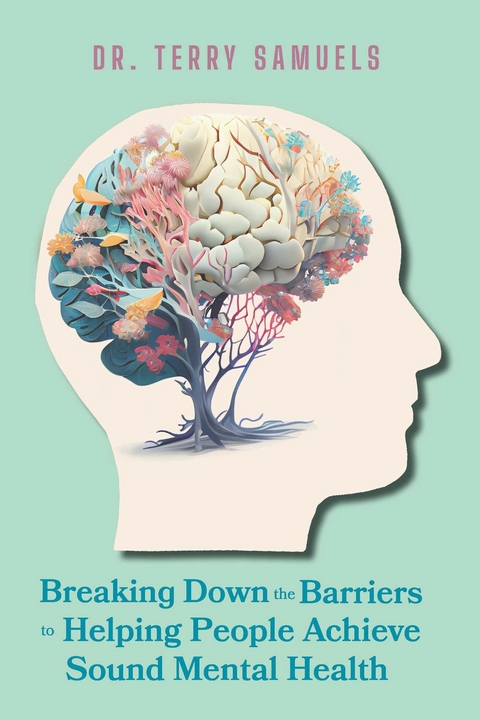
Breaking Down the Barriers to Helping People Achieve Sound Mental Health (eBook)
176 Seiten
Bookbaby (Verlag)
979-8-3178-0204-2 (ISBN)
Terry Samuels earned his Bachelor of Science in Criminal Justice in December 1994 from Armstrong Atlantic University. Terry obtained his Master of Public Administration degree in December 1996 from Georgia State University. Terry obtained his Master of Professional Counseling degree in December 2015 from Grand Canyon University. Terry is a fully licensed therapist in Georgia (LPC011391). Terry has also completed his doctorate in psychology at Grand Canyon University. Terry graduated with his doctorate in December of 2023. Terry has experience working with children, adolescents, and adults on the individual and family levels. These experiences include being a senior-level probation officer in the Henry County, Georgia, juvenile court for approximately two years. In addition, he has experience working with those who have suffered from domestic violence, relationship problems, anxiety, grief/ loss, and depression. Terry has 20 years of experience in mental health, including six years of crisis-level work with children, adolescents, and adults. In addition, he has six years of experience providing Intensive Family Intervention Services (IFI) to children and adolescents and two years of experience providing Assertive Community Treatment Services (ACT) to adults. He also has a 20-year history of working with children in the foster care system. Approach: Terry's approach combines different theories that emphasize addressing each client's needs. For example, Terry believes creating a solid therapeutic relationship is vital in counseling. The applied theories include Person-Centered, Family Systems, Transgenerational, Psychodynamic, DBT, and Cognitive-Behavioral Therapy. Areas of Expertise: ADHD Anger Management Anxiety Attachment/Separation Issues Bipolar Disorder Career Counseling Child & Adolescent Issues (4 & Up) Depression Domestic Violence Foster Care Placement LGBTQ Issues Learning Disabilities Male Related Issues Relationship Problems Self-Esteem Trauma/ PTSD Hi there! As a Psychologist/ therapist, I am eclectic in my use of modalities. I utilize whatever works for my clients. I am certified in DBT (Dialectical Behavioral Therapy). I also perform clinical evaluations for active and retired soldiers in the military.
A valuable resource for understanding mental well-being, offering insights into various conditions, treatment options, and coping mechanisms while also providing a space for personal reflection and connection.
Chapter 1
No Client is the Same in Mental Health
Many of the clients I see in treatment are ill in the actual sense, and therapy is a particular treatment for their mental illness. I firmly believe that being a sound clinician requires me to look at the entire person and not their symptoms or just mental illness. So many things adversely impact how a person feels about themselves. A person’s history profoundly affects how they view their perspective lives. This reality does not deny the role of mental health providers in providing treatment, just as it does not moderate the role of physicians in patient care. If mental ill health is to be taken seriously as a medical and social problem of the highest magnitude, then we should use language that correctly reflects the work that is performed. Redefining psychiatric help as something other than treatment will only serve to limit access to interventions demonstrated to be effective for a variety of mental health symptoms, from depression to personality disorders to unembellished mental disorders like schizophrenia.
Something that stands out is that none of my clients are the same. I might encounter clients with similar symptoms or backgrounds; however, they are distinct in various ways and respond to adversity and treatment differently. I would not say I like generalizing about people or putting them into categories without facts and researching their histories. People will inevitably get categorized in life, whether by age, race, or perceived gender. Still, the outdated stereotypes associated with those labels can overshadow the advantages of belonging to a group. For many people, categorical thinking influences life choices. Behaviors correlated with being good will be valued over those that seem wrong, but classification can disadvantage civilization. It establishes three main struggles: considering people with one cohesion to be more similar, seeing people with one differentiation to be more dissimilar than they are, and stating that an individual is more wanted or favored over another.
The principal problem with clustering people based on one shared characteristic, usually consistent, is that it leads to labeling. As a result, people are perceived and evaluated through one lens rather than seen as individuals with distinctive characteristics and weaknesses.
People are unique based on where they were raised, whether they were exposed to two parents or one or none, and some clients were raised by their grandparents or in foster care. I have learned how to accept people for who they are in life. Also, I have found various strategies to refrain from judging people. Practicing compassion is a sound way to refrain from asserting damaging convictions about people. Empathy means identifying what someone else is living through from their framework of character reference. When people are empathic, they focus on the other person from their perspective, not theirs. For some people, assessing others is a way to feel better about themselves. Critiquing someone gives them a feeling of superiority, which might advance their personality. This judgment can be for anything, such as appearances, financial prestige, and social status. I look at things from a leadership and community perspective. Leaders are motivated to elevate the plight of people around them. Also, the growth and development of a community automatically enhance our status as human beings. Transformational leaders know how to encourage, stimulate, and motivate people to perform in ways that create profound transformation. The result is an engaged group of people empowered to innovate and help shape society’s future success.
I believe therapy can and will be whatever my clients need it to represent. All clinicians should be motivated to continue to grow and evolve and pass along those attributes to each client we see. Clinicians must be open to each client’s feelings. Everything a client expresses is based on their experiences in life. So, as clinicians, we cannot ignore their feelings. We must put everything in context and help our clients come to terms with their past trauma and learn how to heal. We must address transference and countertransference in mental health. Transference is when someone redirects their sensations about one person onto someone else. During a psychotherapy session, it usually refers to a person shifting their judgment about someone else onto their psychotherapist. Countertransference is when a psychotherapist transfers feelings onto the client. I see a therapist at least once a month to make sure that I am cleaning out my baggage. Ensuring I provide sound clinical services to all my clients is a worthwhile investment.
According to Rogers (1977), the therapist’s three attributes, or features, form the fundamental part of the therapeutic relationship - congruence, unconditional positive regard (UPR), and accurate empathic understanding. Congruence: Congruence is the most significant property, according to Rogers. Unconditional Positive Regard (UPR) refers to the therapist’s immersed and unaffected concern for the client. The psychotherapist may not support some of the client’s activities, but the psychotherapist does accept the client. In short, the psychotherapist needs a positive approach to receiving the client. According to Rogers (1977), investigation signals that the greater the measure of caring, respecting, accepting, and regarding the client in a no possessive way, the greater the probability that treatment will be effective. However, it is not possible for psychotherapists to authentically always feel acceptance and unrestricted caring (Corey, 1996). Accurate Empathic Understanding: This refers to the psychotherapist’s ability to comprehend thoughtfully and accurately the client’s experience and considerations in the here and now. Empathic perception indicates that the psychotherapist will identify the client’s feelings as if they were his or her own without becoming lost in those approaches (Corey, 1996). Since we all oppose adjustment, we tend to view the other person’s world only on our terms, not his or her own. Then, we examine and assess it. However, when the psychotherapist figures out how it truly feels to be in another person’s circle without wanting or trying to investigate or judge it, the psychotherapist and the client can develop and evolve together.
It is essential to be aware of the principles that govern psychology and the state guidelines that protect each client. I reside in Georgia, and my license is governed by the Secretary of State—Professional Licensing Boards Division. This is why each clinician seeking licensure must be supervised by a fully licensed person for a specific time. The supervision process is essential to each clinician. Experts should always train clinicians in the field of mental health. There is so much information we must learn. We all seek a master’s degree in professional counseling, social work, or marriage and family therapy. Our classes are specific to our profession. In addition, each clinician must receive a one-year practicum at the end of their program before they graduate. Being adequately educated and trained and developing the awareness relevant to treating each client with the respect and professionalism necessary to address their problems is essential in mental health. Clinicians learn something every day.
Networking is vital as clinicians grow and evolve. It is all right to ask for insight from various colleagues. I rely on therapists, psychologists, psychiatrists, and medical doctors at various hospitals nationwide. I do not have all the answers, but I am surrounded by notable experts in various fields who help me daily. I implore clinicians to ask questions if they are confused about a diagnosis or what is happening with their clients, correct the diagnosis, and find the suitable modality for each client. The goal is to help clients address their problems and become complete human beings. Please put down your egos and provide high-quality services. The last few years have been an especially trying time for mental health. An extraordinary global epidemic interrupted almost every aspect of our lives, including work, school, sports, entertainment, family assemblies, and travel.
Clinicians must be aware of the constant changes that take place in the lives of clients. Covid changed the world forever. Many people, especially the older, are isolated to protect their physical health. However, in many cases, their mental health suffers as they miss out on the familial and social connections that typically would give them such joy. Constant worry about contracting a potentially deadly virus also took its toll.
The pandemic was incrusted on top of other influences that likewise have a detrimental impact on mental health—everything from financial strains to personal relationships to drug and alcohol abuse. There is also the stress of societal issues, many of which come in the form of systemic injustices such as racism, sexism, homophobia, and transphobia that MHA identifies as causing a demanding mental health problem for many.
So, as you can see, it is essential to gain insight into what is going on with clients in mental health. No two clients are exactly alike. People experience diverse things and respond differently to stressful or traumatic events. Suicidal thoughts have many causes. Most often, suicidal thoughts are the result of thinking that you cannot cope when you are faced with what seems to be a devastating life situation. If you do not have hope for the future, you may mistakenly think suicide is a solution. You may experience a sort of...
| Erscheint lt. Verlag | 29.5.2025 |
|---|---|
| Sprache | englisch |
| Themenwelt | Sachbuch/Ratgeber ► Gesundheit / Leben / Psychologie |
| ISBN-13 | 979-8-3178-0204-2 / 9798317802042 |
| Informationen gemäß Produktsicherheitsverordnung (GPSR) | |
| Haben Sie eine Frage zum Produkt? |
 EPUB (Ohne DRM)
Digital Rights Management: ohne DRM
Dieses eBook enthält kein DRM oder Kopierschutz. Eine Weitergabe an Dritte ist jedoch rechtlich nicht zulässig, weil Sie beim Kauf nur die Rechte an der persönlichen Nutzung erwerben.
Dateiformat: EPUB (Electronic Publication)
EPUB ist ein offener Standard für eBooks und eignet sich besonders zur Darstellung von Belletristik und Sachbüchern. Der Fließtext wird dynamisch an die Display- und Schriftgröße angepasst. Auch für mobile Lesegeräte ist EPUB daher gut geeignet.
Systemvoraussetzungen:
PC/Mac: Mit einem PC oder Mac können Sie dieses eBook lesen. Sie benötigen dafür die kostenlose Software Adobe Digital Editions.
eReader: Dieses eBook kann mit (fast) allen eBook-Readern gelesen werden. Mit dem amazon-Kindle ist es aber nicht kompatibel.
Smartphone/Tablet: Egal ob Apple oder Android, dieses eBook können Sie lesen. Sie benötigen dafür eine kostenlose App.
Geräteliste und zusätzliche Hinweise
Buying eBooks from abroad
For tax law reasons we can sell eBooks just within Germany and Switzerland. Regrettably we cannot fulfill eBook-orders from other countries.
aus dem Bereich