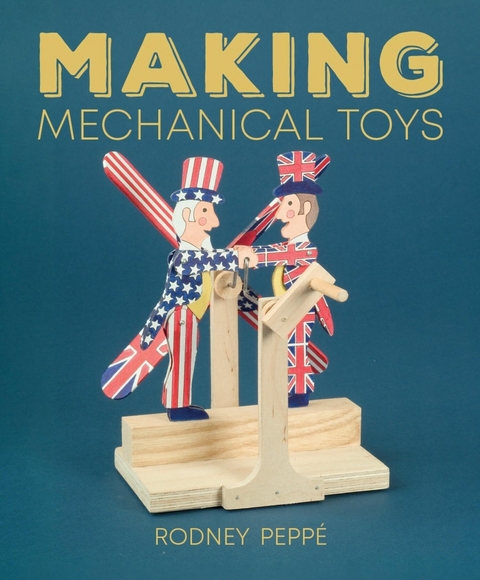
Making Mechanical Toys (eBook)
176 Seiten
The Crowood Press (Verlag)
978-0-7198-4546-8 (ISBN)
Rodney Peppé trained as a wood engraver at the Central School of Art before spending five years in advertising. As a freelance graphic designer he published his first children's book in 1968, The Alphabet Book; more than eighty books and two TV series, HuxleyPig (ITV) and Angelmouse (BBC), followed. Rodney Peppé's Moving Toys was published in 1980 and this, together with his friendship with the legendary artist-craftsman Sam Smith, led to toymaking. He was a winner of the British Toymakers' Guild 'Toymaker of the Year Award,' the Charles Bolton Cup. He had one-man shows at the V&A Museum of Childhood,The National Theatre and the Holburne Museum, Bath. In 1995 his work toured the British Isles for eighteen months. His automata and mechanical toys are now held in collections around the world. Automata and MechanicalToys was published in 2002 by Crowood, and in 2003 a book on his own work, Toys and Models, was also published. In 2013 a touring retrospective exhibition 'The Wonderful World of Rodney Peppe' opened at Ruthin Craft Centre.
Mechanical toys transcend categories of age with their universal appeal. Whether the mechanism is hidden or revealed, simple or complex, the cycle of movement allows you to simply turn a handle and see the magic work before your eyes. Making Mechanical Toys explains how to make these wonderful and fascinating toys through a variety of bright and exciting projects. The well-known 'Kim' game can be played with the Jungle Box where the animals appear one by one. In MIAOW! the cat never quite catches the mouse who is after the cheese. Detailed descriptions and photographs also bring to life dancing ladies, drummers, bobbing boats and a snappy little alligator clothes-peg toy in this delightful and lavish book.
HOW TO USE THIS BOOK
The first step when making any toy will be to check that you have the materials required. Measurements are given slightly oversized on the materials panels to allow for handling dowels and cutting panels. If you cannot obtain the materials stipulated, others can easily be substituted. Say, for example, that stripwood is suggested but it is not available to you, then exchange it for plywood of the same measurements. If the thickness is not quite correct, make adjustments; but ensure that any alterations made are compatible with the specifications of the other materials.
It is essential that you read the instructions together with the plans. When the instructions tell you to cut from plywood, the actual thickness is given to you in millimetres on the plans. This relieves the instructions of too many measurements except for the widths of drilled holes, which are shown visually on the plans.
The term ‘temporarily bonded’ is frequently used and means that two pieces of plywood have been fastened together with sticky tape or dabs of glue which can later be removed. This may be useful, for example, when you wish to drill two side panels together to make an accurate bearing for a crankshaft.
When multiple pieces are cut, whether together or not, they are denoted by an ‘ × ’ on the plans preceding the quantity to show the number of pieces to cut.
Once a plan number has been given within the instructions, it is not referred to again until a different plan is required. Thus items to be cut out are all on one plan, unless another plan number is mentioned.
GENERAL NOTES
Transferring designs from this book is mainly done by using photocopies spray-glued to plywood and then cut out as instructed. Use only the minimum amount of glue, as the photocopies are to be peeled off once the designs have been cut out. If they are difficult to remove, white spirit or lighter fuel can be used to loosen them, but take care not to rub the design while wet.
Three of the toys have designs which are copied (two in colour) and retained as the surface design spray-glued to plywood. In these cases, of course, the bonding must be permanent and both surfaces, the back of the print and plywood, should be spray-glued, bonded together and firmly burnished down.
There are instances when you will need to transfer the design by hand. Trace the design onto tracing paper with an HB pencil. Offset the tracing by burnishing it onto another piece of tracing paper and burnish this down onto the wood. The image is not then reversed.
Shaft bearings are shown 1mm (0.04in) wider than the shaft’s diameter, to allow for shrinkage after painting. Although a 6mm diameter dowel shaft will turn adequately in a 6.5mm bearing, this will become too tight after painting.
When fixing cams to shafts, initially they should be friction fitted by using a bearing with the same diameter as the shaft itself. The cams are tight enough to be tested and repositioned but would, in time, become loose on the shaft. When the piece is finally assembled, either glue the area the cam is going to cover, or superglue all around the edge of the cams where they touch the shaft.
Scoring plywood with a craft knife when cutting straight lines provides a guide channel for the scroll saw or fret saw to follow.
Panels should be cut at least 5mm (0.20in) larger than the measurements specified to allow the photocopy to be applied to the plywood and cut out. Use a jigsaw to cut them out roughly.
Drilling collets is made easier if you make a slight central hole with a bradawl for the drill bit to find and settle into. Grip the collet with pliers or a mole wrench to prevent it spinning round in your fingers.
If dowels are to be thinned, use a craft knife to scrape away the excess before sanding.
TOOLS
It is assumed that the reader has a basic set of tools, including a powered scroll saw or fretsaw for making small tightly curved cuts in wood up to 19mm (0.75in) thick. You will also require a jigsaw for cutting out plywood which is too long for the throats of the other saws.
Other tools which you may find useful are listed below:
• A mitre box is a hand-operated metallic device which guides the saw in cutting accurate mitre and right-angle joints. A mitre saw is recommended for the best results where the saw is integrated with the box.
• A power belt sander is ideal for making boxes and squaring-off edges before manually sanding or chamfering them off. It runs a continuous belt around two rollers. Be very careful to keep fingers away from the metal parts where the belt runs through.
• A sanding disc is an attachment for a power drill, made of rubber with a steel shank. It will leave cross-grain scratches but reduces wood quickly. It is much cheaper than a belt sander and good for filing off panel pins on pin wheels.
• A pin hammer is useful for tapping in panel pins and dowel into plywood or stripwood.
• Snipe-nosed pliers are useful for gripping small objects in confined spaces.
• Diagonal wire cutters will be needed for cutting wire close to the surface.
• Mole grips (or wrenches) are ideal for a wide variety of workbench eventualities, ranging from removing stubborn dowels from cranks to gripping collets to prevent them from spinning when drilled.
The following types of knives may be useful:
• A surgeon’s scalpel with a variety of blades (especially No. 11) is very good for light duty, very precise, cutting.
• A trimming or craft knife has disposable blades which can be stored in its housing. A retractable blade has a safety advantage.
• A putty knife is an invaluable tool for prizing apart temporarily bonded pieces of plywood if glued in spot areas. (Otherwise, tape is used for bonding.) A spatula will do the same job.
• Awls and bradawls are used for making starter holes for screws and nails in wood. Always twist them into wood and take care not to press too hard or the wood will split.
MATERIALS
The main materials required for making each toy are listed at the beginning of each chapter. The basic materials used to construct the toys described in this book are plywood, Aeroply, battening (PSE), stripwood, softwood and dowel. Additional materials, such as pop rivets and piano wire, will also be required for some toys.
Birch ply is the best plywood. Check the edges of ply board for gaps that have been filled but, nevertheless, run right through the board. When buying battening (PSE), or any softwood, watch out for splits and knots. Although these are often found in deal, it is otherwise a very nice wood to work with. Stripwood is made from hardwood, as are dowels. Birch dowels are best for rods and shafts as they don’t bend. Try to buy dowels in batches as they can vary in diameter from batch to batch.
PRIMING AND PAINTING
All the toys in this book were painted with acrylic craft colours with a primer of matt white vinyl emulsion. If you want to use casein emulsion paints such as Plaka colour, use ordinary matt white emulsion as a primer. A primer not only seals the surface of the wood, it gives subsequent coats of paint a lustrous base to enhance them. The colours are waterproof when dry.
Two or three coats of paint should be applied, as required, on top of the primer. Sand down lightly between coats. Varnishing and lacquering are not necessary for acrylic colours which have a built-in protective finish with a slight sheen. However, Plaka colours do need such protection to enhance their velvety-matt surfaces. Remember that colours darken with varnishing or lacquering.
Stencilling will be necessary when making one or two of the pieces featured in this book. The first step is to take a photocopy of the design and spray-glue the back so that it can be attached to a blank sheet of paper. Cut out the stencil from the reinforced paper print. Lightly coat the back of the stencil with spray glue and lay it gently on the surface to be stencilled. With a stencil brush or short-haired stiff-bristled brush dab paint into the stencil. One or two more coats will probably be needed to achieve full opacity. When the design has been successfully applied to the piece, carefully remove the stencil.
Sponging is done wet or dry. Cut a 50mm (2in) square sponge and dab it into a saucer with undiluted acrylic (or other) paint to produce a dry, well defined, leafy effect as on ‘Jungle Box’, the stone effect on ‘Drummer’, or the cloud effect on ‘Elephant Messenger’. A mottled watery effect is achieved by wet sponging, as on ‘Ark Toy’ and ‘Boat and Three Fish’.
Staining is effective if you want the wood grain to show through. Use diluted paint or coloured inks, and sand lightly when dry. ‘American Sailboat’ is an example of staining.
Brushes may be cleaned with soap and lukewarm water after using the waterbound paints which are recommended for these toys. If you are using oil or spirit-bound paints, brushes should be cleaned with white spirit or lighter fuel and then washed with soap in lukewarm water. Ensure that all traces of pigment are removed, otherwise old paint will build up and harden around the metal holder.
MAKING A BOX
Cutting out the box
1Cut out the top panel A from plywood. Unless you wish to make a...
| Erscheint lt. Verlag | 28.1.2025 |
|---|---|
| Sprache | englisch |
| Themenwelt | Sachbuch/Ratgeber ► Freizeit / Hobby ► Kreatives Gestalten |
| Schlagworte | Android • animatronic • Automata • Automaton • bearing box • Clockwork • collectoring • Diorama • kinetic • Magic • makers • Mechanism • Miniatures • Modelmaking • robot • toymaker • Watches • Woodwork |
| ISBN-10 | 0-7198-4546-7 / 0719845467 |
| ISBN-13 | 978-0-7198-4546-8 / 9780719845468 |
| Informationen gemäß Produktsicherheitsverordnung (GPSR) | |
| Haben Sie eine Frage zum Produkt? |
 EPUB (Wasserzeichen)
DRM: Digitales Wasserzeichen
Dieses eBook enthält ein digitales Wasserzeichen und ist damit für Sie personalisiert. Bei einer missbräuchlichen Weitergabe des eBooks an Dritte ist eine Rückverfolgung an die Quelle möglich.
Dateiformat: EPUB (Electronic Publication)
EPUB ist ein offener Standard für eBooks und eignet sich besonders zur Darstellung von Belletristik und Sachbüchern. Der Fließtext wird dynamisch an die Display- und Schriftgröße angepasst. Auch für mobile Lesegeräte ist EPUB daher gut geeignet.
Systemvoraussetzungen:
PC/Mac: Mit einem PC oder Mac können Sie dieses eBook lesen. Sie benötigen dafür die kostenlose Software Adobe Digital Editions.
eReader: Dieses eBook kann mit (fast) allen eBook-Readern gelesen werden. Mit dem amazon-Kindle ist es aber nicht kompatibel.
Smartphone/Tablet: Egal ob Apple oder Android, dieses eBook können Sie lesen. Sie benötigen dafür eine kostenlose App.
Geräteliste und zusätzliche Hinweise
Buying eBooks from abroad
For tax law reasons we can sell eBooks just within Germany and Switzerland. Regrettably we cannot fulfill eBook-orders from other countries.
aus dem Bereich