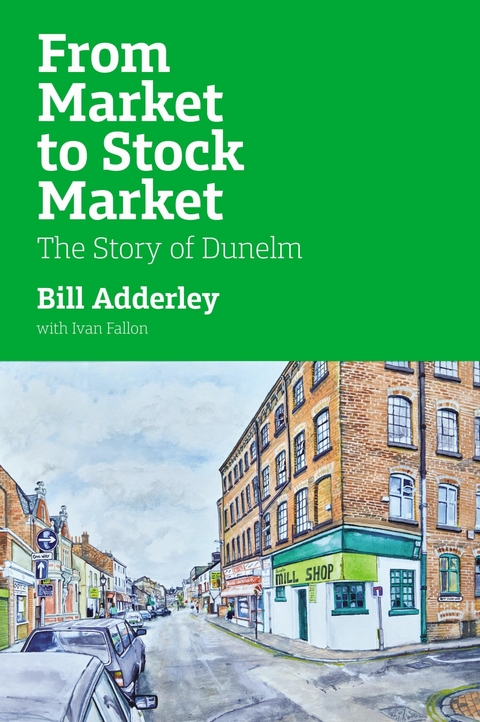
From Market to Stock Market (eBook)
176 Seiten
Unicorn Publishing Group (Verlag)
978-1-917458-26-9 (ISBN)
Bill Adderley was born in Leeds in 1948, the third child in a family of six. Born in a council house in Leeds, Bill left school with four O-Levels when he was sixteen and worked for F.W. Woolworth for the next fourteen years. In 1979, with the support of his wife Jean, he set up his own market stall in Leicester, selling seconds. He was thirty-three when he founded the Dunelm homeware retailing group. In 2022, the Adderley family featured in the Sunday Times Rich List at an estimated £1.8 billion, putting them in the top 100. Bill and Jean have two sons, (Sir) Will and Jonathan, and four grandchildren.
From Market to Stock Market is the astonishing story of Bill Adderley who, from the humblest of beginnings, created one of the most successful retail chains in Britain today. Dunelm, Britain's leading homeware group, has over 180 superstores and a market value on the London Stock Exchange of GBP2.2 billion. The son of poor Irish immigrants, Bill grew up in a council house in Leeds, sharing a bed with his three brothers. He got his first job at fifteen, working as a 'Saturday Boy' at the local Woolworth, and went on to become a Woolworth manager when he was twenty-one. In the 1970s however Woolworth's went into steep decline and Bill left to start up his own business, selling seconds and reject goods on a stall in Leicester market. His first coup was a truckload of reject slippers, followed by reject Marks & Spencer curtains from which he made enough money to start a company that grew into the Dunelm homeware furnishings group. In 2006, Dunelm Group Plc listed on the stock market, since when the shares have increased six-fold. At the age of fifty-eight, Bill passed over the executive reins to his son Will and now lives a quiet life near Leicester with his wife Jean.
Whenever someone asks me where my roots are, I always say, ‘Donegal’, in Ireland. Specifically, Clonmany, on the northwestern corner of the island of Ireland, between the mouths of Lough Swilly on the west, and Lough Foyle, which marks the border with Northern Ireland, on the east.
Most of the happiest memories of my childhood are there. My mother, Bridget Gill, was born in Clonmany, the daughter of a farmer whose family had tilled the land for at least four generations and probably more. I visited Clonmany every year as a boy and even now, more than sixty years later, when I need space and time to think, I sometimes climb into my car and drive there just to see the sea and taste the air.
For a boy growing up in a family of six on a council estate in Yorkshire in the 1950s, Clonmany was paradise. My memory now is of endless, golden days when we went to the seaside, fished in the rivers, or helped my grandfather in the fields. In mid-summer, there was light over the Atlantic until nearly midnight and it was bright again a few hours later. I don’t recall the days when it rained, but I suppose it must have done.
What I remember most clearly is the excitement with which we packed our bags and set off from Leeds on the long journey by train, boat and bus to the remotest county in Ireland. That was the most wonderful feeling in the world – no school for two whole months, just endless summer days stretching ahead seemingly forever.
My grandparents, Willie and Kate Gill, were always there to greet us with a turf fire going and the kettle permanently on the boil. They lived in a simple thatched cottage with no running water, no inside bathroom and no electricity. Every drop of water had to be carried into the house in buckets from the mountain stream just below the house; the lavatory was a hole in the ground with a seat over it in a tiny shed with a tin roof (I have a picture of myself in short trousers walking back from it to the cottage); and light inside the cottage was provided by a Tilley lamp or candles. The family had their own bit of bog where they cut their turf, which, once it had dried, burned for days. My grandfather kept the outside of the cottage immaculate, whitewashing the walls every year and fixing the roof before the winter gales, and inside my grandmother made sure it was always neat as a pin.
My mother was born in that cottage on 15 August 1923, the eldest of six children. Her father farmed about ten acres of poor, hill-side land, where he kept cows, a large horse that pulled the plough (and did everything else), and harvested his meagre crops. My mother used to describe how the family basically lived off the farm. Dinner, eaten at midday, seldom varied: ‘poundies’, the local name for mashed potatoes mixed with scallions (spring onions), butter and milk, sometimes with a bit of meat, but never on Fridays – the Catholic Church proclaimed it was a sin to eat meat on a Friday, so occasionally they had fish. That’s what we lived on too on our summer visits. Nothing much had changed.
My grandparents always reminded me of John Wayne and Maureen O’Hara in The Quiet Man, the film that was made down the coast in County Mayo. They wore the same clothes, the men in collarless shirts and waistcoats even as they ploughed the fields and the women always in shapeless black dresses. I have a picture of my grandparents in their old age looking just like that, my grandfather chewing on his briar pipe. He once showed me how he put the perforated top of an old pepper pot over the bowl, which could keep it going all day, winter and summer.
Although they mostly spoke English in my time, my grandparents grew up in families where the first language was Irish and, according to the 1911 Census, my grandmother could read and write in both Irish and English and my grandfather could read English but not write. Both sides of the family are listed as farmers going back as many generations as far as the records go.
My grandfather was born in Clonmany into what must have been extreme poverty. The potato famine of the 1840s, when more than a million Irish people died and another million emigrated, had devastated the rural areas of Donegal, leaving the survivors – those who hadn’t left for America – on the edge of starvation. Medical treatment was beyond their reach: the story I always heard was that my grandfather’s father, my great-grandfather, bled to death after having a tooth extracted in Clonmany, leaving his large family to scrape a living somehow off their little farm.
Many families in Donegal survived from the remittances sent back from a brother or cousin who had emigrated to America or, more likely, England where for the next hundred years they specialised in digging the tunnels for the London tube trains. My mother had grand-uncles, uncles and cousins who did exactly that and, even today, in prosperous Ireland, the tradition lives on. I often meet locals in the pubs in Donegal who have just returned from London, flush with cash, from working on ‘the tunnels’.
My great-grandmother Margaret was born in 1865 and the 1911 Census, by which stage she was a widow, lists her as ‘farmer’ and my great-grandfather’s occupation as ‘farmer’s son’ (he was only fourteen at the time of the census). All of them are listed as ‘literate’.
When people talk about poverty now, I don’t think they have any notion of how poor the people in rural Ireland were, particularly in Donegal. I remember my grannie telling me that, as a little girl in Clonmany, word came through that a car was about to pass through the town. They had never seen a car before, so she and her sisters ran down to the road where she suddenly realised that all their feet were bleeding – none of them had shoes.
Many years later, RTE, the Irish radio and TV station, interviewed my grandparents on the occasion of their sixty-sixth wedding anniversary. They were the longest married couple in Ireland. The interviewer asked my grannie: ‘What was it you saw in Willie when you first met him?’
My grannie thought about that for a moment and then replied, perfectly seriously, ‘He had his own donkey!’
The interview went out on national radio and in the following week about thirty engaged couples came to ask them for advice.
Their tough way of life and diet did them no harm: they both lived to be ninety-nine, dying within a few months of each other.
My mother, like most of the local children, left school at twelve to help her mother. She went to England, as I shall describe, when she was still in her teens. All her life she loved to go back to Clonmany and we loved to go with her. Every summer, she rented a cottage down the road from my grandparents and over the years I got to know every inch of the Gill family farm and can see every rocky outcrop and every small field in my mind’s eye. There were no fences – just dry-stone walls, built by skilled artisans when the fields were cleared in the eighteenth century. In the summer the cattle grazed on the hillside above the farm where the calves were fattened up to be taken to the market before winter. I have a clear memory of the cows being brought down by the collie dog to be milked in the evening by my grandfather.
There was a meadow that my grandfather originally cut with a sickle, later graduating to a scythe – but never a tractor. The grass lay on the ground for a few days, hopefully in the sun, and we helped him build it into simple haycocks, trampling it down as my grandfather and uncles expertly threw it up on their pitchforks. It would later be brought into the barn to feed the cows through the winter.
One of my little chores was to fetch the water from the stream for my grannie, who poured it into the large enamel bowl in the corner of the kitchen that was always kept filled. It was used for everything, including making tea, which my grandfather, like most people of his generation, drank strong and sweet, stirring four or five teaspoons of sugar into a mug.
There was no bath or shower, yet somehow my grandfather, even if he’d worked in the fields all day in his shirt and waistcoat, always appeared neat and tidy. My grandmother never had a hair out of place.
The farm was near the Atlantic Coast and there were wonderful beaches – we called them ‘strands’ – within easy walking distance, long stretches of unspoiled white sand warmed by the Gulf Stream. The sea was still cold, but you soon warmed up if you splashed around vigorously enough, as we always did. None of us were strong swimmers and you had to be careful as there were rip tides that could drag you out to sea in no time. We played endless games on the sand and the dunes behind.
In the evenings or early mornings, we often went fishing in the river – more a stream – near the house. It was nothing elaborate, just worms on a hook that we dangled in the pools and with which we caught brown trout, which were plentiful. They were not big, less than a quarter of a pound, but my grandmother and mother were always delighted to get them and we often had fresh fish for dinner or for tea, which we ate at six o’clock.
Once I caught a salmon, an...
| Erscheint lt. Verlag | 27.3.2025 |
|---|---|
| Sprache | englisch |
| Themenwelt | Literatur ► Biografien / Erfahrungsberichte |
| Sachbuch/Ratgeber ► Beruf / Finanzen / Recht / Wirtschaft ► Wirtschaft | |
| Sozialwissenschaften ► Politik / Verwaltung | |
| Schlagworte | Biographies • business • Dunelm • Entrepreneurs • Entrepreneurship • Family • furnishings • growth • Homeware • Immigrants • Inspiration • Leicester • Motivation • Retail • Startups • Stock Market • Success • Tycoons • UK Retail • Wealth |
| ISBN-10 | 1-917458-26-6 / 1917458266 |
| ISBN-13 | 978-1-917458-26-9 / 9781917458269 |
| Informationen gemäß Produktsicherheitsverordnung (GPSR) | |
| Haben Sie eine Frage zum Produkt? |
 EPUB (Wasserzeichen)
DRM: Digitales Wasserzeichen
Dieses eBook enthält ein digitales Wasserzeichen und ist damit für Sie personalisiert. Bei einer missbräuchlichen Weitergabe des eBooks an Dritte ist eine Rückverfolgung an die Quelle möglich.
Dateiformat: EPUB (Electronic Publication)
EPUB ist ein offener Standard für eBooks und eignet sich besonders zur Darstellung von Belletristik und Sachbüchern. Der Fließtext wird dynamisch an die Display- und Schriftgröße angepasst. Auch für mobile Lesegeräte ist EPUB daher gut geeignet.
Systemvoraussetzungen:
PC/Mac: Mit einem PC oder Mac können Sie dieses eBook lesen. Sie benötigen dafür die kostenlose Software Adobe Digital Editions.
eReader: Dieses eBook kann mit (fast) allen eBook-Readern gelesen werden. Mit dem amazon-Kindle ist es aber nicht kompatibel.
Smartphone/Tablet: Egal ob Apple oder Android, dieses eBook können Sie lesen. Sie benötigen dafür eine kostenlose App.
Geräteliste und zusätzliche Hinweise
Buying eBooks from abroad
For tax law reasons we can sell eBooks just within Germany and Switzerland. Regrettably we cannot fulfill eBook-orders from other countries.
aus dem Bereich