


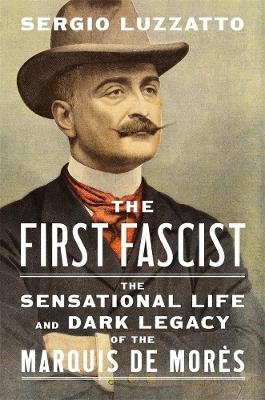
The First Fascist
The Sensational Life and Dark Legacy of the Marquis de Morès
Seiten
2026
Harvard University Press (Verlag)
978-0-674-29769-2 (ISBN)
Harvard University Press (Verlag)
978-0-674-29769-2 (ISBN)
- Noch nicht erschienen (ca. Februar 2026)
- Versandkostenfrei
- Auch auf Rechnung
- Artikel merken
The First Fascist tells the story of Marquis de Morès, an architect of the Dreyfus Affair and a pioneer of blending populism, white supremacy, and open antisemitism. Through violent stunts and media savvy, Morès cultivated support for a union of social classes against perceived Jewish enemies, leaving a lasting legacy in Europe and beyond.
A vivid biography of the nineteenth-century French-Italian aristocrat Marquis de Morès, the first political leader to master the blend of racialized hatred, cross-class solidarity, and paramilitary violence that Benito Mussolini would call “fascism.”
The Marquis de Morès was the first populist, white supremacist, and openly antisemitic leader in the Western world. A key figure behind the Dreyfus affair, he took France by storm with his inflammatory rhetoric, media savvy, and violent stunts. Decades before Mussolini, Morès invoked the fasces—the ancient Roman bundle of wooden rods—to symbolize the society he wished to create: a union of all social classes against their enemy, the Jews.
Animated from his early years by personal ambition and the loss of aristocratic status in modern, democratic France, Morès embarked on an extraordinary career spanning four continents. He ventured to the American frontier and became a cattle rancher in the Dakotas; he set out to build a railway in the jungles of Indochina. But his efforts were dogged by failure—and he blamed Jewish machinations for his defeats. Embittered, he returned to France to pursue what he saw as the mission of an upper-class Frenchman: to fight Jews and other minorities on behalf of the white proletariat. Soon he controlled a large, violent militia of disgruntled workers.
As Sergio Luzzatto makes clear, Morès both anticipated and propelled the fascist politics that erupted in the twentieth century and still resonate powerfully in our own time. Morès’s rapid political rise was halted by financial scandal, but his shadow continued to loom. In Vichy France, as Jews were being deported to Auschwitz, officials would gather to celebrate Morès’s memory.
A vivid biography of the nineteenth-century French-Italian aristocrat Marquis de Morès, the first political leader to master the blend of racialized hatred, cross-class solidarity, and paramilitary violence that Benito Mussolini would call “fascism.”
The Marquis de Morès was the first populist, white supremacist, and openly antisemitic leader in the Western world. A key figure behind the Dreyfus affair, he took France by storm with his inflammatory rhetoric, media savvy, and violent stunts. Decades before Mussolini, Morès invoked the fasces—the ancient Roman bundle of wooden rods—to symbolize the society he wished to create: a union of all social classes against their enemy, the Jews.
Animated from his early years by personal ambition and the loss of aristocratic status in modern, democratic France, Morès embarked on an extraordinary career spanning four continents. He ventured to the American frontier and became a cattle rancher in the Dakotas; he set out to build a railway in the jungles of Indochina. But his efforts were dogged by failure—and he blamed Jewish machinations for his defeats. Embittered, he returned to France to pursue what he saw as the mission of an upper-class Frenchman: to fight Jews and other minorities on behalf of the white proletariat. Soon he controlled a large, violent militia of disgruntled workers.
As Sergio Luzzatto makes clear, Morès both anticipated and propelled the fascist politics that erupted in the twentieth century and still resonate powerfully in our own time. Morès’s rapid political rise was halted by financial scandal, but his shadow continued to loom. In Vichy France, as Jews were being deported to Auschwitz, officials would gather to celebrate Morès’s memory.
Sergio Luzzatto is Emiliana Pasca Noether Chair in Modern Italian History at the University of Connecticut. A winner of the Cundill History Prize, he is the author of The Body of Il Duce and Primo Levi’s Resistance, among other books.
| Erscheint lt. Verlag | 10.2.2026 |
|---|---|
| Zusatzinfo | 50 photos |
| Verlagsort | Cambridge, Mass |
| Sprache | englisch |
| Maße | 156 x 235 mm |
| Gewicht | 926 g |
| Themenwelt | Literatur ► Biografien / Erfahrungsberichte |
| Sachbuch/Ratgeber ► Geschichte / Politik | |
| Geisteswissenschaften ► Geschichte ► Allgemeine Geschichte | |
| Sozialwissenschaften ► Politik / Verwaltung | |
| ISBN-10 | 0-674-29769-5 / 0674297695 |
| ISBN-13 | 978-0-674-29769-2 / 9780674297692 |
| Zustand | Neuware |
| Informationen gemäß Produktsicherheitsverordnung (GPSR) | |
| Haben Sie eine Frage zum Produkt? |
Mehr entdecken
aus dem Bereich



aus dem Bereich
eine Reise um die Welt zu außergewöhnlichen Persönlichkeiten, …
Buch | Softcover (2023)
Piper (Verlag)
CHF 25,20
Eine wahre Geschichte von Schiffbruch, Mord und Meuterei
Buch | Hardcover (2024)
C.Bertelsmann (Verlag)
CHF 34,95


