


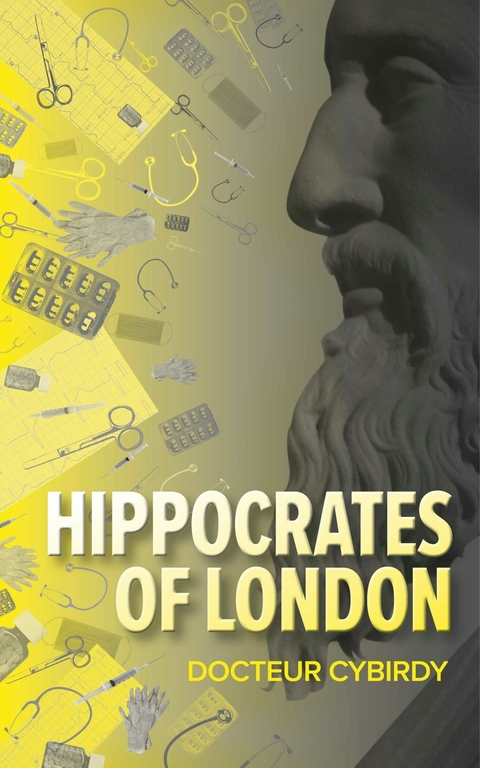
Hippocrates of London (eBook)
195 Seiten
Publishdrive (Verlag)
978-1-0686309-0-3 (ISBN)
In the pre-Covid UK capital, Melo, a young blogger and anthropologist, is sought out by the mysterious Dr Elpis, a woman who hides her face. Despite the doctor's secrecy, Melo is intrigued by her open and honest desire to share her worldview as one of the last independent doctors in London.
Whip-smart, provocative and animated by a mystical quest of universality, it is one of the most original collections of medical stories in recent years.
Docteur Cybirdy is a faceless writer and a General Physician who has practiced medicine for the past thirty years in France and in the UK.
Passionate about art of medicine and ethics, in Hippocrates of London, her debut novel, she shares her anecdotes with humanity and dignity, with a literary twist removed from hyper-rationality.
In the pre-Covid UK capital, Melo, a young blogger and anthropologist, is sought out by the mysterious Dr Elpis, a woman who hides her face. Despite the doctor's secrecy, Melo is intrigued by her open and honest desire to share her worldview as one of the last independent doctors in London.Whip-smart, provocative and animated by a mystical quest of universality, it is one of the most original collections of medical stories in recent years.Docteur Cybirdy is a faceless writer and a General Physician who has practiced medicine for the past thirty years in France and in the UK.Passionate about art of medicine and ethics, in Hippocrates of London, her debut novel, she shares her anecdotes with humanity and dignity, with a literary twist removed from hyper-rationality.
Prologue
It happened like many times before.
She is sitting in her home on the red velvet sofa. She looks up to see a long corridor; she stands and walks through. The corridor is filled with rooms. All doors are open. As she walks by, she observes. Each room has a colour theme: indigo, vermillion red, and various yellows. The indigo room contains a beautiful carpet and a Louis XV console table, the vermillion red room is filled with oriental cushions and a deep green ottoman. The mellow yellow space is occupied with opalescent art nouveau furniture with light coming through to fill the room. She does not enter. She keeps walking through. And then, she sees him.
Hippocrates sits on a great, white throne, holding his kithara vertically on his left thigh. She knows him but she does not say his name. His eyes meet hers slowly, and their metallic blue transparency makes her feel like she might be looking at herself. His body sits immobile and upright; his posture is statuesque. His face, neck and uncovered right shoulder resemble porcelain while the rest of his body is draped with a long, immaculate himation. Hippocrates’ hands are ever so slightly moving. She watches the subtle shift of his fingers on the chords: his thumb is turned upward, and he plucks one string while the other fingers are held horizontally, slightly curved. They stare at one another. She does not feel fear. She stays and watches him until he opens his mouth and says with the voice and the words of her mother, “The future belongs to the early birds.” She wakes up.
Dr. Elpis smiled at her dream. She rose from her bed and let the voice of her mother ring in her ear. She remembered that phrase well, it was one of her mother’s many idioms. L’avenir appartient à ceux qui se lèvent tôt. ‘The future belongs to the early birds,’ she remembers the woman used to address her every morning with those words when she would join her in the kitchen before breakfast time.
Elpis was always the first of her siblings to wake up. The little girl’s voyage of discovery would begin as soon as she woke. First, she stayed close to her mother and observed her morning routine. She watched the woman’s hands move as they prepared the food. They were hard working hands, with damaged skin insulted again and again by the elements: fire, water, wax, paint and even bleach. The skin was dry, nearly callous, and ingrained with dirt and walnut paint around the cuticles of her short cut nails. Her mother’s hands were agile though, they had been guided and protected by the repetitive skills and common sense she’d learned at a young age. Her mother did not speak much, only when necessary and often used idioms to make her point. ‘The future belongs to the early birds’, was one of them.
As a young child, Elpis seldom travelled beyond her Breton village and the grey granite church. It was her beacon for whenever she got lost, a piece of art she could always refer to. The church was quite stunning, made to impress young minds, like it did to the primitive pagans of the Middle Ages in Brittany. The gargoyles were apocalyptic dragons, and there was a famous statue of the pagan messenger of death called the ankou, sharing a wall with Christian artefacts.
Elpis left Brittany at eighteen. She went to Paris to study medicine and, following her graduation, returned close to her family. A few years later, she moved again, this time to London to learn about nutrition at the School of Hygiene and Tropical Medicine near Russell Square in Bloomsbury. And as it so often goes in life, she stayed much longer than she originally intended and settled in the megalopolis.
As a doctor trained in the eighties, she respected and revered Hippocrates. The myth surrounding him was a kind of nomism she applied to classic culture and respect of traditions that was central to her doctoring.
She pledged the Hippocratic oath on the day of graduation and never ceased to be guided by it.
For the past thirty years, the doctor had watched as anomie became more and more settled within society. She watched as people struggled to find the possibility of a happy future. As a doctor, she looked after people within society, and as anomie was developing, she had to adapt and change the way she could treat and connect with her patients. People were lost. Sadness was spreading in this new, unhealthy environment where basic human laws of respect and care were shrinking in concert, day by day, like a skin of sorrows.
The doctor never stopped hoping though. Her connection with Hippocrates and his teaching was intense. This helped her to keep going and hoping. However, Elpis needed something else and that was to help others to regain hope.
In 2018, she made a crucial decision.
She would pass on what she knew to help the younger generation to escape the inevitable road that the world was paving, a road that was disconnected and uncaring. She would tell her own experiences of being guided by the Hippocratic oath, the universal and intemporal ethical guide. She would pass the message on actively. She knew it could never be forgotten.
Once she decided on her destiny, she felt the urgency to seek solace in the wisdom she bestowed and transfer it. It was like an act of mind letting. She had to become a mind donor. But how? The doctor was stuck until one moment of serendipity. One day, while she was googling, she came across a blog with an astonishing title, ‘The Anthropology of the Native Digitals.’ Not only was the title wicked, what was written was nearly extraordinary.
The author, a girl named Melo, was writing simple accounts of what she saw, heard, and even smelled, while studying groups of people within their environment. The authenticity was transpiring. There were no opinions or analysis on this blog, just raw material of the human experience reported with intelligence on topics ranging from the cultural melting pot to Japanese art and coworking modalities in London. The writer even called upon Socratic philosophy on a few occasions. Anomie was described as a fear these young people were struggling with, a fear without a name. Melo was using clever references; the writer was a wunderkind. It was obvious that Melo was a digital native too, she must have been born after the early nineties. This was what Dr. Elpis needed.
She carried on reading her essays with enthusiasm, being carried by the joy of discovering new ways of life. One essay caught her interest: it was about a coworking office in London and was documenting how young people from different backgrounds with different projects organised their days together in every innovative way. What Elpis liked about Melo’s writing was that it was an objective description of human life in a particular context. It was a non-judgmental science.
The evidence was there in front of her eyes. Melo Smith seemed like the sign that she’d been waiting for. She would be the one who could listen and write about what the doctor had to say. Elpis typed a message.
“Dear Melo,
My name is Dr. Elpis. I have been a Harley Street doctor for many years. I am writing to you because I am searching for a voice. I found your blog, and I think that you might be the person I am looking for. I need someone with your talent and reputation to document my stories. Anonymity and authenticity are both essential to my project. If you want to know more, meet me at The Mirage restaurant in Soho this Saturday morning at 7 am.”
▲
Melo was preparing for her usual pre-dinner meeting with her father, checking emails and messages and logging off for the day when she got Dr. Elpis’ message. She was amused by it. But didn’t feel the need to address the ominous request just yet. She closed her laptop, then made her way down the stairs to her father’s library.
Outside the library, she saw that the door was left open. This was the agreed upon signal between father and daughter. If the door was open, she could enter. If it was closed, she could not. She pushed the opened door and entered the space as usual.
The library was a multifunctional living space linked to the man’s intellectual life. It was like one of those workshop spaces of a goldsmith before industrialisation, or even a present-day artist’s studio. Everything was by some magic at the right place, at the right time. As a linguist by profession, Melo’s father lived among books. His library was characterised by a mix of British and French cosiness with a warm, velvety, classic indoor space, where books and their readers were kings of the show.
Her father was sitting on the velvet sofa getting ready to smoke his pipe. The moment was a ritual for father and daughter. Melo crossed the room quietly, as the man was filling his pipe bowl with a loose pinch of tobacco, pressing it down gently with the tamper. Melo joined and sat down in the corner of the sofa, bringing her legs up and tightly to her chest. Her father carried on with a few test puffs, and then lit the flame to the pipe bowl in a circular motion, drawing on the pipe all the while.
“How has your day been?” the father began.
“Good, I went to the educational seminar I told you about last week. Not many people attended though, it was a bit boring. On Tuesday, I played with the band in the studio, it was good. I got a strange message today.”
“From where?”
“A Harley Street doctor that likes my blog, she’s asked me to meet her for a potential project together.”
“And?”
“The doctor did not give any more information, she just proposed to meet.”
“Should you ask more?”
There were a few minutes of stillness. The father drew two puffs and moved closer to his child,...
| Erscheint lt. Verlag | 13.5.2024 |
|---|---|
| Sprache | englisch |
| Themenwelt | Literatur ► Biografien / Erfahrungsberichte |
| Literatur ► Romane / Erzählungen | |
| Sachbuch/Ratgeber ► Natur / Technik | |
| Geisteswissenschaften ► Philosophie ► Ethik | |
| Geisteswissenschaften ► Psychologie ► Humanistische Psychotherapien | |
| Medizin / Pharmazie ► Medizinische Fachgebiete ► Medizinethik | |
| Studium ► Querschnittsbereiche ► Geschichte / Ethik der Medizin | |
| Schlagworte | Anthropology Blogger • Coming-of-age Contemporary Narrative • doctor biography modern medicine • Inspiring doctors stories • London Gothic Contemporary Storytelling • Mythical Hippocratic Oath ethics • True Medical ethical stories |
| ISBN-10 | 1-0686309-0-6 / 1068630906 |
| ISBN-13 | 978-1-0686309-0-3 / 9781068630903 |
| Informationen gemäß Produktsicherheitsverordnung (GPSR) | |
| Haben Sie eine Frage zum Produkt? |
 EPUB (Ohne DRM)
Digital Rights Management: ohne DRM
Dieses eBook enthält kein DRM oder Kopierschutz. Eine Weitergabe an Dritte ist jedoch rechtlich nicht zulässig, weil Sie beim Kauf nur die Rechte an der persönlichen Nutzung erwerben.
Dateiformat: EPUB (Electronic Publication)
EPUB ist ein offener Standard für eBooks und eignet sich besonders zur Darstellung von Belletristik und Sachbüchern. Der Fließtext wird dynamisch an die Display- und Schriftgröße angepasst. Auch für mobile Lesegeräte ist EPUB daher gut geeignet.
Systemvoraussetzungen:
PC/Mac: Mit einem PC oder Mac können Sie dieses eBook lesen. Sie benötigen dafür die kostenlose Software Adobe Digital Editions.
eReader: Dieses eBook kann mit (fast) allen eBook-Readern gelesen werden. Mit dem amazon-Kindle ist es aber nicht kompatibel.
Smartphone/Tablet: Egal ob Apple oder Android, dieses eBook können Sie lesen. Sie benötigen dafür eine kostenlose App.
Geräteliste und zusätzliche Hinweise
Buying eBooks from abroad
For tax law reasons we can sell eBooks just within Germany and Switzerland. Regrettably we cannot fulfill eBook-orders from other countries.
aus dem Bereich


