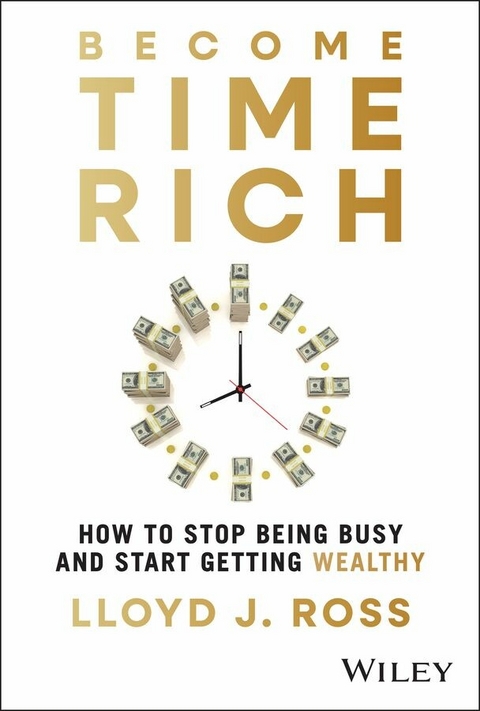
Become Time Rich (eBook)
208 Seiten
Wiley (Verlag)
978-1-394-33752-1 (ISBN)
Become wealthier-in every way that really matters-by effectively managing your time
In Become Time Rich: How to Stop Being Busy and Start Getting Wealthy, celebrated financial educator and business coach Lloyd Ross delivers an exciting, practical, and insightful new take on how to effectively manage your time to help you reach exceptional financial and lifestyle outcomes. The book teaches you how to achieve more by doing less and spending the time you save on things you love that also enrich your life.
You'll learn four powerful Time Rich laws with the potential to transform your life, work, and bank accounts. You'll also discover how you can apply the principles of purpose, elimination, leverage, and priority to dramatically improve every aspect of your day-to-day experiences.
Inside the book:
- Captivating narratives and practical exercises that will liberate you from the pernicious myth that 'being busy' equals 'being wealthy'
- Real-world techniques to help you scale your time and multiply your efficiency
- How to set boundaries that help you hang on to your precious time without eliminating valuable opportunities
A life-changing new discussion of how to manage, save, and keep more of life's most invaluable resource, Become Time Rich is an essential read for managers, executives, entrepreneurs, founders, young professionals, business leaders, and other busy people who want to spend more time doing what they love while simultaneously building the lifestyle they've always dreamed of.
LLOYD J. ROSS is the founder and director of Money Buys Happiness LLC, a leading financial education and business coaching company. He hosts the podcast Money Grows on Trees and is an experienced international platform speaker.
Become wealthier in every way that really matters by effectively managing your time In Become Time Rich: How to Stop Being Busy and Start Getting Wealthy, celebrated financial educator and business coach Lloyd Ross delivers an exciting, practical, and insightful new take on how to effectively manage your time to help you reach exceptional financial and lifestyle outcomes. The book teaches you how to achieve more by doing less and spending the time you save on things you love that also enrich your life. You'll learn four powerful Time Rich laws with the potential to transform your life, work, and bank accounts. You'll also discover how you can apply the principles of purpose, elimination, leverage, and priority to dramatically improve every aspect of your day-to-day experiences. Inside the book: Captivating narratives and practical exercises that will liberate you from the pernicious myth that being busy equals being wealthy Real-world techniques to help you scale your time and multiply your efficiency How to set boundaries that help you hang on to your precious time without eliminating valuable opportunities A life-changing new discussion of how to manage, save, and keep more of life's most invaluable resource, Become Time Rich is an essential read for managers, executives, entrepreneurs, founders, young professionals, business leaders, and other busy people who want to spend more time doing what they love while simultaneously building the lifestyle they've always dreamed of.
Introduction
As I sat on the edge of my beach chair, sipping my piña colada out of a plastic cup and watching the sun slowly set over the Caribbean Sea, with my wife, Alisha, sitting across from me absorbing the final rays from the Mexican sun, I looked down at my phone and opened my banking app.
Another record month, I thought, mesmerized by the fact that we were making more income in a week than some people make in a year, all while sitting quietly on a beach in Cancun on a three‐week jaunt around North America.
In that moment, it was difficult not to feel an overwhelming sense of gratitude and pride for all we'd achieved up to that point and the life we'd built for ourselves over the preceding ten years.
In that time, we'd built, scaled, and were running the following:
- A highly profitable network marketing business (all online) with over 80 consultants globally
- An online education and coaching business that had just been recognized by Clickfunnels.com with a Two Comma Club award
- A successful events business that puts through 400+ students per year across four key events in Australia (so far)
- A company partnership that acquires small, largely automated traditional businesses
- A platform public‐speaking business that I run on the side when opportunities emerge throughout the year
- An actively managed, multiple seven‐figure equity portfolio that I personally manage
- An award‐winning podcast, Money Grows on Trees, that's been dropping weekly episodes for three years and counting
- An online social media school
All while traveling to Fiji, Mexico, the United States, Thailand, and Bali.
Not to mention the 35 annual family birthdays (we have a big joint family), business dinners, events to plan, health to look after, a new puppy at home, and the beginnings of starting a family.
How was it possible to manage all of that and still have time to peacefully attack the piece of pineapple living at the bottom of my plastic cocktail cup on a beach in Cancun?
It wasn't magic, nor was it luck. It was the result of a decision made many years earlier to own our time and build a life that would not just grant us a predictable flow of money and financial independence but would also yield a predictable flow of free time to do whatever we want, with whomever we want, almost whenever we want.
It seems ridiculous now to think that you could manage all of the things listed here without having a nervous breakdown, and there was a time in my life when I would have thought it impossible (and certainly unenjoyable) to even consider creating such a plateful.
But there we were, Alisha and I, at peace on the beach, while under the hood of our various enterprises an array of products, people, partnerships, systems, and capital continued working in harmony to produce value for the world in a predictable manner.
As I turned around to look back at the resort, I caught a glimpse of a hammock swaying steadily in the breeze, and I was reminded of the cover of Tim Ferriss's The Four‐Hour Workweek, a book I'd picked up 12 years prior in a desperate attempt to drastically shift the trajectory of the life I'd found myself in.
But that story takes me back to another exotic location, an island in the Persian Gulf, at a time when my life was very different than it is now.
Psychologically Unemployable
As we crossed the bridge onto the island, surrounded by a colossal hotel, theme park, and residential projects under construction, a wave of imposter syndrome washed over me. At the age of 23, fresh out of law school with a few years in real estate sales, I found myself out of my depth, embarking on a job in Abu Dhabi for what was then the sixth‐largest development project in the world: Yas Island.
Just a few months earlier, I had been pounding the pavement in Sydney, aspiring to enter the investment banking world. However, the collapse of Bear Stearns and the bankruptcy of Lehman Brothers abruptly halted that pursuit. Amid the global financial crisis, the opportunity to work as an assistant development manager for the world's largest real estate developer in Abu Dhabi felt like a godsend.
Initially, I felt fortunate to contribute to the inaugural F1 Grand Prix circuit and witness a miniature city come to life. However, the aftermath of the Grand Prix brought the financial crisis to the Middle East, and the company I worked for teetered on the brink of bankruptcy. But what truly began to wear me down was the daily three‐hour commute to a job that lacked personal growth, career progression, or any real chance for wealth accumulation. In four years, all I encountered were wage cuts, layoffs, and redundancies.
Frustrated by the limitations of a nine‐to‐five corporate job, I decided to take matters into my own hands. I sought alternative ways to earn money and build wealth, drawing on the knowledge gained from years of reading about money and investing. Despite initial attempts to cut costs and invest in stocks, I soon realized that escaping my job would take a considerable amount of time with this strategy alone. So, I continued my search for a better path.
Listening to audiobooks during my daily commute and reading extensively, I contemplated becoming an entrepreneur. However, I lacked a clear road map. So instead, I decided to pursue a new career in banking through further studies despite warnings from the financial analysts I worked with.
I committed to the challenging CFA charter program (Chartered Financial Analyst), a self‐study program spanning three levels, each with a grueling six‐hour, closed‐book exam offered only once per year. In 2010, only 90,000 people held this certification worldwide, making it the most prestigious qualification available that would differentiate me in the financial industry. I devoted 20 hours per week and used my annual leave over three years to pass Level I and Level II, and I was on the verge of completing the final level when my career took an unexpected 90‐degree turn.
By 2012, the development company had gone through a restructure, and I was moved into a different role, one that required me to do even more wasteful work without increased income or personal growth. At that moment, I came to the realization that I was not cut out for such an existence. I had become “psychologically unemployable.”
Getting Out of the Rat Race
About that time, I came across Tim Ferriss's book The Four‐Hour Workweek, and it resonated deeply with me. It dawned on me that this was what I truly yearned for. Not another full‐time corporate engagement, not a return to the rat race, the daily grind, or the crucible. What I genuinely craved was control over my own time and agenda. A four‐hour workweek. Despite lacking a clear road map, I was certain it must be possible. After all, someone else had achieved it. Why couldn't I?
With that conviction, I sat down at my desk, crafted my resignation letter, and bid farewell to my job in Abu Dhabi. Little did I know that the letter marked the end of receiving a traditional wage. So, with what small amount of money I'd saved, alongside my then girlfriend (now wife), Alisha, I returned to Australia to join my father in a “post‐GFC” real estate business, which would quickly become a sink‐or‐swim ordeal.
What awaited me proved to be one of the most challenging periods of time in my entire career. It seemed like I had a knack for moving to places just as the global financial crisis decimated them. The real estate market was essentially lifeless when I commenced work in March 2012.
Surviving solely on sales commissions, I was grateful for the savings from my previous job, as it took me six months to secure my first deal and make some money. What ensued was a seven‐year business baptism by fire. I learned a lot from my dad, and together, we completely reconstructed the property business, discarding unnecessary overhead and debt. We integrated new online systems for greater leverage and repositioned the business away from mortgage reduction into straight property investment planning.
Although I was undeniably earning more than I had in my previous job and I had skilled up tremendously through the many challenges we undertook together, one thing still eluded me. My income, although tied to my performance rather than my time, remained dependent on making sales.
I lacked leverage. What I sought was a four‐hour workweek, but what I ended up with was more money and a six‐day workweek. Nevertheless, I maintained an open mind, believing that something good would eventually emerge.
It was during this time of rebuilding the property business with my dad that my older sister, Brooke, presented me with an opportunity to create some additional income. This opportunity required minimal time to begin because it would leverage the small social media network I had already built on Facebook, and it was something I could run from my phone in between appointments at work or from home.
At the time, I didn't fully grasp that she was talking about network marketing, but frankly, I didn't care. I wanted time freedom and was willing to do whatever it took to get it. Without any formal training or much knowledge of how to proceed, Alisha and I teamed up with my sister, and we jumped in headfirst. We...
| Erscheint lt. Verlag | 19.5.2025 |
|---|---|
| Sprache | englisch |
| Themenwelt | Sachbuch/Ratgeber ► Beruf / Finanzen / Recht / Wirtschaft ► Bewerbung / Karriere |
| Wirtschaft ► Betriebswirtschaft / Management | |
| Schlagworte | how can I get less busy? • Time Management • time management book • time management laws • time management strategies • time management styles • time management techniques • time saving book • time saving strategies • why am I so busy? |
| ISBN-10 | 1-394-33752-3 / 1394337523 |
| ISBN-13 | 978-1-394-33752-1 / 9781394337521 |
| Informationen gemäß Produktsicherheitsverordnung (GPSR) | |
| Haben Sie eine Frage zum Produkt? |
 EPUB (Adobe DRM)
Kopierschutz: Adobe-DRM
Adobe-DRM ist ein Kopierschutz, der das eBook vor Mißbrauch schützen soll. Dabei wird das eBook bereits beim Download auf Ihre persönliche Adobe-ID autorisiert. Lesen können Sie das eBook dann nur auf den Geräten, welche ebenfalls auf Ihre Adobe-ID registriert sind.
Details zum Adobe-DRM
Dateiformat: EPUB (Electronic Publication)
EPUB ist ein offener Standard für eBooks und eignet sich besonders zur Darstellung von Belletristik und Sachbüchern. Der Fließtext wird dynamisch an die Display- und Schriftgröße angepasst. Auch für mobile Lesegeräte ist EPUB daher gut geeignet.
Systemvoraussetzungen:
PC/Mac: Mit einem PC oder Mac können Sie dieses eBook lesen. Sie benötigen eine
eReader: Dieses eBook kann mit (fast) allen eBook-Readern gelesen werden. Mit dem amazon-Kindle ist es aber nicht kompatibel.
Smartphone/Tablet: Egal ob Apple oder Android, dieses eBook können Sie lesen. Sie benötigen eine
Geräteliste und zusätzliche Hinweise
Buying eBooks from abroad
For tax law reasons we can sell eBooks just within Germany and Switzerland. Regrettably we cannot fulfill eBook-orders from other countries.
aus dem Bereich