


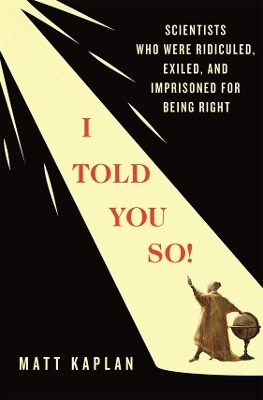
I Told You So!
Scientists Who Were Ridiculed, Exiled, and Imprisoned for Being Right
Seiten
2026
St Martin's Press (Verlag)
978-1-250-37227-7 (ISBN)
St Martin's Press (Verlag)
978-1-250-37227-7 (ISBN)
- Noch nicht erschienen (ca. April 2026)
- Versandkostenfrei
- Auch auf Rechnung
- Artikel merken
An energetic and impassioned work of popular science about scientists who have had to fight for their revolutionary ideas to be accepted—from Darwin to Pasteur to modern day Nobel Prize winners.
For two decades, Matt Kaplan has covered science for the Economist. He’s seen breakthroughs often occur in spite of, rather than because of, the behaviour of the research community, and how support can be withheld for those who don’t conform or have the right connections. In this passionately argued and entertaining book, Kaplan narrates the history of the 19th century Hungarian physician Ignaz Semmelweis, who realised that Childbed fever—a devastating infection that only struck women who had recently given birth—was spread by doctors not washing their hands. Semmelweis was met with overwhelming hostility by those offended at the notion that doctors were at fault, and is a prime example of how the scientific community often fights new ideas, even when the facts are staring them in the face.
In entertaining prose, Kaplan reveals scientific cases past and present to make his case. Some are familiar, like Galileo being threatened with torture and Nobel laureate Katalin Karikó being fired when on the brink of discovering how to wield mRNA–a finding that proved pivotal for the creation of the Covid-19 vaccine. Others less so, like researchers silenced for raising safety concerns about new drugs, and biologists ridiculed for revealing major flaws in the way rodent research is conducted. Kaplan shows how the scientific community can work faster and better by making reasonably small changes to the forces that shape it.
For two decades, Matt Kaplan has covered science for the Economist. He’s seen breakthroughs often occur in spite of, rather than because of, the behaviour of the research community, and how support can be withheld for those who don’t conform or have the right connections. In this passionately argued and entertaining book, Kaplan narrates the history of the 19th century Hungarian physician Ignaz Semmelweis, who realised that Childbed fever—a devastating infection that only struck women who had recently given birth—was spread by doctors not washing their hands. Semmelweis was met with overwhelming hostility by those offended at the notion that doctors were at fault, and is a prime example of how the scientific community often fights new ideas, even when the facts are staring them in the face.
In entertaining prose, Kaplan reveals scientific cases past and present to make his case. Some are familiar, like Galileo being threatened with torture and Nobel laureate Katalin Karikó being fired when on the brink of discovering how to wield mRNA–a finding that proved pivotal for the creation of the Covid-19 vaccine. Others less so, like researchers silenced for raising safety concerns about new drugs, and biologists ridiculed for revealing major flaws in the way rodent research is conducted. Kaplan shows how the scientific community can work faster and better by making reasonably small changes to the forces that shape it.
| Erscheint lt. Verlag | 7.4.2026 |
|---|---|
| Verlagsort | New York |
| Sprache | englisch |
| Maße | 137 x 211 mm |
| Themenwelt | Sachbuch/Ratgeber ► Natur / Technik |
| Naturwissenschaften | |
| Sozialwissenschaften ► Soziologie | |
| ISBN-10 | 1-250-37227-5 / 1250372275 |
| ISBN-13 | 978-1-250-37227-7 / 9781250372277 |
| Zustand | Neuware |
| Informationen gemäß Produktsicherheitsverordnung (GPSR) | |
| Haben Sie eine Frage zum Produkt? |
Mehr entdecken
aus dem Bereich



aus dem Bereich
wenn Mensch und Maschine eins werden
Buch | Hardcover (2024)
Piper (Verlag)
CHF 33,55


