


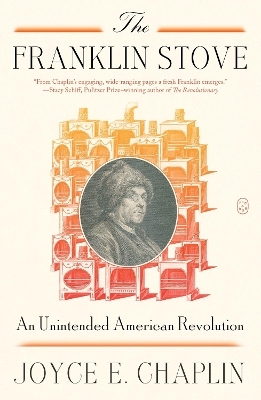
The Franklin Stove
An Unintended American Revolution
Seiten
2026
Picador USA (Verlag)
978-1-250-41997-2 (ISBN)
Picador USA (Verlag)
978-1-250-41997-2 (ISBN)
- Noch nicht erschienen (ca. März 2026)
- Portofrei ab CHF 40
- Auch auf Rechnung
- Artikel merken
The biggest revolution in Benjamin Franklin's lifetime was made to fit inside a fireplace. Assembled from iron plates like a piece of flat-pack furniture, the Franklin stove became one of the most famous consumer products of its era, spreading from Pennsylvania to England, Italy, and beyond. It was more than just a material object, however-it was also a hypothesis. Franklin was proposing that, armed with science, he could invent his way out of a climate crisis: a period of global cooling known as the Little Ice Age, when unusually bitter winters brought life to a standstill. And he conceived of his invention as equal parts appliance and scientific instrument-one that, by modifying how heat and air moved through indoor spaces, might be able to reveal the workings of the atmosphere outside and explain why it seemed to be changing.
Joyce E. Chaplin's The Franklin Stove is the story of this singular invention, and a revelatory new look at the Founding Father we thought we knew. We follow Franklin as he promotes his stove in England and France, takes measurements of the jet stream, and spars with proponents of the theory that clearcutting shade trees would lead to warmer winters. As the story of the Franklin stove shows, it's not so easy to engineer our way out of a climate crisis; with this book, Chaplin reveals how that challenge is as old as the United States itself.
Joyce E. Chaplin's The Franklin Stove is the story of this singular invention, and a revelatory new look at the Founding Father we thought we knew. We follow Franklin as he promotes his stove in England and France, takes measurements of the jet stream, and spars with proponents of the theory that clearcutting shade trees would lead to warmer winters. As the story of the Franklin stove shows, it's not so easy to engineer our way out of a climate crisis; with this book, Chaplin reveals how that challenge is as old as the United States itself.
Joyce E. Chaplin is the James Duncan Phillips Professor of Early American History at Harvard University, where she also holds affiliations with the Graduate School of Design and Center for the Environment. She is the author of The First Scientific American: Benjamin Franklin and the Pursuit of Genius, among other books, and her writing has appeared in The New York Times, The Washington Post, The Wall Street Journal, and London Review of Books. She lives in Cambridge, Massachusetts.
| Erscheint lt. Verlag | 10.3.2026 |
|---|---|
| Zusatzinfo | 21 Black-and-White Images in Text / Notes, Index |
| Verlagsort | New York |
| Sprache | englisch |
| Maße | 135 x 208 mm |
| Themenwelt | Literatur ► Biografien / Erfahrungsberichte |
| Sachbuch/Ratgeber ► Geschichte / Politik | |
| Geisteswissenschaften ► Geschichte ► Regional- / Ländergeschichte | |
| Geschichte ► Teilgebiete der Geschichte ► Technikgeschichte | |
| ISBN-10 | 1-250-41997-2 / 1250419972 |
| ISBN-13 | 978-1-250-41997-2 / 9781250419972 |
| Zustand | Neuware |
| Informationen gemäß Produktsicherheitsverordnung (GPSR) | |
| Haben Sie eine Frage zum Produkt? |
Mehr entdecken
aus dem Bereich



aus dem Bereich
eine Geschichte der Fehlbarkeit von Mensch und Technologie
Buch | Hardcover (2025)
C.H.Beck (Verlag)
CHF 44,75
Buch | Softcover (2024)
Lehmanns Media (Verlag)
CHF 27,90
von Gutenberg bis zum Smartphone
Buch | Hardcover (2025)
Klett-Cotta (Verlag)
CHF 33,55


