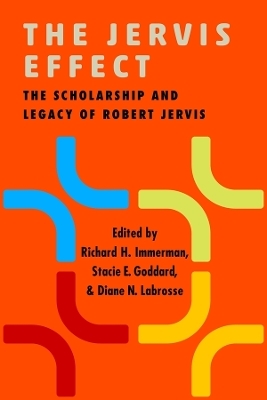
The Jervis Effect
Columbia University Press (Verlag)
978-0-231-22155-9 (ISBN)
- Lieferbar (Termin unbekannt)
- Versandkostenfrei
- Auch auf Rechnung
- Artikel merken
Robert Jervis (1940–2021) was a titan in the field of international relations. Part political scientist, part psychologist, part historian, and part policy analyst, he drew on a vast array of theoretical approaches and empirical methods to develop keen and distinctive insights on a wide range of topics. From academic political science to the policy world, the scope of Jervis’s influence is astonishing.
Bringing together top scholars in political science, international relations, and history, this book offers a deep dive into Jervis’s pathbreaking scholarship and its legacy across disciplines. The authors consider how his work reshaped subjects such as nuclear strategy, arms control, deterrence theory, structural realism, diplomatic history, intelligence analysis, and the causes of war. They further discuss Jervis’s leadership on the CIA’s declassification board, which provided a bridge between academics and the intelligence community, and his influence as a public intellectual. The contributors also pay tribute to Jervis as a mentor, colleague, and friend who worked to build and sustain a broad intellectual community. Offering a wide-ranging overview of Jervis’s most important contributions to many fields, this book provides a deep understanding of Jervis’s scholarly work, which continues to inspire new generations of scholars who seek to follow in his footsteps.
Richard H. Immerman is professor emeritus and Edward J. Buthusiem Family Distinguished Faculty Fellow in History, Emeritus at Temple University, where he is also Marvin Wachman Director Emeritus of the Center for the Study of Force and Diplomacy. Stacie E. Goddard is the Betty Freyhof Johnson ’44 Professor of Political Science and Associate Provost for Wellesley in the World at Wellesley College. Diane N. Labrosse is the executive and managing editor of H-Diplo and senior managing editor of H-Diplo/The Jervis Forum.
Introduction. A League of His Own: The Sui Generis Scholarship of Robert Jervis, by Paul K. MacDonald
Part I. Robert Jervis and International Relations Theory
1. Acting in Which System?, by Jack Snyder
2. Realism and Misperceptions, by Lawrence Freedman
3. Seminal Contributions to Rational Theories of State Behavior, by Charles L. Glaser
4. The Jervisian Style in International Relations, by Joseph M. Parent
5. A Not-So-Closet Constructivist?, by Stacie E. Goddard and Ronald R. Krebs
6. The “Fourth” Assumption for the Operation of Balance of Power Systems, by Randall L. Schweller
7. A Liberal Realist, by Doug Macdonald
8. The Field of Security Studies, by Stephen M. Walt
Part II. Robert Jervis, Psychology, and Bargaining
9. A Leader and a Subversive: Robert Jervis’s Contradictory Contributions to International Relations Theory, by Thomas J. Christensen
10. Understanding Life and Life’s Choices: A Tribute, by James W. Davis
11. On “Cooperation Under the Security Dilemma,” by Michael Doyle
12. Perspectives on the Security Dilemma, by James D. Fearon
13. Scholarly Silverback and Founder of the Field of Political Psychology, by Rose McDermott
14. A Psychology of Rational Signaling, by Jonathan Mercer
15. The Consummate Fox, by Philip E. Tetlock
16. Jack of All Trades, Master of All, by James Goldgeier and Elizabeth N. Saunders
Part III. Robert Jervis and the Practice of Statecraft: Nuclear Weapons, Intelligence, and Beyond
17. Political Psychology and the Analysis of Intelligence Failures, by Janice Gross Stein
18. The Social Dilemmas of Technological Innovation, by Robert F. Trager
19. Complexity, Nonlinearity, and Other Essential Jervisian Insights on International Security Problems, by Cynthia Roberts
20. Bridging the Gap Between Public Discourse and Secret Intelligence, by Richard K. Betts
Part IV. Robert Jervis, History, and Historians
21. Theorist and Methodologist, by Jack S. Levy
22. Reading Robert Jervis, by Vladislav Zubok
23. Remembering Robert Jervis, by Marc Trachtenberg
24. Learning from History, by Deborah Welch Larson
25. An Appreciation, by James McAllister
26. Perceptions and Misperceptions and the Outbreak of World War I: Memories of an Interdisciplinary Scholarly Relationship, by Volker R. Berghahn
Part V. Robert Jervis as Public Intellectual
27. The Art and Science of the Postmortem, by Richard H. Immerman
28. Robert Jervis and Official History, by Michael Warner
29. The CIA’s Historical Review Panel, by Melvyn P. Leffler
30. Lowering Barriers and Connecting Scholars through Innovative Online Publications: H-Diplo/ISSF, by Diane N. Labrosse
31. The Public Intellectual, by Dipali Mukhopadhyay
Part VI. Robert Jervis as Colleague, Mentor, and Friend
Coda: To My Fellow Perceiver, by Keren Yarhi-Milo
Epilogue: The Jervis Effect: The Scholarship and Legacy of Robert Jervis, by Richard H. Immerman, Stacie E. Goddard, and Diane N. Labrosse
Acknowledgments
Appendix: Robert Jervis, How I Got Here
Contributors
Index
| Erscheinungsdatum | 14.11.2025 |
|---|---|
| Zusatzinfo | 4 black-and-white illustrations |
| Verlagsort | New York |
| Sprache | englisch |
| Maße | 152 x 229 mm |
| Themenwelt | Literatur ► Biografien / Erfahrungsberichte |
| Sachbuch/Ratgeber ► Geschichte / Politik | |
| Sozialwissenschaften ► Politik / Verwaltung ► Staat / Verwaltung | |
| ISBN-10 | 0-231-22155-X / 023122155X |
| ISBN-13 | 978-0-231-22155-9 / 9780231221559 |
| Zustand | Neuware |
| Informationen gemäß Produktsicherheitsverordnung (GPSR) | |
| Haben Sie eine Frage zum Produkt? |
aus dem Bereich