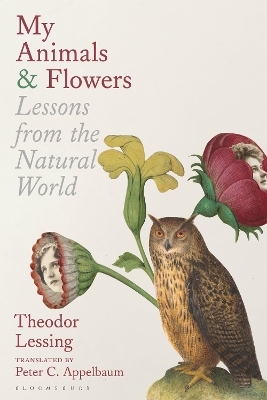
My Animals & Flowers
Bloomsbury Academic (Verlag)
978-1-350-52678-5 (ISBN)
- Lieferbar (Termin unbekannt)
- Versandkostenfrei
- Auch auf Rechnung
- Artikel merken
Translated into English for the first time, My Animals and Flowers bring forth Theodor Lessing’s visionary philosophy of need in an idiosyncratic series of musings on the natural world, which range from light-hearted to darkly shadowed. Full of imagination, wit, and insight into the nature and history of living species, they demonstrate Lessing’s brilliant ability to combine biological observation with social, psychological, political, historical, educational, and above all, philosophical thoughts.
Grimly pessimistic about human society, Lessing found both a mirror and a refuge in the world of animals and flowers. In observing nature and attributing all type of human characteristics to animals and plants, he exposes the fusing of nature and culture, and – in dialogue with the natural world – confronts a whole cluster of political questions from the question of equality for women and marital fidelity to the pollution of cities and man’s destruction of the environment. Much of this work, sketching out the implications of an atomic age for example, has proved uncannily prophetic.
To read this book is to enter into a curious and deeply sensitive world, in which to peer down at a colony of ants is to be reminded of ‘giant nations, each in conflict with the others’, and to catch a glimpse of bright poppies in a cornfield is to be submerged in a chain of thoughts from St Augustine to David Hume. Amongst the autobiographical reflections, Lessing weaves in critical observations of Western civilization, and critique of human culture as a destructive and disfiguring influence in the natural world. Ultimately, his philosophy of need shows how civilization comes at the expense of nature, ringing true with the climate of our times.
Theodor Lessing (1872-1933) was a German Jewish philosopher known for opposing the rise of Hindenburg as president of the Weimar Republic and for his book on Jewish self-hatred. Peter Appelbaum (translator) is Emeritus Professor of Pathology at Pennsylvania State University, USA. During his retirement years he has published fourteen books and translations about Jews in Central Europe during World War I and thereafter. He was awarded the (London) Times Literary Supplement - Risa Domb Porjes Prize in 2019 for his translation of Avigdor Hameiri’s Hell on Earth. He has published two previous translations of Theodor Lessing’s works: Jewish Self-Hate (2021), and Enemy in the Country: Satires and Novellas (2022). Benton Arnovitz is director at the United States Holocaust Memorial Museum, USA. He is also an editor, literary agent, and retired publishing director.
Theodor Lessing and His Philosophy of Need, Herman Simissen
Translator’s Introduction
Part I: My Animals
1. Rabbits and Cats
2. Sparrows and Swallows
3. White Mice
4. Tristan and Isolde – Sparrows
5. Dogs and Cats
6. Our Beloved Crows
7. Jays
8. Hyenas
9. Ants
10. The Chicken Coop
11. Dormice, or The Demise of the Aristocracy
12. Turkeys
13. Silver Bill and Amarant
14. The Bird of Loyalty
15. Spiders and Flies
16. The Horse
17. The Dove
18. Bees and Wasps or Bourgeoisie and Romanticism
19. Wolves and Dogs
20. The Wild Donkey and the Tame Donkey
21. German Trees
Appendix 1. Nanekobo
Appendix 2. Frogs
Appendix 3. The Flea
Appendix 4. Worms and Insects
Appendix 5. The Barbel
Appendix 6. Big Cats and Chauffeurs
Part II: Flowers
1. Snowdrops
2. Roses
3. Northern Morning
4. Busy Lizzies
5. Birches on the Heath
6. Poppies in the Cornfield
7. Love and Hate Among Flowers
8. Favorite Flowers
9. Bleeding Trees
10. Moravian Soil
11. The Color of Flowers
12. A Great Hindu
13. Faces of Flowers
14. Garden Happiness
15. Laurel and Ivy
16. Wheat and Grapes
17. Frost Flowers on the Window
18. Asteriscus
19. The Miracle of Flowers
20. Butterflies at Play
21. Passiflora
22. Sunflowers
23. Stones
| Erscheinungsdatum | 20.12.2025 |
|---|---|
| Übersetzer | Peter C. Appelbaum |
| Zusatzinfo | 10 bw illus |
| Verlagsort | London |
| Sprache | englisch |
| Maße | 154 x 236 mm |
| Gewicht | 640 g |
| Themenwelt | Sachbuch/Ratgeber ► Natur / Technik ► Natur / Ökologie |
| Geisteswissenschaften ► Philosophie ► Philosophie der Neuzeit | |
| Naturwissenschaften ► Biologie ► Ökologie / Naturschutz | |
| ISBN-10 | 1-350-52678-9 / 1350526789 |
| ISBN-13 | 978-1-350-52678-5 / 9781350526785 |
| Zustand | Neuware |
| Informationen gemäß Produktsicherheitsverordnung (GPSR) | |
| Haben Sie eine Frage zum Produkt? |
aus dem Bereich