Decisive Moments in History (eBook)
50 Seiten
Charles River Editors (Verlag)
978-1-4753-3076-2 (ISBN)
'Find out just what any people will quietly submit to and you have the exact measure of the injustice and wrong which will be imposed on them.' - Frederick Douglass
'Our objective is complete freedom, justice and equality by any means necessary.' - Malcolm X
'I've seen the Promised Land. I may not get there with you. But I want you to know tonight, that we, as a people, will get to the Promised Land.' - Dr. Martin Luther King Jr.
In the 19th century, the Scottish writer Thomas Carlyle famously wrote, 'The history of the world is but the biography of great men', popularizing the 'Great Man' theory that the course of history is shaped by a select few heroic individuals. While historians and others continue to debate the accuracy of the Great Man theory of history, there is no question that the course of history is permanently altered by decisive moments in time, where a different result would have produced drastically different outcomes. Charles River Editors' Decisive Moments in History examines the events that changed history forever and set the world down the path it finds itself on today.
When famous political philosopher Alexis de Tocqueville toured the new United States of America, he was impressed by the representative government set up by the Founders. At the same time, he ominously predicted, 'If there ever are great revolutions there, they will be caused by the presence of the blacks upon American soil. That is to say, it will not be the equality of social conditions but rather their inequality which may give rise thereto.'
De Tocqueville was prescient, because the longest battle fought in the history of the United States has been the Civil Rights Movement. The framers of the Constitution kicked the problem down the road, over half a million died during the Civil War to end slavery, and then many more fought and died to dismantle segregation and legalized racism in the 100 years after.
Today every American is taught about watershed moments in the history of minorities' struggles for civil rights over the course of American history: the Civil War, Brown v. Board of Education, Rosa Parks' refusal to give up her seat, Dr. Martin Luther King Jr.'s 'I Have a Dream' speech, and the passage of the Civil Rights Act of 1964. Indeed, the use of the phrase 'Civil Rights Movement' in America today almost invariably refers to the period of time from 1954-1964.
However, the American Civil Rights Movement actually came into existence long before it is presumed to have done so. The Movement's primary work was slow, evolving, gradual and long-term. Its more glamorous moments, such as the Montgomery Bus Boycott (1955-1956), the Selma to Montgomery March (1965), and the March on Washington (1963), mainly were supplemental to the all-important grassroots work already going on in communities, churches, legislatures and courts. The nascent stages of the Movement actually began far earlier, among abolitionists and the the writings and activism of Frederick Douglass and others.
The Civil Rights Movement also included counternarratives led by activists like Malcolm X, who pointed out that Brown v. Board may have demanded integration, but it did not implement it. Insisting that politely asking the government for civil rights was futile, Malcolm X represented the face of the civil rights movement that demanded stronger words and action than nonviolent protest.
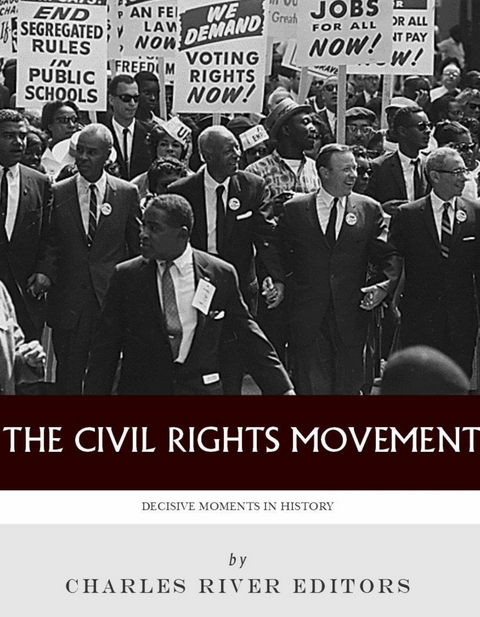
Decisive Moments in History: The Civil Rights Movement comprehensively covers the struggle for civil rights in the United States, remembering its most famous and memorable events but also highlighting its lesser known ups and downs on the path to equality. Along with pictures of the important people, places, and events, you will learn about the Civil Rights Movement like you never have before, in no time at all.
"e;Find out just what any people will quietly submit to and you have the exact measure of the injustice and wrong which will be imposed on them."e; - Frederick Douglass"e;Our objective is complete freedom, justice and equality by any means necessary."e; Malcolm X I've seen the Promised Land. I may not get there with you. But I want you to know tonight, that we, as a people, will get to the Promised Land. Dr. Martin Luther King Jr.In the 19th century, the Scottish writer Thomas Carlyle famously wrote, "e;The history of the world is but the biography of great men"e;, popularizing the Great Man theory that the course of history is shaped by a select few heroic individuals. While historians and others continue to debate the accuracy of the Great Man theory of history, there is no question that the course of history is permanently altered by decisive moments in time, where a different result would have produced drastically different outcomes. Charles River Editors Decisive Moments in History examines the events that changed history forever and set the world down the path it finds itself on today.When famous political philosopher Alexis de Tocqueville toured the new United States of America, he was impressed by the representative government set up by the Founders. At the same time, he ominously predicted, If there ever are great revolutions there, they will be caused by the presence of the blacks upon American soil. That is to say, it will not be the equality of social conditions but rather their inequality which may give rise thereto. De Tocqueville was prescient, because the longest battle fought in the history of the United States has been the Civil Rights Movement. The framers of the Constitution kicked the problem down the road, over half a million died during the Civil War to end slavery, and then many more fought and died to dismantle segregation and legalized racism in the 100 years after. Today every American is taught about watershed moments in the history of minorities struggles for civil rights over the course of American history: the Civil War, Brown v. Board of Education, Rosa Parks refusal to give up her seat, Dr. Martin Luther King Jr. s I Have a Dream speech, and the passage of the Civil Rights Act of 1964. Indeed, the use of the phrase Civil Rights Movement in America today almost invariably refers to the period of time from 1954-1964.However, the American Civil Rights Movement actually came into existence long before it is presumed to have done so. The Movement's primary work was slow, evolving, gradual and long-term. Its more glamorous moments, such as the Montgomery Bus Boycott (1955 1956), the Selma to Montgomery March (1965), and the March on Washington (1963), mainly were supplemental to the all-important grassroots work already going on in communities, churches, legislatures and courts. The nascent stages of the Movement actually began far earlier, among abolitionists and the the writings and activism of Frederick Douglass and others.The Civil Rights Movement also included counternarratives led by activists like Malcolm X, who pointed out that Brown v. Board may have demanded integration, but it did not implement it. Insisting that politely asking the government for civil rights was futile, Malcolm X represented the face of the civil rights movement that demanded stronger words and action than nonviolent protest. Decisive Moments in History: The Civil Rights Movement comprehensively covers the struggle for civil rights in the United States, remembering its most famous and memorable events but also highlighting its lesser known ups and downs on the path to equality. Along with pictures of the important people, places, and events, you will learn about the Civil Rights Movement like you never have before, in no time at all.
| Erscheint lt. Verlag | 5.5.2025 |
|---|---|
| Sprache | englisch |
| Themenwelt | Sachbuch/Ratgeber ► Geschichte / Politik ► 20. Jahrhundert bis 1945 |
| Geisteswissenschaften ► Geschichte ► Regional- / Ländergeschichte | |
| Schlagworte | Civil War • Cold War • kennedy • Lincoln • Malcolm X • Martin Luther King • Washington |
| ISBN-10 | 1-4753-3076-6 / 1475330766 |
| ISBN-13 | 978-1-4753-3076-2 / 9781475330762 |
| Informationen gemäß Produktsicherheitsverordnung (GPSR) | |
| Haben Sie eine Frage zum Produkt? |
 EPUB (Ohne DRM)
Digital Rights Management: ohne DRM
Dieses eBook enthält kein DRM oder Kopierschutz. Eine Weitergabe an Dritte ist jedoch rechtlich nicht zulässig, weil Sie beim Kauf nur die Rechte an der persönlichen Nutzung erwerben.
Dateiformat: EPUB (Electronic Publication)
EPUB ist ein offener Standard für eBooks und eignet sich besonders zur Darstellung von Belletristik und Sachbüchern. Der Fließtext wird dynamisch an die Display- und Schriftgröße angepasst. Auch für mobile Lesegeräte ist EPUB daher gut geeignet.
Systemvoraussetzungen:
PC/Mac: Mit einem PC oder Mac können Sie dieses eBook lesen. Sie benötigen dafür die kostenlose Software Adobe Digital Editions.
eReader: Dieses eBook kann mit (fast) allen eBook-Readern gelesen werden. Mit dem amazon-Kindle ist es aber nicht kompatibel.
Smartphone/Tablet: Egal ob Apple oder Android, dieses eBook können Sie lesen. Sie benötigen dafür eine kostenlose App.
Geräteliste und zusätzliche Hinweise
Buying eBooks from abroad
For tax law reasons we can sell eBooks just within Germany and Switzerland. Regrettably we cannot fulfill eBook-orders from other countries.
aus dem Bereich