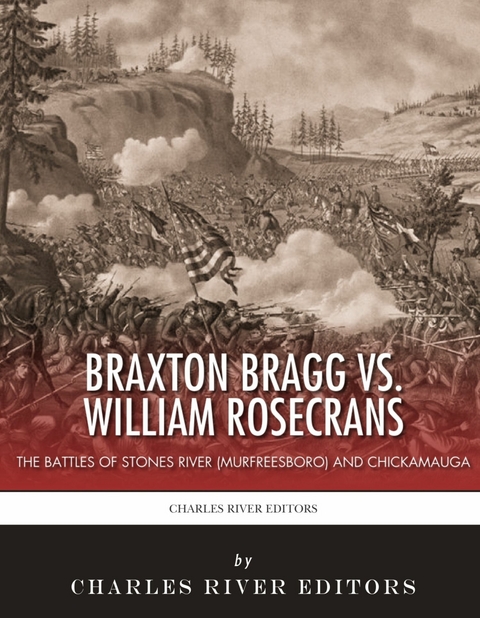
Braxton Bragg vs. William Rosecrans (eBook)
80 Seiten
Charles River Editors (Verlag)
9781475332742 (ISBN)
Americans have long been fascinated by the Civil War and its biggest battles, particularly Gettysburg, Antietam, and Shiloh, all of which involved Robert E. Lee or Ulysses S. Grant. But one of the 6 biggest battles of the war, and the one that took the heaviest toll by % on both armies was fought at the end of 1862 in Tennessee, and it involved neither of those generals.
In late December 1862, William Rosecrans's Union Army of the Cumberland was contesting Middle Tennessee against Braxton Bragg's Army of Tennessee, and for three days the two armies savaged each other as Bragg threw his army at Rosecrans in a series of desperate assaults. Bragg's army was unable to dislodge the Union army, and he eventually withdrew his army after learning that Rosecrans was on the verge of receiving reinforcements. Though the battle was stalemated, the fact that the Union army was left in possession of the field allowed Rosecrans to declare victory and embarrassed Bragg.
Though Stones River is mostly overlooked as a Civil War battle today, it had a decisive impact on the war. The two armies had both suffered nearly 33% casualties, an astounding number in 1862 that also ensured Rosecrans would not start another offensive campaign in Tennessee until the following June. The Union victory also ensured control of Nashville, Middle Tennessee, and Kentucky for the rest of the war, prompting Lincoln to tell Rosecrans, 'You gave us a hard-earned victory, which had there been a defeat instead, the nation could scarcely have lived over.'
Americans have long been fascinated by the Civil War and its biggest battles, particularly Gettysburg, Antietam, and Shiloh, all of which involved Robert E. Lee or Ulysses S. Grant. But the second biggest battle of the entire war mostly gets overlooked among casual readers, despite the fact it represented the last great chance for the Confederates to salvage the Western theater.
In mid-September, the Union Army of the Cumberland under General William Rosecrans had taken Chattanooga, but rather than be pushed out of the action, Army of Tennessee commander Braxton Bragg decided to stop with his 60,000 men and prepare a counterattack south of Chattanooga at a creek named Chickamauga. To bolster his fire-power, Confederate President Jefferson Davis sent 12,000 additional troops under the command of Lieutenant General James Longstreet, whose corps had just recently fought at Gettysburg in July.
On the morning of September 19, 1863, Bragg's men assaulted the Union line, which was established in a wooded area thick with underbrush along the river. That day and the morning of the next, Bragg continue to pummel Union forces, with the battle devolving from an organized succession of coordinated assaults into what one Union soldier described as 'a mad, irregular battle, very much resembling guerrilla warfare on a vast scale in which one army was bushwhacking the other, and wherein all the science and the art of war went for nothing.'
Late that second morning, Rosecrans was misinformed that a gap was forming in his front line, so he responded by moving several units forward to shore it up. What Rosecrans didn't realize, however, was that in doing so he accidentally created a quarter-mile gap in the Union center, directly in the path of Longstreet's men. Described by one of Rosecrans' own men as 'an angry flood,' Longstreet's attack was successful in driving one-third of the Union Army off the field, with Rosecrans himself running all the way to Chattanooga, where he was later found weeping and seeking solace from a staff priest.
In the aftermath of the Battle of Chickamauga, several Confederate generals blamed the number of men lost during what would be the bloodiest battle of the Western Theater on Bragg's incompetence, also criticizing him for refusing to pursue the escaping Union army.
Americans have long been fascinated by the Civil War and its biggest battles, particularly Gettysburg, Antietam, and Shiloh, all of which involved Robert E. Lee or Ulysses S. Grant. But one of the 6 biggest battles of the war, and the one that took the heaviest toll by % on both armies was fought at the end of 1862 in Tennessee, and it involved neither of those generals.In late December 1862, William Rosecrans s Union Army of the Cumberland was contesting Middle Tennessee against Braxton Bragg s Army of Tennessee, and for three days the two armies savaged each other as Bragg threw his army at Rosecrans in a series of desperate assaults. Bragg s army was unable to dislodge the Union army, and he eventually withdrew his army after learning that Rosecrans was on the verge of receiving reinforcements. Though the battle was stalemated, the fact that the Union army was left in possession of the field allowed Rosecrans to declare victory and embarrassed Bragg.Though Stones River is mostly overlooked as a Civil War battle today, it had a decisive impact on the war. The two armies had both suffered nearly 33% casualties, an astounding number in 1862 that also ensured Rosecrans would not start another offensive campaign in Tennessee until the following June. The Union victory also ensured control of Nashville, Middle Tennessee, and Kentucky for the rest of the war, prompting Lincoln to tell Rosecrans, You gave us a hard-earned victory, which had there been a defeat instead, the nation could scarcely have lived over."e;Americans have long been fascinated by the Civil War and its biggest battles, particularly Gettysburg, Antietam, and Shiloh, all of which involved Robert E. Lee or Ulysses S. Grant. But the second biggest battle of the entire war mostly gets overlooked among casual readers, despite the fact it represented the last great chance for the Confederates to salvage the Western theater.In mid-September, the Union Army of the Cumberland under General William Rosecrans had taken Chattanooga, but rather than be pushed out of the action, Army of Tennessee commander Braxton Bragg decided to stop with his 60,000 men and prepare a counterattack south of Chattanooga at a creek named Chickamauga. To bolster his fire-power, Confederate President Jefferson Davis sent 12,000 additional troops under the command of Lieutenant General James Longstreet, whose corps had just recently fought at Gettysburg in July. On the morning of September 19, 1863, Bragg's men assaulted the Union line, which was established in a wooded area thick with underbrush along the river. That day and the morning of the next, Bragg continue to pummel Union forces, with the battle devolving from an organized succession of coordinated assaults into what one Union soldier described as a mad, irregular battle, very much resembling guerrilla warfare on a vast scale in which one army was bushwhacking the other, and wherein all the science and the art of war went for nothing. Late that second morning, Rosecrans was misinformed that a gap was forming in his front line, so he responded by moving several units forward to shore it up. What Rosecrans didn t realize, however, was that in doing so he accidentally created a quarter-mile gap in the Union center, directly in the path of Longstreet s men. Described by one of Rosecrans own men as an angry flood, Longstreet's attack was successful in driving one-third of the Union Army off the field, with Rosecrans himself running all the way to Chattanooga, where he was later found weeping and seeking solace from a staff priest. In the aftermath of the Battle of Chickamauga, several Confederate generals blamed the number of men lost during what would be the bloodiest battle of the Western Theater on Bragg s incompetence, also criticizing him for refusing to pursue the escaping Union army.
| Erscheint lt. Verlag | 2.5.2025 |
|---|---|
| Sprache | englisch |
| Themenwelt | Sachbuch/Ratgeber ► Geschichte / Politik ► Allgemeines / Lexika |
| Geisteswissenschaften ► Geschichte ► Regional- / Ländergeschichte | |
| Schlagworte | Antietam • Civil War • Gettysburg • Grant • Lee • Lincoln • Sherman |
| ISBN-13 | 9781475332742 / 9781475332742 |
| Informationen gemäß Produktsicherheitsverordnung (GPSR) | |
| Haben Sie eine Frage zum Produkt? |
 EPUB (Ohne DRM)
Digital Rights Management: ohne DRM
Dieses eBook enthält kein DRM oder Kopierschutz. Eine Weitergabe an Dritte ist jedoch rechtlich nicht zulässig, weil Sie beim Kauf nur die Rechte an der persönlichen Nutzung erwerben.
Dateiformat: EPUB (Electronic Publication)
EPUB ist ein offener Standard für eBooks und eignet sich besonders zur Darstellung von Belletristik und Sachbüchern. Der Fließtext wird dynamisch an die Display- und Schriftgröße angepasst. Auch für mobile Lesegeräte ist EPUB daher gut geeignet.
Systemvoraussetzungen:
PC/Mac: Mit einem PC oder Mac können Sie dieses eBook lesen. Sie benötigen dafür die kostenlose Software Adobe Digital Editions.
eReader: Dieses eBook kann mit (fast) allen eBook-Readern gelesen werden. Mit dem amazon-Kindle ist es aber nicht kompatibel.
Smartphone/Tablet: Egal ob Apple oder Android, dieses eBook können Sie lesen. Sie benötigen dafür eine kostenlose App.
Geräteliste und zusätzliche Hinweise
Buying eBooks from abroad
For tax law reasons we can sell eBooks just within Germany and Switzerland. Regrettably we cannot fulfill eBook-orders from other countries.
aus dem Bereich