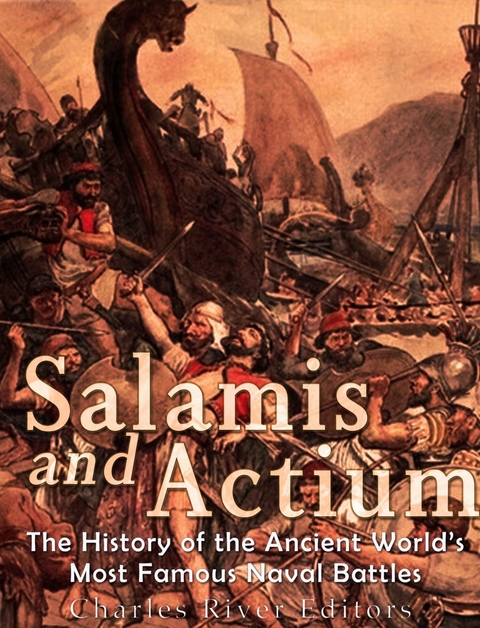
Salamis and Actium (eBook)
86 Seiten
Charles River Editors (Verlag)
9781475332278 (ISBN)
When the Spartans' famous and sacrificial stand at the Battle of Thermopylae ended during the Second Persian War, the Athenian fleet was forced to fall back, and Xerxes' massive Persian army marched unopposed into Greece before advancing on Athens. The Greek armies were scattered and unable to face the might of Persia, so Athens was forced to do the unthinkable: evacuate the entire population of the city to Salamis, from where the Athenians watched in horror as Xerxes' troops plundered the defenseless city, set it aflame, and razed the Acropolis.
However, the Athenians remained belligerent, in part because according to the oracle at Delphi, 'only the wooden wall shall save you.' Indeed, this would prove true when Themistocles managed to lure the Persian fleet into the straits of Salamis. There, on a warm day in September 480 BCE, hundreds of Greek and Persian ships faced each other in a narrow strait between the Attic peninsula of Greece and the island of Salamis. The battle that ensued would prove to be epic on a number of different levels, as it set a precedent for how later naval battles were fought in the ancient Mediterranean, turned the tide in the Greeks' favor against the Persians in the Persian Wars, and ultimately played a role in Athens' rise to a preeminent role in the Hellenic world.
Bereft of much of his fleet after Salamis, Xerxes feared being stranded on the wrong side of the Hellespont, as there was a chance Themistocles might take the allied navy north to destroy his bridge across the straits. Accordingly, he retreated with the greater part of his army, back through Thermopylae and then from there to Persia, and many of his men perished from lack of adequate supplies and disease. Thus, it can safely be said that while Thermopylae continues to be more celebrated and better remembered, Salamis was the decisive battle of the Second Persian War.
Every era has watershed moments that shape the arc of history, and for Ancient Rome, few were as decisive or monumental as the Battle of Actium in 31 B.C. The battle's importance is understandable given the stakes and people involved; Actium pitted the joint navies of Cleopatra and Mark Antony against the battle fleet of Octavian. In many ways, this climactic battle was the culmination of a years-long power struggle between the heirs of the assassinated Julius Caesar, with Octavian being his legally appointed heir and Antony being his longtime lieutenant and trusted advisor. Antony had even taken Caesar's Egyptian mistress as his own.
Actium is also remarkable because Roman conflicts were almost always decided on land. The generals of the Roman Republic were far more comfortable fighting on land than at sea, and while Pompey Magnus had made a reputation fighting on the Mediterranean, it was his victories during Sulla's war that earned him his distinguished nickname. Likewise, Caesar had largely shunned naval combat throughout his distinguished career, and he had even been captured by pirates while sailing in the Aegean. Philippi, Mutina, Utica and Pharsalus had all been land battles, and with good reason. Unlike the British Empire of the 19th century or Athens and her 'Wooden Wall', the Roman military machine was almost entirely geared towards land combat, which received the greater part of funding from the state and was considered by far the more honorable profession. While the annals of Roman history are replete with great generals, they are considerably lighter on the side of the admirals, and there were many examples of generals finding the transition to sea difficult. Roman antipathy for sea fighting may explain why the piracy problem was such an endemic one for the Mediterranean during their rule.
| Erscheint lt. Verlag | 1.5.2025 |
|---|---|
| Sprache | englisch |
| Themenwelt | Sachbuch/Ratgeber ► Geschichte / Politik ► Vor- und Frühgeschichte / Antike |
| Geschichte ► Allgemeine Geschichte ► Altertum / Antike | |
| Schlagworte | Antony • Athens • Augustus • Caesar • Cleopatra • Rome • Sparta |
| ISBN-13 | 9781475332278 / 9781475332278 |
| Informationen gemäß Produktsicherheitsverordnung (GPSR) | |
| Haben Sie eine Frage zum Produkt? |
 EPUB (Ohne DRM)
Digital Rights Management: ohne DRM
Dieses eBook enthält kein DRM oder Kopierschutz. Eine Weitergabe an Dritte ist jedoch rechtlich nicht zulässig, weil Sie beim Kauf nur die Rechte an der persönlichen Nutzung erwerben.
Dateiformat: EPUB (Electronic Publication)
EPUB ist ein offener Standard für eBooks und eignet sich besonders zur Darstellung von Belletristik und Sachbüchern. Der Fließtext wird dynamisch an die Display- und Schriftgröße angepasst. Auch für mobile Lesegeräte ist EPUB daher gut geeignet.
Systemvoraussetzungen:
PC/Mac: Mit einem PC oder Mac können Sie dieses eBook lesen. Sie benötigen dafür die kostenlose Software Adobe Digital Editions.
eReader: Dieses eBook kann mit (fast) allen eBook-Readern gelesen werden. Mit dem amazon-Kindle ist es aber nicht kompatibel.
Smartphone/Tablet: Egal ob Apple oder Android, dieses eBook können Sie lesen. Sie benötigen dafür eine kostenlose App.
Geräteliste und zusätzliche Hinweise
Buying eBooks from abroad
For tax law reasons we can sell eBooks just within Germany and Switzerland. Regrettably we cannot fulfill eBook-orders from other countries.
aus dem Bereich