


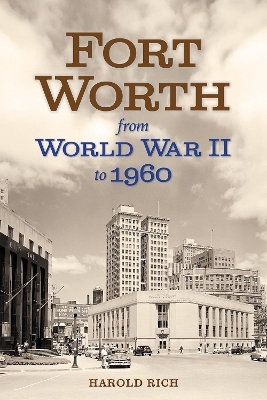
Fort Worth from World War II to 1960 Volume 11
Seiten
2025
University of North Texas Press,U.S. (Verlag)
978-1-57441-984-9 (ISBN)
University of North Texas Press,U.S. (Verlag)
978-1-57441-984-9 (ISBN)
Fort Worth from World War II to 1960 reviews Fort Worth’s history during the challenging times of World War II, the postwar adjustment period, and the first full decade of the Cold War. Harold Rich tells the story in broad strokes with foci on local crime and criminals, vice, the police, race relations, and economic development. What emerges is a portrait of a growing city developing major urban accoutrements such as industrialization, freeways, and an art infrastructure while also struggling with an active and sizable criminal underworld and the emerging Civil Rights Movement. The overall impression is that the nearly two decades from 1942 to 1960 were critical to transitioning Fort Worth from a nineteenth- to a twentieth-century city, but the end result was not an unqualified success.
Fort Worth would achieve significant economic progress in the 1940s, especially from the addition of Convair, that would expand its population at a fast pace but would lose much of that momentum in the 1950s. During both decades the police confronted rising demands related to traffic control and internal corruption that most notably affected their ability to deal with gambling and prostitution, both of which seemed to be everywhere. As the 1950s drew to a close, both vices began to subside, more from a decline in public acceptance than from police activity.
In the 1940s and 1950s, Fort Worth’s criminal underworld was a major presence, heavily involved in vice and in several daring robberies, including a thwarted plan to rob Carswell Air Force Base. The most notorious gangsters met their ends in a long-running series of internal conflicts that began during the war and destroyed most of that underworld. At the same time, the postwar period witnessed the spread of illegal drug use across broad societal lines, sparking a corresponding response by police. In contrast, little changed regarding race relations despite the efforts of many local activists and favorable rulings emanating from the nation’s courts. More significant progress would come in the 1960s and accelerate thereafter.
Fort Worth would achieve significant economic progress in the 1940s, especially from the addition of Convair, that would expand its population at a fast pace but would lose much of that momentum in the 1950s. During both decades the police confronted rising demands related to traffic control and internal corruption that most notably affected their ability to deal with gambling and prostitution, both of which seemed to be everywhere. As the 1950s drew to a close, both vices began to subside, more from a decline in public acceptance than from police activity.
In the 1940s and 1950s, Fort Worth’s criminal underworld was a major presence, heavily involved in vice and in several daring robberies, including a thwarted plan to rob Carswell Air Force Base. The most notorious gangsters met their ends in a long-running series of internal conflicts that began during the war and destroyed most of that underworld. At the same time, the postwar period witnessed the spread of illegal drug use across broad societal lines, sparking a corresponding response by police. In contrast, little changed regarding race relations despite the efforts of many local activists and favorable rulings emanating from the nation’s courts. More significant progress would come in the 1960s and accelerate thereafter.
Harold Rich, a Fort Worth resident for seventy years, earned his PhD from Texas Christian University. He is the author of Fort Worth: Outpost, Cowtown, Boomtown (winner of the Al Lowman Award from the Texas State Historical Association) and Fort Worth between the World Wars, as well as articles in the East Texas Historical Journal and the West Texas Historical Review.
| Erscheinungsdatum | 04.10.2025 |
|---|---|
| Reihe/Serie | Texas Local Series |
| Zusatzinfo | 27 b&w illus. |
| Verlagsort | Denton |
| Sprache | englisch |
| Maße | 152 x 229 mm |
| Themenwelt | Sachbuch/Ratgeber ► Geschichte / Politik ► Regional- / Landesgeschichte |
| Geisteswissenschaften ► Geschichte ► Allgemeine Geschichte | |
| Geisteswissenschaften ► Geschichte ► Regional- / Ländergeschichte | |
| ISBN-10 | 1-57441-984-6 / 1574419846 |
| ISBN-13 | 978-1-57441-984-9 / 9781574419849 |
| Zustand | Neuware |
| Informationen gemäß Produktsicherheitsverordnung (GPSR) | |
| Haben Sie eine Frage zum Produkt? |
Mehr entdecken
aus dem Bereich

aus dem Bereich
eine Geschichte der Vereinigten Staaten von 1950 bis heute
Buch | Hardcover (2024)
Klett-Cotta (Verlag)
CHF 48,95


