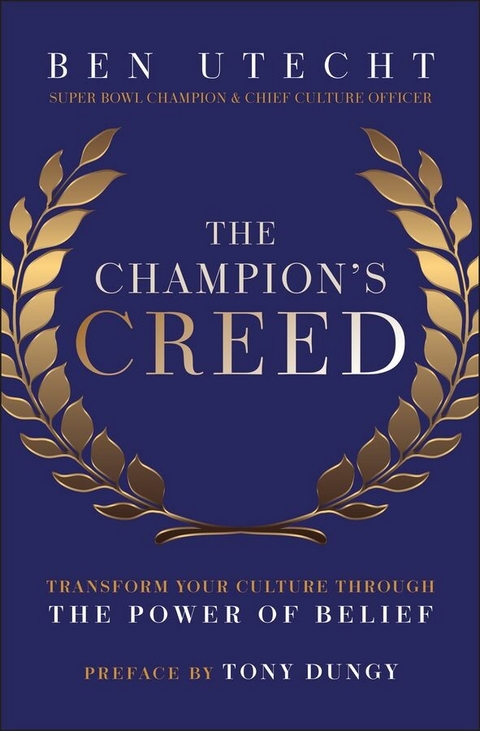
The Champion's Creed (eBook)
175 Seiten
Wiley (Verlag)
978-1-394-33124-6 (ISBN)
Visionary strategies from former NFL star to infuse your company's Culture with purpose and direction
In The Champion's Creed, NFL star and Chief Culture Officer Ben Utecht unveils the blueprint for forging unbeatable teams in any arena. Central to Utecht's methodology is the creation of a 'Culture Creed'-a dynamic manifesto that transcends typical mission statements. This powerful tool becomes the compass guiding every decision, action, and interaction within an organization. Readers will learn how to craft and implement their own Culture Creed, infusing their company's Culture with purpose and direction. Drawing from his unique journey from Super Bowl victor to leading corporate strategist, Utecht melds gridiron wisdom with executive acumen, presenting a transformative approach to culture, leadership, and team building that promises to show readers how to:
- Synchronize fundamental beliefs with business objectives
- Nurture an atmosphere that naturally boosts productivity
- Master the 'Four L's' of exemplary guidance: Listening, Learning, Language, and Love
- Develop a potent 'Ethos Declaration' to steer every facet of operations
Whether you're helming a startup or steering a Fortune 500 behemoth, The Champion's Creed not only provides an essential resource for visionaries aiming to leave an indelible mark on their industry but also gives us the secrets to building a legacy of success, inspiring peak performance, and creating an organizational culture that stands the test of time.
BEN UTECHT is a renowned corporate leadership and culture expert. He's the Chief Culture Officer for True North Private Equity and a former Super Bowl Champion. He is a recipient of the Uncommon Leader Award from NFL Hall of Fame coach Tony Dungy. His philosophy centers on intentional culture design, empowering companies to create and implement strategies that drive bottom-line improvement while developing individuals.
Visionary strategies from former NFL star to infuse your company's Culture with purpose and direction In The Champion's Creed, NFL star and Chief Culture Officer Ben Utecht unveils the blueprint for forging unbeatable teams in any arena. Central to Utecht's methodology is the creation of a Culture Creed a dynamic manifesto that transcends typical mission statements. This powerful tool becomes the compass guiding every decision, action, and interaction within an organization. Readers will learn how to craft and implement their own Culture Creed, infusing their company's Culture with purpose and direction. Drawing from his unique journey from Super Bowl victor to leading corporate strategist, Utecht melds gridiron wisdom with executive acumen, presenting a transformative approach to culture, leadership, and team building that promises to show readers how to: Synchronize fundamental beliefs with business objectives Nurture an atmosphere that naturally boosts productivity Master the Four L's of exemplary guidance: Listening, Learning, Language, and Love Develop a potent Ethos Declaration to steer every facet of operations Whether you're helming a startup or steering a Fortune 500 behemoth, The Champion's Creed not only provides an essential resource for visionaries aiming to leave an indelible mark on their industry but also gives us the secrets to building a legacy of success, inspiring peak performance, and creating an organizational culture that stands the test of time.
2
What Is Culture?
Organizational culture is the lifeblood of any institution, a dynamic force that shapes behavior, drives performance, and ultimately determines success. It is, as one of the foremost experts in the field, renowned organizational psychologist Dr. Edgar Schein, eloquently puts it, “a pattern of shared basic assumptions learned by a group as it solved its problems of external adaptation and internal integration.”1 This profound insight encapsulates the essence of culture as a learned phenomenon, deeply ingrained in the collective psyche of an organization.
In today's rapidly evolving business landscape, the importance of a strong, purposeful organizational culture cannot be overstated. It is the invisible hand that guides decision‐making, fosters innovation, and creates a sense of belonging among team members. As leaders, we must recognize that culture is not merely a buzzword or an intangible concept, but a powerful tool that can be strategically shaped and leveraged to drive organizational success.
The foundation of a robust organizational culture lies in the alignment of beliefs, values, and behaviors. It is imperative that we, as leaders, articulate a clear set of beliefs that produce values and expectations that serve as the North Star for our teams. These objectives and aligned beliefs should be the bedrock upon which we build our organizational ethos, guiding every action and decision. As John C. Maxwell, renowned leadership expert, astutely observes, “A leader is one who knows the way, goes the way, and shows the way.”2 In the context of organizational culture, this means not only defining the cultural norms but also exemplifying them in our daily conduct.
One of the most powerful aspects of organizational culture is its ability to unite diverse individuals for a common purpose. As a chief culture officer, alongside professor emeritus Dr. Daniel Zismer, I define culture as “What we believe, why we believe, and how we behave.”3 This succinct description underscores the holistic nature of culture, encompassing not just actions but also the underlying motivations and beliefs that drive them. By fostering a shared belief system, we can create a sense of unity and purpose that transcends individual differences and propels the organization toward its goals.
It is crucial to understand that organizational culture is not static; it is a living, breathing entity that requires constant nurturing and reinforcement. As leaders, we must be proactive in shaping and maintaining the desired culture. This involves not only articulating the cultural values but also embedding them in every aspect of organizational life—from hiring practices and onboarding processes to performance evaluations and reward systems. As Dr. Schein emphasizes, “The only thing of real importance that leaders do is to create and manage culture.”4
Moreover, we must recognize that culture is not something that can be imposed from the top down. It must be inspired from top down and chosen by its members. That's how you create a culture movement. Leadership should always strive for a transformative process, not a conforming process that focuses on power and control. While leadership plays a crucial role in setting the tone, true cultural transformation occurs when every member of the organization internalizes and embodies the shared beliefs and values. This requires consistent communication, leading by example, and creating opportunities for employees to actively participate in shaping and reinforcing the culture.
In today's increasingly complex and uncertain business environment, a strong organizational culture can be a significant source of competitive advantage. It can foster resilience, adaptability, and innovation—qualities that are essential for long‐term success. As John C. Maxwell wisely states, “The pessimist complains about the wind. The optimist expects it to change. The leader adjusts the sails.”5 A robust culture equips organizations with the ability to adjust their sails in the face of changing winds, maintaining course toward their objectives.
To illustrate the power of a strong organizational culture, let's examine the case of the 2006 Indianapolis Colts, my team that achieved the pinnacle of NFL success by winning a Super Bowl championship. This triumph wasn't just a result of athletic prowess; it was a testament to the power of a carefully cultivated team culture.
The Colts' journey to success began with a deliberate choice to establish a specific cultural framework, known as the “Colts Way.” This wasn't a vague concept or a catchy slogan; it was a comprehensive belief system that permeated every aspect of the organization. From the owner, Jim Irsay, down to the newest recruit, everyone was inspired to buy into and embody this culture.
At the heart of the Colts' culture was the leadership of Hall of Fame coach Tony Dungy. He recognized that a team is more than just a collection of talented individuals; it's a complex ecosystem of human beliefs, motivations, and behaviors. His challenge was to create a family out of 53 diverse individuals, each with their own backgrounds, personalities, and aspirations. We have an acronym for family in football: “Forget About Me, I Love You.” Our team united through the belief that selflessness inspires commitment and loyalty.
Dungy's approach exemplifies Dr. Zismer's principle that “culture is the leader's choice.”6 He took responsibility for shaping the team's culture, making it objective and tangible rather than leaving it to chance. By drawing a clear line in the sand, Dungy created a structured environment that allowed each player to achieve their greatest potential and contribute to the team's success.
This chosen culture wasn't just about winning games; it was about fostering a sense of unity and purpose that transcended individual differences. It was about creating an environment where every team member felt valued, understood their role, and was committed to a common goal. This aligns perfectly with Dr. Schein's observation that culture is “the deeper level of basic assumptions and beliefs that are shared by members of an organization, that operate unconsciously and define in a basic ‘taken for granted’ fashion an organization's view of its self and its environment.”7
The success of the Colts demonstrates that culture doesn't have to be subjective or left to chance. It can be an objective tool that directly impacts the behaviors of team members, resulting in ultimate success. This is a crucial lesson for all organizations, not just sports teams. As leaders, we have the power and responsibility to choose and shape our organizational culture deliberately.
The Colts' experience also highlights the importance of alignment between beliefs, values, and behaviors. Everything we do is connected to what we believe, and why we believe, which both drive toward how we behave. By establishing a clear set of beliefs and expectations, the Colts created a framework that guided the actions and decisions of every team member, from our star quarterback Peyton Manning to the support staff.
This alignment is crucial in any organization. When our collective behaviors are consistently guided by shared beliefs, we create a powerful synergy that can propel our organization to unprecedented heights of success and impact. It's not enough to have values written on a wall; they must be lived and breathed by every member of the organization.
The Colts' success also illustrates John C. Maxwell's observation that “The greatest leadership principle that I have ever learned in over twenty‐five years of leadership is that those closest to the leader will determine the success level of that leader.”8 By cultivating a strong, positive culture, Dungy created an environment where leadership could flourish at all levels of the organization. Players felt empowered to contribute their best and to lead in their own way.
This principle applies equally in the business world. When we create a culture that empowers and inspires our team members, we multiply our leadership impact. We create an organization where everyone feels responsible for success and where leadership is not confined to those with formal titles.
The Colts' journey also demonstrates that culture is not something that can be established once and then forgotten. It requires constant reinforcement and nurturing. Dungy and his coaching staff had to consistently communicate and exemplify the cultural beliefs and values they wanted to see in the team. They had to make tough decisions that aligned with these beliefs and values, even when it might have been easier to compromise.
Now let's be honest—the NFL is an intense industry, and while I am highlighting the positive aspects of coaching behavior and intentions, we had plenty of moments where coaches and players alike failed to behave in a manner reflecting our culture. It was in those moments when we could lean on the core beliefs and values installed by Dungy's coaching style and practice a little corporate grace (okay, maybe a lot of grace sometimes), and refocus our attitudes, prioritizing a team‐first mindset.
One example that comes to mind is the way in which some assistant coaches chose to motivate players to perform better. Their choice of words at times could be brutal, vulgar, and...
| Erscheint lt. Verlag | 28.4.2025 |
|---|---|
| Vorwort | Tony Dungy |
| Sprache | englisch |
| Themenwelt | Sachbuch/Ratgeber ► Beruf / Finanzen / Recht / Wirtschaft ► Bewerbung / Karriere |
| Wirtschaft ► Betriebswirtschaft / Management | |
| Schlagworte | Business Advice • Business Growth • Business Objectives • business productivity • business vision • company manifesto • Corporate Culture • Executive Development • Leadership Training • Mission Statement • nfl business • team productivity |
| ISBN-10 | 1-394-33124-X / 139433124X |
| ISBN-13 | 978-1-394-33124-6 / 9781394331246 |
| Informationen gemäß Produktsicherheitsverordnung (GPSR) | |
| Haben Sie eine Frage zum Produkt? |
 EPUB (Adobe DRM)
Kopierschutz: Adobe-DRM
Adobe-DRM ist ein Kopierschutz, der das eBook vor Mißbrauch schützen soll. Dabei wird das eBook bereits beim Download auf Ihre persönliche Adobe-ID autorisiert. Lesen können Sie das eBook dann nur auf den Geräten, welche ebenfalls auf Ihre Adobe-ID registriert sind.
Details zum Adobe-DRM
Dateiformat: EPUB (Electronic Publication)
EPUB ist ein offener Standard für eBooks und eignet sich besonders zur Darstellung von Belletristik und Sachbüchern. Der Fließtext wird dynamisch an die Display- und Schriftgröße angepasst. Auch für mobile Lesegeräte ist EPUB daher gut geeignet.
Systemvoraussetzungen:
PC/Mac: Mit einem PC oder Mac können Sie dieses eBook lesen. Sie benötigen eine
eReader: Dieses eBook kann mit (fast) allen eBook-Readern gelesen werden. Mit dem amazon-Kindle ist es aber nicht kompatibel.
Smartphone/Tablet: Egal ob Apple oder Android, dieses eBook können Sie lesen. Sie benötigen eine
Geräteliste und zusätzliche Hinweise
Buying eBooks from abroad
For tax law reasons we can sell eBooks just within Germany and Switzerland. Regrettably we cannot fulfill eBook-orders from other countries.
aus dem Bereich