


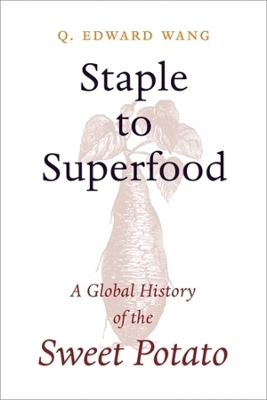
Staple to Superfood
A Global History of the Sweet Potato
Seiten
2025
Columbia University Press (Verlag)
978-0-231-21736-1 (ISBN)
Columbia University Press (Verlag)
978-0-231-21736-1 (ISBN)
Staple to Superfood explores the sweet potato’s rich history and remarkable global influence, from the Americas to Europe to Asia and the Pacific.
Sweet potatoes were among the American crops Christopher Columbus brought back to Europe—where they were thought to be an aphrodisiac. In China, this versatile root became a staple that fueled rapid population growth. Introduced to Japan to stave off famine, sweet potatoes later sustained the country’s imperial expansion. Because this hardy plant can thrive in almost any soil, it has long been cultivated as a subsistence crop in Southeast Asia, Africa, and Oceania. In recent years, Western health experts have begun touting the humble sweet potato as a “superfood” with numerous nutritional benefits.
Considering these events and many others, Staple to Superfood explores the sweet potato’s rich history and remarkable global influence. Q. Edward Wang demonstrates how this resilient root has not only nourished communities but also defined their identities. Tracing its journeys through the intricate networks of global trade and cultural exchange, he shows how the sweet potato transformed agricultural practices, culinary traditions, and social structures worldwide. From the Americas to Europe to Asia and the Pacific, the spread of this crop illuminates the varied paths that global development has taken. Wang also contrasts the sweet potato with its botanically unrelated namesake, the white potato. Blending agricultural, cultural, and historical perspectives, Staple to Superfood offers a fresh look at the power of food to transform societies. It is a compelling exploration of how the sweet potato shaped the modern world and continues to influence global food systems today.
Sweet potatoes were among the American crops Christopher Columbus brought back to Europe—where they were thought to be an aphrodisiac. In China, this versatile root became a staple that fueled rapid population growth. Introduced to Japan to stave off famine, sweet potatoes later sustained the country’s imperial expansion. Because this hardy plant can thrive in almost any soil, it has long been cultivated as a subsistence crop in Southeast Asia, Africa, and Oceania. In recent years, Western health experts have begun touting the humble sweet potato as a “superfood” with numerous nutritional benefits.
Considering these events and many others, Staple to Superfood explores the sweet potato’s rich history and remarkable global influence. Q. Edward Wang demonstrates how this resilient root has not only nourished communities but also defined their identities. Tracing its journeys through the intricate networks of global trade and cultural exchange, he shows how the sweet potato transformed agricultural practices, culinary traditions, and social structures worldwide. From the Americas to Europe to Asia and the Pacific, the spread of this crop illuminates the varied paths that global development has taken. Wang also contrasts the sweet potato with its botanically unrelated namesake, the white potato. Blending agricultural, cultural, and historical perspectives, Staple to Superfood offers a fresh look at the power of food to transform societies. It is a compelling exploration of how the sweet potato shaped the modern world and continues to influence global food systems today.
Q. Edward Wang is Eminent Professor of the College of Humanities and Social Sciences at Rowan University. He is the author of Chopsticks: A Cultural and Culinary History (2015), among other works on global cultural history.
List of Illustrations
Acknowledgments
Introduction
1. American Origin and Oceanian Diffusion
2. A Sweet Connection Between Europe and America
3. Mundane or Miracle? Feeding and Fueling China’s Population
4. Hunger Food? Daily Meals? Sweet Potato in Japan and Korea
5. Sweet Potato Islands, Sweet Potato Peoples
6. From “Asian Crop” to “African Crop”: Recent Global Expansions
Epilogue
Notes
Selected Bibliography
Index
| Erscheinungsdatum | 17.10.2025 |
|---|---|
| Reihe/Serie | Columbia Studies in International and Global History |
| Zusatzinfo | 6 b&w Illustrations, 1 map |
| Verlagsort | New York |
| Sprache | englisch |
| Maße | 152 x 229 mm |
| Themenwelt | Sachbuch/Ratgeber ► Essen / Trinken ► Themenkochbücher |
| Geisteswissenschaften ► Geschichte ► Allgemeine Geschichte | |
| Geisteswissenschaften ► Geschichte ► Regional- / Ländergeschichte | |
| Sozialwissenschaften | |
| ISBN-10 | 0-231-21736-6 / 0231217366 |
| ISBN-13 | 978-0-231-21736-1 / 9780231217361 |
| Zustand | Neuware |
| Informationen gemäß Produktsicherheitsverordnung (GPSR) | |
| Haben Sie eine Frage zum Produkt? |
Mehr entdecken
aus dem Bereich



aus dem Bereich
schnell, gesund und kindgerecht
Buch | Softcover (2025)
Gräfe und Unzer (Verlag)
CHF 19,90
Franz Kafkas vegetarische Verwandlung in 544 Rezepten
Buch | Hardcover (2025)
Klett-Cotta (Verlag)
CHF 48,90


