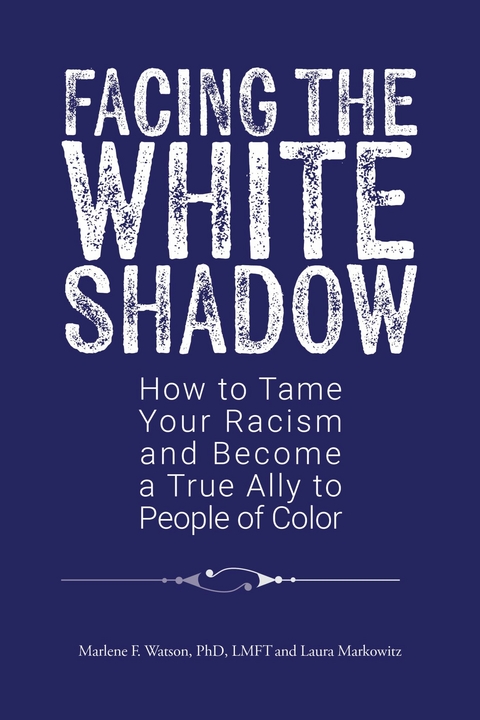
Facing the White Shadow (eBook)
232 Seiten
Story Bridge Books (Verlag)
979-8-9913953-1-1 (ISBN)
Laura Markowitz is a National Magazine Award-winning feature writer, contributing producer for Arizona Public Media, and a book writer and editor. Her articles, radio series, and TV productions focus on social justice and systems change. She is coauthor of Voices On The Economy: How Open- Minded Exploration of Rival Perspectives Can Spark New Solutions to Our Urgent Economic Problems (VOTE 2023), coeditor of The Art of Psychotherapy (Wylie, 1999) and The Evolving Therapist (Guilford, 1992), and former editorin- chief of the award-winning magazine for LGBTQ people and their loved ones, In the Family.
Facing the White Shadow: How to Tame Your Racism and Become a True Ally to People of Color is for White people who are just starting the work of understanding their racism and also for those who have been doing the work but still experience anxiety and wonder what they might be doing wrong. Many White people often feel feel overwhelmed, ashamed, and confused about how to be trustworthy antiracist allies to people of color. Facing the White Shadow is a self-help book that guides White readers to understand and manage their own racism. Readers learn how to be vigilant and talk back to their internalized racism---their White shadows--- so they can enjoy authentic and mutually satisfying relationships with people of color. No more tensing up at work when race is discussed. No more fear of being misunderstood by friends or called out or cancelled on social media. Filled with relatable stories, exercises, and solid advice, this book offers a compassionate framework for White readers without minimizing the devastating effects of racism on people of color. The book is a unique collaboration between a preeminent Black couple and family therapist who is also a longtime trainer in the field of diversity, equity, and inclusion, and a White journalist who has reported on issues of racial, social, and economic justice for decades.
CHAPTER 1
Meet Your White Shadow
“Race” is the idea that humans can be differentiated into groups that have distinct inherited physical and behavioral differences. Racism is the belief that certain groups are inherently inferior. It is a way to justify prejudice and discrimination against those groups. But science has shown that human beings are more similar than we are different. Biologically, we are fundamentally the same. We all bleed red. We all have the same needs and drives. Yet, our ideas about one another continue to be shaped by racism. I (Marlene) read a remarkable New York Times opinion piece by Brent Staples on October 12, 2019, entitled, “How Italians Became White.” It described how darker-skinned southern Italians had long been viewed as savages by lighter-skinned northern Italians. When southern Italians emigrated to the United States, they were persecuted as people of color—criminalized, discriminated against, and even lynched by angry White people. Today, we don’t consider an Italian person of European descent as a person of color, but there was a time in history when they were called White nigger and nigger wop.
Race is one of the most pernicious lies humanity has ever propagated, and it is also one of the most disastrous for all of us. Think about how much better your life would have been if all human beings, regardless of their “race,” had been allowed to realize their potential and contribute their genius to the world. We might have already solved the world’s problems. More of us could be able to experience well-being and security. So why do we believe so strongly in racial differences? Some historians suggest that early humans developed xenophobia, the fear and hatred of strangers or foreigners, as a survival mechanism. Until you knew for certain that a stranger wasn’t going to murder you or your loved ones, you kept up your guard. Strangers were people who weren’t in your group. The most obvious way you knew this was because they didn’t look like you. That seems like a credible argument, but it has been challenged by others who point to boatloads of evidence of cooperation among groups of strangers. If your group cooperated through trade, intermarriage, and mutual aid, everyone’s chances of survival were enhanced. My point is that none of us should give ourselves a pass and say our fear of the “other” is natural, normal, or somehow baked into our DNA. It’s a learned phenomenon we can challenge and transform.
When you step back from the human-made story of race, you realize how ridiculous it is that we differentiate ourselves based on the least important aspects of who we are. The color of our skin, the texture or color of our hair, the size and shape of our nose, or the color of our eyes—they have absolutely nothing to do with our amazing human potential. Our intelligence, morality, compassion, abilities, and wisdom are not in any way linked to our appearance, yet we are sorted and judged, included or excluded, and allowed or not allowed based on this false idea of “race.” The institutions of American society were founded on the false assumption that White people are superior to people of color. This wrong thinking was used by White people to justify the enslavement of Africans, the genocide of First Peoples, and the colonization of much of the planet by White Europeans. In the history of humanity, racism is a recurring tragic theme. Sitting here today, even understanding that race is something we made up and racism is wrong thinking, we’re still left to grapple with the deeply embedded lie of White superiority. It is woven into our religions, justice system, political system, economic system, education system, media, arts and entertainment industries, and every other facet of society. And most tragic of all, it is lodged in our own minds. You haven’t escaped from the infection of racism. Neither have I. I can imagine that it’s challenging to see yourself as a participant in a system that grinds down and chews up Black people, Indigenous people, and other people of color (BIPOC). But, unfortunately, every one of us is assigned a role in this tragedy. As a White person, your role—if left unchallenged—will default to upholding and perpetuating systemic racism. This book will help you understand how you can recast yourself as a trustworthy anti-racist ally to people of color.
Whenever I give workshops on this topic, I see White people’s eyes glaze over when I use the term “systemic racism” because it seems too abstract. Let me make it more personal. I’m talking about the violence we BIPOC experience on a routine basis at the hands of the police and criminal justice system. I’m talking about the violence at the hands of White vigilantes who shoot us simply for walking down the street or call the police because a person of color rings their doorbell and they feel threatened. I’m talking about medical professionals ignoring or minimizing the symptoms of Black people and treating us with disrespect because they assume we are addicts or not intelligent enough to understand our conditions. Did you know BIPOC have more amputations from diabetes, more premature deaths from treatable illnesses, more chronic diseases, and higher rates of infant mortality as a result of higher levels of stress than White people? I feel stressed just thinking about it. And these are just a few quick examples of the physical threat racism poses to people of color. On top of all this, systemic racism causes us to be more likely than White people to live in poverty. That means we suffer at a higher rate from conditions caused by deprivation including suicide, malnutrition, eating disorders, and substance abuse.
For hundreds of years, BIPOC in the United States have struggled to live lives of dignity and find happiness and personal fulfillment despite systemic racism. But it’s always going to be an uphill battle until those systems are washed clean of the false notion that White people are superior and people of color are inferior. We are full human beings, and we deserve the opportunity to create meaningful lives and contribute our best to a society that respects and values us.
Let’s talk about you and me. We both developed automatic filters through which we make assumptions—constantly—about the morality, intelligence, and worthiness of ourselves and our fellow human beings. Like everyone else, we were taught that race is real and that White people are better than everyone else. The most obvious victims of this thinking are BIPOC. We are the ones who get passed over for promotions, killed by police during routine traffic stops, racially profiled at border checkpoints, and viewed suspiciously when we’re at the bank, in the parking lot, in the classroom, or waiting for a bus. It may be less obvious to you that White people are also victims of racism. Whenever you use race as a justification for violence, genocide, theft, or even the casual cruelty of workplace bullying, you dim your own light. You lose a part of your own soul. When you look the other way while BIPOC are harmed, discriminated against, excluded, and disrespected your humanity is at risk. We’re all harmed by racism because it falsely divides us and then drives us apart. It causes us to live in fear of one another. What a loss! Just imagine how far humanity could have advanced if we had learned to appreciate and embrace diversity instead of enshrining racism. It may take generations to completely eradicate systemic racism. (I know there are those who doubt it’s possible, but I choose to hope.) However, the good news is that it is in your power—right now—to challenge your own racism.
Many White people have confided to me that they feel confused, ashamed, and defensive when they have racist thoughts and reactions. I imagine you (hello!) as a well-meaning White person who is concerned and probably also confused and anxious about racism. I imagine you’re troubled by the fact that racism continues to impact the lives of BIPOC. You want to be part of the solution, but you’re not completely clear on what you should be doing or how you, personally, can dismantle the systems that keep racism in place. I wrote this book to be your guide to dismantling the one “system” you have absolute control over: yourself. We’re going to teach you how to be in a new relationship with your own internalized racism—a relationship that puts you in charge and prevents prejudice from spilling into the world. My coauthor, Laura, and I wrote this book with high hopes for you and infused it with our best wishes for your well-being. We sincerely hope that comes through in and between the lines of these pages.
In these pages, you’ll learn how to face your racism and talk back to it in constructive ways so that it stops having a subconscious hold over your thoughts, actions, and speech. White families rarely teach their children how to deal with racism. You may not have had open conversations about the complications of being White in a racist society. You were probably taught to be afraid of people of color even if no racist comments were ever made at your dinner table. We all absorb negative ideas about people of color just by watching television and movies, seeing the news, reading novels, going to a store, or sitting in a classroom. The skin color and ethnicity of the heroes, fashion models, sports stars, beloved historical figures, politicians, and other role models of success, beauty, intelligence, and ingenuity have long been overwhelmingly White....
| Erscheint lt. Verlag | 22.5.2025 |
|---|---|
| Sprache | englisch |
| Themenwelt | Sachbuch/Ratgeber ► Gesundheit / Leben / Psychologie ► Lebenshilfe / Lebensführung |
| ISBN-13 | 979-8-9913953-1-1 / 9798991395311 |
| Informationen gemäß Produktsicherheitsverordnung (GPSR) | |
| Haben Sie eine Frage zum Produkt? |
 EPUB (Ohne DRM)
Größe: 1,8 MB
Digital Rights Management: ohne DRM
Dieses eBook enthält kein DRM oder Kopierschutz. Eine Weitergabe an Dritte ist jedoch rechtlich nicht zulässig, weil Sie beim Kauf nur die Rechte an der persönlichen Nutzung erwerben.
Dateiformat: EPUB (Electronic Publication)
EPUB ist ein offener Standard für eBooks und eignet sich besonders zur Darstellung von Belletristik und Sachbüchern. Der Fließtext wird dynamisch an die Display- und Schriftgröße angepasst. Auch für mobile Lesegeräte ist EPUB daher gut geeignet.
Systemvoraussetzungen:
PC/Mac: Mit einem PC oder Mac können Sie dieses eBook lesen. Sie benötigen dafür die kostenlose Software Adobe Digital Editions.
eReader: Dieses eBook kann mit (fast) allen eBook-Readern gelesen werden. Mit dem amazon-Kindle ist es aber nicht kompatibel.
Smartphone/Tablet: Egal ob Apple oder Android, dieses eBook können Sie lesen. Sie benötigen dafür eine kostenlose App.
Geräteliste und zusätzliche Hinweise
Buying eBooks from abroad
For tax law reasons we can sell eBooks just within Germany and Switzerland. Regrettably we cannot fulfill eBook-orders from other countries.
aus dem Bereich