


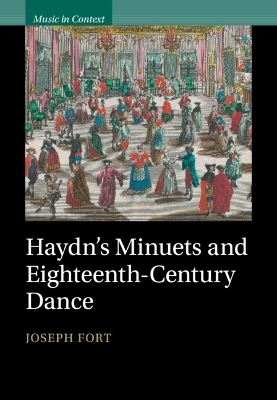
Haydn's Minuets and Eighteenth-Century Dance
Seiten
2025
Cambridge University Press (Verlag)
978-1-009-51559-7 (ISBN)
Cambridge University Press (Verlag)
978-1-009-51559-7 (ISBN)
Audiences in eighteenth-century Vienna attended the city's popular public balls, where they danced the minuet. This book reconstructs this dance, enabling audiences today to understand Haydn's minuets through the kinaesthetic associations and expectations that bodily knowledge of the dance brings, revealing previously hidden features of this music.
Audiences in eighteenth-century Vienna attended the city's popular public balls, where they danced the minuet. This book explores the public dance culture of Vienna in the late eighteenth century as an essential context in which to understand minuet composition from this period, focusing on the music of Haydn, and restores the array of kinaesthetic associations and expectations that eighteenth-century audiences brought to the listening experience through their knowledge of the dance. It reconstructs the choreography of the minuet as it was performed in the Viennese dance halls and examines the repertoire of minuets composed specifically for dancing, bringing new perspectives to the minuet genre. This recovered bodily knowledge allows the author to put forward an analytical method of 'somatic enquiry' and apply it to Haydn's symphonic minuets from the 1790s, revealing previously hidden features in this music that come to light when listening with an understanding of the dance.
Audiences in eighteenth-century Vienna attended the city's popular public balls, where they danced the minuet. This book explores the public dance culture of Vienna in the late eighteenth century as an essential context in which to understand minuet composition from this period, focusing on the music of Haydn, and restores the array of kinaesthetic associations and expectations that eighteenth-century audiences brought to the listening experience through their knowledge of the dance. It reconstructs the choreography of the minuet as it was performed in the Viennese dance halls and examines the repertoire of minuets composed specifically for dancing, bringing new perspectives to the minuet genre. This recovered bodily knowledge allows the author to put forward an analytical method of 'somatic enquiry' and apply it to Haydn's symphonic minuets from the 1790s, revealing previously hidden features in this music that come to light when listening with an understanding of the dance.
Joseph Fort is College Organist and Director of the Chapel Choir, and Senior Lecturer in Music at King's College London. He took up this post in 2015, upon completion of his Ph.D. in Music Theory at Harvard University.
List of figures; List of tables; List of musical examples; Acknowledgements; Introduction; 1. The dance culture of late-eighteenth-century Vienna; 2. The choreography of the Viennese minuet as a group dance; 3. The music of the Viennese minuet; 4. A somatic enquiry into the minuet; 5. Somatic analysis of the concert minuets; Epilogue; Bibliography; Index.
| Erscheinungsdatum | 23.09.2025 |
|---|---|
| Reihe/Serie | Music in Context |
| Zusatzinfo | Worked examples or Exercises |
| Verlagsort | Cambridge |
| Sprache | englisch |
| Gewicht | 611 g |
| Themenwelt | Kunst / Musik / Theater ► Musik ► Klassik / Oper / Musical |
| Sachbuch/Ratgeber ► Sport ► Tanzen / Tanzsport | |
| ISBN-10 | 1-009-51559-4 / 1009515594 |
| ISBN-13 | 978-1-009-51559-7 / 9781009515597 |
| Zustand | Neuware |
| Informationen gemäß Produktsicherheitsverordnung (GPSR) | |
| Haben Sie eine Frage zum Produkt? |
Mehr entdecken
aus dem Bereich

aus dem Bereich
Essays und Gespräche
Buch | Hardcover (2025)
Wallstein Erfolgstitel (Verlag)
CHF 29,90


