


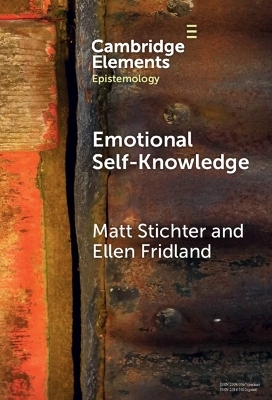
Emotional Self-Knowledge
How Affective Skills Reveal Our Values, Goals, Cares, and Concerns
Seiten
2025
Cambridge University Press (Verlag)
978-1-009-49456-4 (ISBN)
Cambridge University Press (Verlag)
978-1-009-49456-4 (ISBN)
This Element solves the puzzle of why bodily and emotional self-knowledge is strongly associated with good mental health and well-being by mapping out the connections between bodily states, emotional states, and the intended goals.
Knowledge of our emotional and bodily states helps us to further know our goals, values, interests, cares, and concerns. The authors first lay out a puzzle as to why bodily and emotional self-knowledge is strongly associated with good mental health and well-being. They solve this puzzle by mapping out connections between bodily states, emotional states, and our goals with an account of emotions as embodied appraisals. Emotions being embodied implies that self-knowledge of our bodily states aids in acquiring knowledge of our emotional states. Emotions as appraisals means that situations are appraised relative to our goals, such that self-knowledge of emotional states aids in acquiring knowledge of our goals, which are not always transparent to us. While emotional self-knowledge can be difficult to acquire, through skilled practice we can improve awareness and knowledge of our emotional and bodily states.
Knowledge of our emotional and bodily states helps us to further know our goals, values, interests, cares, and concerns. The authors first lay out a puzzle as to why bodily and emotional self-knowledge is strongly associated with good mental health and well-being. They solve this puzzle by mapping out connections between bodily states, emotional states, and our goals with an account of emotions as embodied appraisals. Emotions being embodied implies that self-knowledge of our bodily states aids in acquiring knowledge of our emotional states. Emotions as appraisals means that situations are appraised relative to our goals, such that self-knowledge of emotional states aids in acquiring knowledge of our goals, which are not always transparent to us. While emotional self-knowledge can be difficult to acquire, through skilled practice we can improve awareness and knowledge of our emotional and bodily states.
1. Introduction; 2. The puzzle of 'Feeling Well'; 3. Solving the puzzle; 4. Emotions and Self-Knowledge; 5. Self-Knowledge can be difficult to acquire; 6. Conclusion; References.
| Erscheinungsdatum | 24.06.2025 |
|---|---|
| Reihe/Serie | Elements in Epistemology |
| Zusatzinfo | Worked examples or Exercises |
| Verlagsort | Cambridge |
| Sprache | englisch |
| Maße | 152 x 229 mm |
| Gewicht | 275 g |
| Themenwelt | Sachbuch/Ratgeber ► Gesundheit / Leben / Psychologie ► Psychologie |
| Geisteswissenschaften ► Philosophie ► Erkenntnistheorie / Wissenschaftstheorie | |
| Geisteswissenschaften ► Psychologie | |
| ISBN-10 | 1-009-49456-2 / 1009494562 |
| ISBN-13 | 978-1-009-49456-4 / 9781009494564 |
| Zustand | Neuware |
| Informationen gemäß Produktsicherheitsverordnung (GPSR) | |
| Haben Sie eine Frage zum Produkt? |
Mehr entdecken
aus dem Bereich


aus dem Bereich
Buch | Softcover (2021)
Kohlhammer (Verlag)
CHF 39,95
Spektrum, Ursachen, Diagnose, Therapie und Beratung
Buch | Softcover (2024)
Kohlhammer (Verlag)
CHF 39,95
Imagery Rescripting & Reprocessing Therapy bei Traumafolgestörungen, …
Buch | Softcover (2025)
Klett-Cotta (Verlag)
CHF 76,95


