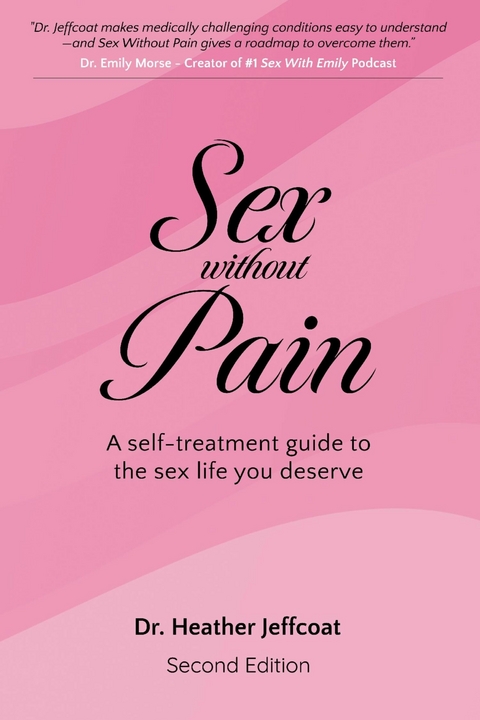
Sex Without Pain (eBook)
100 Seiten
Bookbaby (Verlag)
979-8-3509-9825-2 (ISBN)
Dr. Heather Jeffcoat (she/her/hers) is the author of Sex Without Pain: A Self-Treatment Guide To The Sex Life You Deserve and a recognized expert in the field of Pelvic Health Physical Therapy. She is also a Past President of the Academy of Pelvic Health Physical Therapy from 2021-2024, and she has served on the Board of Directors and Advisory Board of the International Pelvic Pain Society. After receiving many emails from people around world, she noticed there was a gap in access to quality pelvic floor physical therapy providers, and women deserved answers and a treatment plan for the painful sex they were experiencing. She developed her book as a way to get her proven techniques to all who needed it. Her first edition of this book published in 2014, with this second edition available March 2025. She has been a featured guest on ABC News, The Washington Post, Vogue, Glamour, Cosmopolitan, Women's Health Magazine, Self, Shape, Huffington Post, Health and many other media outlets. Dr. Heather has also contributed to the ICA Update and the International Childbirth Education Association Journal, where she hosted the long-running quarterly column entitled 'Perinatal Wellness'. She has presented her techniques twice at the American Urogynecologic Association's (AUGS) annual meeting, most recently in 2018 in video format during their general scientific session on the topic of developing a community-based program for treating vaginismus and vulvodynia/vestibulodynia. She developed a course for providers to further her mission of improving women's sexual health, and it made its debut in Istanbul, Turkey in Spring of 2019. In Summer 2019, she worked with the Chinese Olympic Committee's summer and winter athletes in Beijing. She maintains her passion for treating sports and orthopedic injuries, and brings a whole-body approach to her work with women's sexual dysfunction and chronic pain disorders. She understands that many of her patients rarely have isolated pelvic issues as the majority also come with hip, back, neck, TMJ disorders or other orthopedic dysfunction that she concurrently treats. She knows that not addressing all of their overlapping chronic pain conditions could be driving their pain further away from a solution unless the bigger picture is addressed. Dr. Heather received her Doctor of Physical Therapy degree from Duke University and her BS in Animal Physiology and Neuroscience from UC San Diego. Additionally, she received her Comprehensive Teacher Training Certification in Pilates from BASI and is a Certified Fascial Stretch Therapist through the Stretch to Win Institute. She opened Fusion Wellness & Femina Physical Therapy in 2009, owing to the changing healthcare climate at the time that emphasized the quantity of patient care over its quality. In a situation where she had to see two patients per hour that had complex pain conditions, incontinence, or all of the above, she knew that her patients deserved to be provided with actual care, not just the idea of care. With 1-2 hour sessions, her office is able to provide the hands-on treatment, skilled corrective exercises and other interventions by specialized and licensed physical therapists so they can get on the path to putting their pain or weakness behind them.
Dr. Heather Jeffcoat offers a comprehensive, evidence-based program to help women overcome pelvic pain and achieve a fulfilling, pain-free sex life. With over 20 years of clinical experience in Women's and Pelvic Health, Dr. Jeffcoat provides practical solutions for conditions such as vaginismus, overactive pelvic floor, vulvodynia, dyspareunia, bladder pain syndrome (IC or interstitial cystitis), and endometriosis. This self-treatment guide empowers women with a step-by-step approach to diagnosing and treating the muscular components contributing to their pain. The book defines common causes of pelvic and sexual pain, explaining how muscle dysfunction and trigger points create physical discomfort. Dr. Jeffcoat emphasizes that these conditions are real, medically documented, and treatable. Through her specialized techniques, she provides women with the tools to understand their bodies and begin healing. At the core of the treatment plan is the IRAS Method, a structured exercise regimen using a dilator kit to retrain pelvic muscles. This method guides users through progressive stretching techniques to reduce muscle tension and alleviate pain. By following the IRAS Method in order, women can systematically relax the affected muscles and improve comfort during intercourse. A key part of the program is the self-assessment section, encouraging readers to identify pain areas and understand underlying causes. This medical-style evaluation helps create a personalized treatment plan for effective pain management. Dr. Jeffcoat also includes progressive relaxation exercises to address the emotional and mental aspects of pelvic and sexual pain, fostering holistic healing. Throughout the book, Dr. Jeffcoat dispels common myths about pelvic and sexual pain and its causes. She challenges misconceptions like "e;pain during sex is normal"e; and reassures readers that persistent pain is not inevitable. By debunking these myths, she reduces the stigma surrounding pelvic pain and provides accurate, science-based information. A dedicated chapter on dilator and pelvic wand techniques offers a gradual stretching regimen, and includes a valuable program for those experiencing deep pain during intercourse. Dr. Jeffcoat outlines practical steps for safe and effective dilator and pelvic wand use, including detailed instructions to prevent setbacks and enhance progress. When ready, the book offers guidance on transitioning to intercourse. This chapter emphasizes patience, partner communication (if applicable), and a gradual reintroduction of intimacy. Dr. Jeffcoat stresses the importance of listening to one's body and using the program's techniques to maintain comfort and confidence during sexual activity. To support long-term wellness, Dr. Jeffcoat includes an optional stretching program targeting large muscle groups like the hips and lower back. These exercises improve flexibility, release pelvic floor tension, and promote lasting relief. A bonus section features a progressive relaxation exercise to alleviate stress and encourage natural pelvic muscle relaxation. Dr. Jeffcoat's program addresses both the physical and emotional components of pelvic pain. Fear and anxiety related to intercourse are common among women with chronic pelvic conditions. By combining physical exercises with mental relaxation techniques, the guide offers a comprehensive, multidimensional healing approach. In summary, Sex Without Pain is an essential resource for women seeking to reclaim their sexual health and enjoy pain-free intimacy. Dr. Heather Jeffcoat's expertise and compassionate approach guide readers through every stage of the healing journey. With its blend of scientific knowledge, practical exercises, and myth-busting insights, this book is a powerful tool for anyone affected by pelvic or sexual pain. By following the program, women can take control of their bodies, reduce discomfort, and experience the satisfying sex life they deserve.
CHAPTER ONE DEFINING THE PAIN
Congratulations – you’ve just taken the first step toward the sex life you deserve! The first thing you should know is that you are not alone. My patient schedule is packed with women who struggle with painful intercourse; and my voicemail, inbox, and waiting list are perpetually full. Some of the women I treat have never experienced pain-free intercourse; others have had satisfying sex lives previously. Some look for answers right away; others have suffered in silence for years, or had their efforts and spirits derailed by poor or incomplete medical advice. Some experience pain so severe that intercourse is impossible; but a truly astounding number of women have just “learned to live” with a certain amount of pain during intercourse. No matter where you find yourself on that spectrum, this book is for you; because I believe that every woman deserves a pain-free, satisfying sex life.
The first step in treating any condition is to define the pain; but although we are all familiar with the basic descriptions that apply to muscle pain in areas like the back or neck, most women – and even some doctors – have trouble defining pelvic pain and linking it to its causes. Allow me to help.
Every woman is different; but most of the women I see share a common diagnosis of one or more of the following conditions: vaginismus, overactive pelvic floor, hypertonic pelvic floor, vulvodynia, endometriosis, interstitial cystitis/bladder pain syndrome, dyspareunia, and pelvic floor dysfunction.
What is Vaginismus?
Vaginismus is a spasm of the muscles in the vaginal wall, usually isolated to the outer one-third muscle layer. (You may also see or hear vaginismus described as Genito-Pelvic Pain/Penetration Disorder, or GPPPD.) All physical therapists are trained to treat muscle spasms throughout the body; but it takes specialized training to treat the pelvic floor. (In this case, “pelvic floor” means the muscles that surround the urethra, vagina, and rectum, and support the pelvic organs.) Take a look at this side view diagram of a normal, rested pelvic floor.
As you can see, the muscles around the openings of the urethra (leading to the bladder), the vagina (leading to the uterus) and the rectum are relaxed. It is possible for objects, stool, or fluid to pass through without causing pain. Contrast that with the following image of a pelvic floor where vaginismus is present.
The muscles around the openings of the urethra, vagina, and rectum are pulled upward and forward; this narrows, or even closes off, the openings. The result is limited space; and when fluid or objects pass through that limited space, pain is created.
My patients with vaginismus usually describe attempts at having intercourse as “hitting a wall”, and the experience is typically associated with severe pain. Several patients have even thought that they “don’t have a hole”. In fact, they do; but a high degree of spasm in the first muscle layer can make it appear that the opening to the vaginal canal has been closed. If the condition presents itself during a first attempt at intercourse, it is called primary vaginismus. Women who experience the symptoms after a history of pain-free intercourse (but often after childbirth, infection, or an injury) are diagnosed with secondary vaginismus. Treatments for both conditions may include physical therapy, medications, and muscle injections.
What is an Overactive Pelvic Floor?
The muscles in an overactive pelvic floor simply do not relax at times when relaxation is necessary to function properly. Sometimes they actually contract involuntarily when they should relax – for example, during intercourse or when inserting a tampon. Some physicians may call these muscles hypertonic or non-relaxing. An overactive pelvic floor is a condition similar to vaginismus, and patients often describe attempts at intercourse in the same ways. The physical difference lies in the resting state of the muscle. In vaginismus, the muscle may be quite relaxed at rest; but when a stretch is applied (such as inserting a tampon or attempting intercourse), the muscle will recoil and go into spasm. With an overactive pelvic floor, the muscles are always in that non-relaxing state of rest.
What is Vulvodynia?
Vulvodynia simply means “vulvar pain”. The vulva is the external female genitalia, and includes the labia, clitoris and area around the vaginal opening. The area around the vaginal opening just before the entrance to the vaginal canal is called the vulvar vestibule. If the vulvar area is inflamed, the condition is called vulvar vestibulitis and if it is painful it is diagnosed as vestibulodynia. Many of my patients come to me with vulvar symptoms as well as vaginismus or an overactive pelvic floor. Occasionally, certain oral medications, suppositories, topical creams/gels or injections may be utilized to speed up the healing process; but they are almost always prescribed in conjunction with physical therapy to optimize outcomes.
What is Dyspareunia?
Dyspareunia is a general term that means “painful intercourse”. By itself, that word does not describe the location or cause of the pain. Superficial dyspareunia describes pain with initial entry; deep dyspareunia refers to pain that may be felt on the deeper pelvic floor muscles, bladder, uterus, ovaries, or the general pelvic or abdominal area. Muscular issues may be to blame for this type of pain; but it can have other medical causes, which should be explored with your doctor.
What is Bladder Pain Syndrome?
Bladder Pain Syndrome (BPS), sometimes still referred to as Interstitial Cystitis (IC), is pelvic pain, pressure, or discomfort related to the bladder and/or urethra. Women with IC/BPS typically experience uncommon or increased urinary frequency (often more than 10 times per day), or persistent urges to pee (even when they’ve just emptied their bladder), without an infection or other illness present. Often, they suspect they have a urinary tract infection (or UTI); but their lab tests usually come back negative. IC/BPS is included in this book because a vast majority of women who have this condition also experience painful sex. In fact, IC/BPS occurs so commonly with vulvodynia and endometriosis that the medical community refers to these three conditions as “the evil triplets”.
When the first edition of Sex Without Pain was published, pelvic floor physical therapy was considered a last resort treatment for IC/BPS; but multiple studies over the past decade have supported it as one of the primary treatments. In response to the overwhelming scientific data, the American Urological Association has updated their guidelines, moving “pelvic floor physical therapy” to a top line, early intervention.2 As a result, I’ve added a section in this edition specifically to help you explore self-treatment of pain from IC/BPS and endometriosis.
Could I have Endometriosis?
Endometriosis is a condition in which endometrial-like tissue (similar to, but not the same as, the tissue that lines the uterus) is found outside the uterus. As of the publication of this second edition of this book, the only way to diagnose endometriosis definitively is through a confirmation with a biopsy during surgery.
At this time, promising emerging technologies for diagnosis are still limited in their ability to “rule in” all types of endometriosis, including asymptomatic (silent) endometriosis. An ultrasound can identify an endometriosis cyst (endometrioma) within the ovaries. Similarly, an MRI may point to a high suspicion of deep infiltrating endometriosis; but this depends highly on several factors. It’s also important to note that a “normal” ultrasound or MRI result does not rule out endometriosis. (Stage 4 endometriosis has often been missed by MRI.) Suffice to say, only surgery is definitive. And while “exploratory laparoscopies” are still performed, your surgeon should have a high degree of confidence prior to any surgical procedure that, based on your history, symptoms, and physical exam, they are likely to find and will be able to excise endometriosis.
If you decide to pursue surgery, look for a surgical specialist in endometriosis who has the technical skills to offer you full excision surgery, not ablation surgery. Think of full excision surgery for endometriosis as a treatment strategy similar to cancer removal. The surgeon’s goal is to remove it from the root and around all the margins. Ablation surgery just burns the top of that lesion, leaving the endometriosis otherwise intact and still actively able to generate pain, inflammation, and dysfunction.
Further discussion on diagnosis and treatment of endometriosis is beyond the scope of this book. If you know or suspect endometriosis is a factor in your sexual pain, please see my Recommended Reading List in Appendix IV. The book, Beating Endo: How to Reclaim Your Life from Endometriosis by Iris Kerin Orbuch, M.D. and Amy Stein, D.P.T. is an excellent comprehensive resource.3
Other Common Medical Terms
As you can see, there are many different names medical providers may put to your pain; and new terms are being added to diagnostic manuals every...
| Erscheint lt. Verlag | 31.3.2025 |
|---|---|
| Sprache | englisch |
| Themenwelt | Sachbuch/Ratgeber ► Gesundheit / Leben / Psychologie |
| ISBN-13 | 979-8-3509-9825-2 / 9798350998252 |
| Informationen gemäß Produktsicherheitsverordnung (GPSR) | |
| Haben Sie eine Frage zum Produkt? |
 EPUB (Ohne DRM)
Größe: 3,8 MB
Digital Rights Management: ohne DRM
Dieses eBook enthält kein DRM oder Kopierschutz. Eine Weitergabe an Dritte ist jedoch rechtlich nicht zulässig, weil Sie beim Kauf nur die Rechte an der persönlichen Nutzung erwerben.
Dateiformat: EPUB (Electronic Publication)
EPUB ist ein offener Standard für eBooks und eignet sich besonders zur Darstellung von Belletristik und Sachbüchern. Der Fließtext wird dynamisch an die Display- und Schriftgröße angepasst. Auch für mobile Lesegeräte ist EPUB daher gut geeignet.
Systemvoraussetzungen:
PC/Mac: Mit einem PC oder Mac können Sie dieses eBook lesen. Sie benötigen dafür die kostenlose Software Adobe Digital Editions.
eReader: Dieses eBook kann mit (fast) allen eBook-Readern gelesen werden. Mit dem amazon-Kindle ist es aber nicht kompatibel.
Smartphone/Tablet: Egal ob Apple oder Android, dieses eBook können Sie lesen. Sie benötigen dafür eine kostenlose App.
Geräteliste und zusätzliche Hinweise
Buying eBooks from abroad
For tax law reasons we can sell eBooks just within Germany and Switzerland. Regrettably we cannot fulfill eBook-orders from other countries.
aus dem Bereich