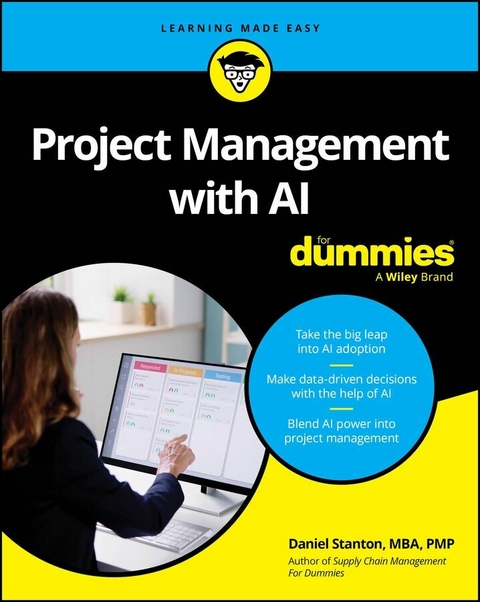
Project Management with AI For Dummies (eBook)
386 Seiten
For Dummies (Verlag)
978-1-394-32085-1 (ISBN)
Use artificial intelligence to upgrade your project management efficiency
Project managers need to stay on top of the latest technologies and trends to stay current in their job skills. Adding artificial intelligence usage to your skillset now will help you future-proof your career and put you ahead of the competition on the job market. Project Management with AI For Dummies provides you with a jumping-off point for using artificial intelligence in all stages of project management. This beginner-friendly guide teaches you how to use AI to plan, initiate, and manage projects, including building an AI-powered project model, streamlining schedules and budgets, and beyond. Plus, you'll learn to ingrate AI on your teams for enhanced collaboration. Give your performance a boost with the assistance of AI-and this Dummies guide.
- Take the big leap into AI adoption for all stages of project management
- Make data-driven decisions for better planning and performance
- Discover AI tools that you can start using right away
- Get tips on avoiding common pitfalls when getting started with AI
Project Management with AI For Dummies makes it easy for current and future project managers to get started harnessing the latest technologies.
Daniel Stanton, MBA, PMP earned the moniker 'Mr. Supply Chain' thanks to his work as an advocate of supply chain education, his work as a consultant in the field, and his reputation as the bestselling author of Supply Chain Management For Dummies. The roots of his supply chain knowledge are planted in his project management expertise.
Chapter 1
What Is AI?
IN THIS CHAPTER
Defining artificial intelligence
Understanding key AI concepts like machine learning, natural language processing, large language models, and robotics
Highlighting the distinction between AI and automation
Artificial intelligence, or AI, is transforming nearly every industry, including project management. From streamlining workflows to predicting outcomes, AI has the potential to make project managers more effective and efficient. But before I dive into how AI can benefit your projects, I want to help you understand what AI is, the key concepts that underpin it, and how it differs from automation. In this chapter, I break down the basics of AI, introduce you to the core concepts, and clarify the distinction between AI and automation.
Setting Your Expectations for This Book
I designed this book to guide you through the process of understanding and implementing AI in your work, from the basics to more advanced applications. Part 1 lays the foundation by explaining why AI is important in project management and how it’s transforming the field:
- Chapter 1 explores the overall importance of AI in modern project management.
- Chapter 2 covers AI’s impact on project efficiency and decision-making.
- Chapter 3 provides an overview of how using AI in project management provides measurable benefits like time savings, cost reduction, and risk mitigation, which can be tracked through key performance indicators (KPIs) and baseline metrics.
Part 2 focuses on the practical steps of adopting AI tools and technologies:
- Chapter 4 offers guidance on what to look for in AI software and helps you choose the right AI tools for your specific projects.
- Chapter 5 delves into how AI can automate tasks and workflows to streamline processes to save time.
- Chapter 6 emphasizes the role of AI in making data-driven decisions, enabling project managers to leverage insights from vast datasets.
- Chapter 7 explains how AI tools can enhance team collaboration, ensuring smoother communication and coordination across projects.
Part 3 dives into practical applications of AI in everyday project management:
- Chapter 8 shows how AI can improve project planning and scheduling by offering predictive insights and dynamic adjustments to timelines.
- Chapter 9 explains how to predict and manage project risks using AI and foresee potential challenges.
- Chapter 10 focuses on how AI can optimize budgeting and cost control, ensuring that projects remain financially viable.
- Chapter 11 covers how AI improves tracking project performance and automating reporting processes for better transparency and oversight.
Part 4 addresses critical ethical, security, and change management considerations:
- Chapter 12 explores the ethical use of AI in project management, helping you navigate fairness, transparency, and accountability when using AI tools.
- Chapter 13 focuses on protecting data and ensuring security in AI-powered projects, offering strategies for keeping sensitive information safe.
- Chapter 14 helps you manage AI adoption within your organization, outlining strategies for overcoming resistance to change and guiding your team through the transition.
Finally, Part 5 offers practical advice and tips for project managers:
- Chapter 15 provides ten tips for getting started with AI, offering a roadmap for integrating AI tools into your workflow.
- Chapter 16 highlights common mistakes to avoid when using AI in projects, ensuring you can steer clear of potential pitfalls.
- Chapter 17 rounds out the book by introducing ten essential AI tools every project manager should know, giving you the resources to fully leverage AI’s capabilities.
Whether you’re new to AI or looking to refine your AI strategies, this book covers everything you need to know for successfully integrating AI into project management.
Understanding AI: The Basics
AI is fundamentally about simulating human intelligence within machines, enabling them to perform tasks that typically require human cognitive functions. These functions may include understanding language, recognizing patterns, making decisions, and solving complex problems.
AI is not a single entity but rather an umbrella term for a broad range of technologies and techniques that enable machines to learn from data and improve their performance over time. The idea behind AI is to allow machines to execute tasks that require judgment, insight, or creativity — things that were once thought to be exclusive to human abilities.
AI’s relevance spans across various industries. In project management, AI offers ways to streamline operations, make data-driven decisions, and even anticipate challenges. While the concept of AI often conjures up images of highly autonomous systems that mimic human thinking, the reality is more nuanced. AI applications in project management typically involve specialized systems that optimize specific processes. Understanding these nuances helps you recognize where AI can be most effective in improving project outcomes.
The two major types of AI that are commonly discussed are narrow AI (also known as weak AI) and general AI (strong AI). Narrow AI refers to systems that are designed for specific tasks and can outperform humans in that domain. For example, speech recognition, image classification, and recommendation algorithms are typical examples of narrow AI. These systems are highly focused and excel in their designated tasks but lack the versatility of human intelligence. In contrast, general AI is the theoretical concept where machines could, in the long term, replicate human-like intelligence across a broad array of tasks. General AI is still a concept rooted more in science fiction than in practical reality.
In the realm of project management, narrow AI tools are most relevant. These tools help optimize specific aspects of projects, such as automating routine tasks, analyzing historical data to predict outcomes, or managing resources more efficiently. The true power of narrow AI in this context lies in its ability to process vast amounts of information quickly and provide actionable insights. This enables project managers to make informed decisions, enhance productivity, and mitigate risks effectively.
Recognize the distinction between narrow and general AI. When selecting AI tools for your projects, focus on those that specialize in optimizing specific areas of your workflow rather than trying to find a one-size-fits-all solution.
Defining Key AI Concepts
To effectively harness the power of AI in project management, it’s crucial to grasp some of the key concepts that form the foundation of AI. These core ideas include machine learning, natural language processing, large language models, and robotics. (See Figure 1-1.) Each of these technologies serves a distinct purpose and contributes to different aspects of project management, from automating routine tasks to generating insights that guide decision-making. Understanding these concepts will enable you to better assess how you can integrate AI into your workflow to drive efficiencies and improve overall project outcomes. In this section, I explain these key AI concepts and explore their applications in project management.
Machine learning
Machine learning (ML) is a core subset of AI that enables computers to learn from and make decisions based on data. Unlike traditional programming, where specific instructions are given to perform tasks, ML allows systems to learn from examples and improve over time. This is achieved by training algorithms on large datasets, which helps the model recognize patterns and relationships within the data. The more data an ML model is exposed to, the more consistent it becomes in its predictions or classifications.
FIGURE 1-1: Relationships between different approaches to AI.
However, ML can’t judge whether data is right or wrong. It simply detects what occurs more or less frequently in the data it’s given. So, if the training data is biased, incomplete, or inaccurate, the ML model will learn and reinforce those errors, leading to flawed predictions or classifications. This concept is often summarized as “garbage in, garbage out” (GIGO); if the input data is flawed, the output will be as well. While ML models can improve with more data, their accuracy depends entirely on the quality, diversity, and reliability of the data they are trained on.
In the context of project management, machine learning can significantly enhance processes such as task scheduling, resource allocation, and risk management. By analyzing historical project data, ML can identify trends, predict delays, and recommend optimized resource allocation strategies. It can also forecast the success of different project timelines and help predict where bottlenecks are likely to occur. As a project manager, leveraging ML tools can help you make data-driven decisions that reduce uncertainty and increase project efficiency. Chapter 6 gives more details on how ML can be used to analyze data and enhance project decisions.
When implementing ML in your project, ensure you have access to clean, high-quality...
| Erscheint lt. Verlag | 24.3.2025 |
|---|---|
| Sprache | englisch |
| Themenwelt | Sachbuch/Ratgeber ► Beruf / Finanzen / Recht / Wirtschaft ► Wirtschaft |
| Wirtschaft ► Betriebswirtschaft / Management ► Projektmanagement | |
| Schlagworte | agile project management • ai budgeting • AI for Business • ai for pms • ai for project management • AI Project Management • ai project planning • ai scheduling • Project Management • project management AI • Project management software • project manager book |
| ISBN-10 | 1-394-32085-X / 139432085X |
| ISBN-13 | 978-1-394-32085-1 / 9781394320851 |
| Informationen gemäß Produktsicherheitsverordnung (GPSR) | |
| Haben Sie eine Frage zum Produkt? |
 EPUB (Adobe DRM)
Kopierschutz: Adobe-DRM
Adobe-DRM ist ein Kopierschutz, der das eBook vor Mißbrauch schützen soll. Dabei wird das eBook bereits beim Download auf Ihre persönliche Adobe-ID autorisiert. Lesen können Sie das eBook dann nur auf den Geräten, welche ebenfalls auf Ihre Adobe-ID registriert sind.
Details zum Adobe-DRM
Dateiformat: EPUB (Electronic Publication)
EPUB ist ein offener Standard für eBooks und eignet sich besonders zur Darstellung von Belletristik und Sachbüchern. Der Fließtext wird dynamisch an die Display- und Schriftgröße angepasst. Auch für mobile Lesegeräte ist EPUB daher gut geeignet.
Systemvoraussetzungen:
PC/Mac: Mit einem PC oder Mac können Sie dieses eBook lesen. Sie benötigen eine
eReader: Dieses eBook kann mit (fast) allen eBook-Readern gelesen werden. Mit dem amazon-Kindle ist es aber nicht kompatibel.
Smartphone/Tablet: Egal ob Apple oder Android, dieses eBook können Sie lesen. Sie benötigen eine
Geräteliste und zusätzliche Hinweise
Buying eBooks from abroad
For tax law reasons we can sell eBooks just within Germany and Switzerland. Regrettably we cannot fulfill eBook-orders from other countries.
aus dem Bereich