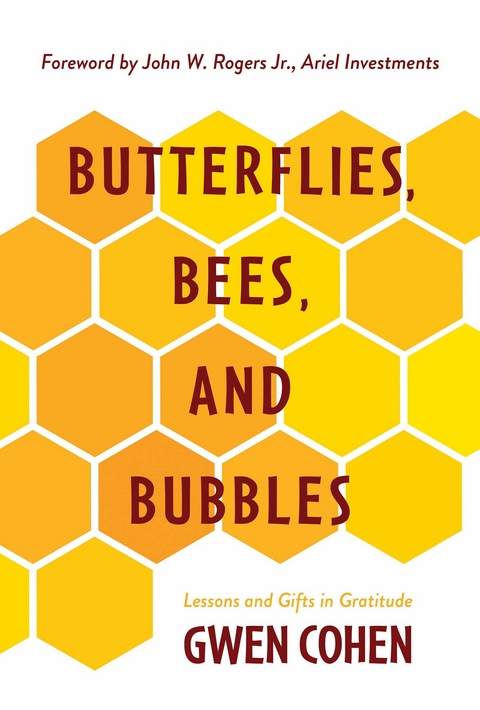
Butterflies, Bees, and Bubbles (eBook)
208 Seiten
Bookbaby (Verlag)
979-8-3509-9297-7 (ISBN)
Gwen Cohen enjoyed a remarkable 36-year career as a Senior Vice President and Wealth Advisor at Morgan Stanley. She credits the wisdom shared by her dynamic parents, grandmother Maude, and great-grandparents for propelling her to academic and professional success. Gwen earned a business degree from Tuskegee University and an MBA from Northwestern's Kellogg School of Management before joining Morgan Stanley. While assisting clients in managing their wealth, she noticed that many sought guidance on navigating other important aspects of their lives. This observation made her realize that the financial literacy and critical thinking skills she had learned in her youth were just as valuable to her clients and their families. Gwen is frequently invited to share her insights with large audiences nationwide, inspiring her to publish her first book, Butterflies, Bees, and Bubbles: Lessons and Gifts in Gratitude. This book is a collection of accessible stories and wisdom that gently guides readers on the path to adulthood. It is a loving tribute to the three influential women who embody the book's title. Believing in the importance of giving back, Gwen has committed a portion of the net proceeds from her book to causes that are close to her heart.
"e;Butterflies, Bees, and Bubbles: Lessons and Gifts in Gratitude,"e; offers a treasured collection of stories about three influential multigenerational women of the author's life: her great-grandmother Ida, grandmother Maude, and mother Clementine. The author shares how their stories, songs, and sayings provided a compass that helped her to navigate opportunities and challenges that led to personal and professional success. The author provides valuable insights and practical resources on the companion website, offering readers guidance and support beyond the book. "e;Butterflies, Bees, and Bubbles"e; is an amazingly written collection of narratives that stretches the imagination about gifts that we all possess. The timeless values that Ida introduced to Maude and her children in the early 1900s were adapted by Clementine for the 21st-century woman. This book is for anyone seeking guidance and inspiration to empower themselves and take control of their futures. "e;Butterflies, Bees, and Bubbles: Lessons and Gifts in Gratitude"e; is a tribute to these phenomenal women whose advice is a gift that keeps on giving. In the spirit of gratitude, the author has committed a portion of the net proceeds of this literary effort to be donated to causes close to her heart.
“Ida-ology”
Sharing home-grown financial wisdom with my wealth management clients and workshop attendees felt as natural as breathing. This valuable knowledge came from my mother, and it proved to be powerful. While I experienced impressive results from this philosophy, I did not realize its significance for others until a client shared its impact on her life and encouraged me to write about it in a book. I loved the idea of sharing my mother’s wisdom and empowering a wider audience of people I might never meet.
Then, I made a stunning discovery: this wisdom had been passed down to my mother, Clementine, from her mother, Maude, who had received it from my great-grandmother, Ida. She strongly believed that financial literacy was essential for preparing children for adulthood, so she created a curriculum to empower her children and, eventually, her community.
In 1918, Ida taught her children to embrace three essential values: financial responsibility, thoughtful family planning, and philanthropy. I affectionately call it “Ida-ology.” This dynamic philosophy has outlived my great-grandmother and thrived for over a century because it consistently produces excellent results.
I presented Mom with the idea of publishing a book in late 2014. Nearly two years later, after completing an inspiring writing course at Northwestern University, I asked her if she would collaborate on this book about Ida. She lovingly agreed.
Less than a month later, my mom suddenly took flight. In my grief, the loss of her presence far outweighed the impact of the lessons she had learned from Ida—at least for a while.
Through sessions with grief counselors, I rediscovered the power of gratitude journaling. While reviewing my old journals, I encountered Mom’s memorable mantra: “Everything that you will ever need in life is already on your path.” This realization reignited my motivation.
Out of gratitude for the guidance, stories, sayings, and songs from the women in my family, I felt compelled to honor all three generations: Ida, Maude, and Mom. I had benefited from their wisdom far more than they ever did. No doubt, this was by design, or as Mom would say, it was divinely ordered.
Gramma Maude and Mom refined and conveyed Ida’s lessons in digestible and impactful ways that shaped my life—and even saved it. Thanks to Ida’s legacy, communicated through her stories and sayings, they helped me navigate purposefully. Although she was born 100 years before I graduated college, her bold ideas and life experiences paved the way for me and many others who have embraced her philosophy.
All Things Ida
I had fond memories of summers spent in Chicago, and now, days after graduating from Tuskegee University, I was returning to begin my professional career at IBM. I visited Aunt Ethel, Ida’s youngest daughter, who lived in the three-flat building Ida and my great-grandfather, Fletcher, had bought on the West Side of the city decades earlier.
As I approached the building, a row of daylilies was visible through the chain-link fence. Purple bearded irises bloomed alongside the east wall. The vacant lot next door featured a white birdbath in the middle of a perfectly mowed lawn. Sparrows had made it their favorite watering hole for years.
It felt like I was home, although I had never spent a single night in what had been my great-grandparents’ place. I recalled the familiar visits to the backyard garden to cut flowers or collards with my Aunt Ethel and the barking Doberman peering through the pickets of a third-floor back porch nearby. But he was more than a memory. He was still there, and I was still afraid of him.
Just as I thought of the neighbor across the street, someone called out, “Hey!” It was Mrs. Payne herself. She always wished me well at the end of summer before I returned to college and saw me approaching the Satisfield home. I greeted her and proudly announced that I had graduated. We chatted, and I thanked her for her good wishes and prayers throughout my college years.
This block was so familiar, holding memories of neighbors who cared about each other.
Now, it was time for me to create new memories.
Aunt Ethel must have been watching as I approached the building’s entrance. Before I could press the doorbell, the buzzer made the same annoying sound, admitting me.
“Gwen, is that you?” her high-pitched voice called from the third floor.
Before I could answer, I heard, “Come on up, Baby!” She had called me Baby since I was one. A college degree would not change that.
With every visit to Ethel’s or her sister Ora’s home, a meal or snack would be awaiting. The spaghetti and fried perch aroma wafted from Ethel’s kitchen and greeted me as I climbed the stairs. At the top was my Aunt Ethel, 61, a petite, very proper lady with rosy cheeks and understated lipstick. Though pulled back, her salt-and-pepper hair was visible in a framed mirror behind her that reflected layers of soft curls that fell across her shoulders. She reached out and held me for a long time.
Aunt Ethel directed me into the living room, which was larger than any studio apartment I could have afforded. A French door with eight beveled panes welcomed me. In earlier years, youngsters rarely spent time in this room—unless we were helping to tidy up for an adult gathering. I remembered how much I enjoyed just being in the room.
And now, Ethel was inviting me there for a glass of lemonade before a meal in the dining room at the end of a long hallway. Somewhere between there and the spot where Ethel and I stood, I could hear the loud broadcast of a White Sox baseball game above a steady static. Uncle Sam, Ethel’s husband, always preferred listening to a Sox game on the radio, even when it was televised. Without leaving his post, Uncle Sam called out, “Hey, Gwen! I’ll talk to you when the game is over. Make yourself at home.”
Ethel would make sure that I would. For now, I could enjoy being in this iconic room: the mauve and gray art deco furniture, the fresh flowers framing a row of windows facing the boulevard, the carefully placed photographs around the room, and small paintings along the west wall.
The same framed eight-by-ten photograph displayed in the homes of Ida and Fletcher’s children was on the table before me. It captured Ida and Fletcher Satisfield’s 50th wedding anniversary in 1944. As I studied it, Aunt Ethel gestured for me to sit in the swivel chair beside hers.
She had an agenda. She wanted details about my new job at IBM, and I was excited to share. The more I talked, the more Ethel smiled.
After hearing that my work would be Chicago-based, but my training would be in Atlanta, Poughkeepsie, and Armonk, New York, Ethel suggested I live at the Satisfield home until I completed training. That was a curve ball I did not expect. I listened.
She reasoned that the local IBM office was four miles east, and a rapid-transit stop was on Lake Street, one block north of the Satisfield home. Her arguments were well presented.
She proposed a one-bedroom area inside their spacious home, with a separate bath and access to the iconic living room where we sat. When I was in town, she told me I could count on a home-cooked dinner five days a week.
Yes, I would pay rent. That’s how Aunt Ethel operated; nothing is free. But she admitted it would be an excellent arrangement for me and a welcomed change for her.
It was a change of plans for me, indeed. Fresh out of college, I was looking forward to my own apartment and had budgeted for one.
Looking around, I discovered this arrangement included a bonus: full access to all things Ida—her books, sayings, and table linens—many of which she tatted herself. Though not extravagant, Ida’s treasures—her china, dessert dishes, table lamps, lead glass ashtrays, and photos—were on permanent display. Yes, photos.
I graciously accepted Aunt Ethel’s offer.
Sitting with a glass of lemonade, I couldn’t resist staring at the photo before me. My great-grandparents, Ida and Fletcher, had celebrated their golden wedding anniversary in the very room where we sat. Even though I had seen this photo for years in others’ homes, it still enchanted me.
Ida and Fletcher had brought a ballroom ambiance into their home that day. This was a sterling moment.
Both wore white gloves. Aunt Ethel said Fletcher was properly tuxedoed at Ida’s insistence. Four daughters and two sons-in-law flanked them. Fresh flowers were prominent on a nearby table and in their corsages.
World War II had already lasted for several years. Family members and neighbors had already served their country on Europe’s battlefields. According to Aunt Ethel and her sister, Ora, also pictured in the photo, Ida, then 70, and Fletcher, 81, savored their golden anniversary as a season of harvest.
°°°
The Satisfields were married in 1894 in Barbour County, Alabama. Their firstborn, Levi, was followed by Maude (my Gramma), Ora, and six more daughters.
This celebrated couple had made bold steps during their lifetimes and was grateful for having thrived through the Great Migration. During their early years as a couple, Fletcher worked on the railroad, relegating them to a “commuter marriage” while...
| Erscheint lt. Verlag | 21.3.2025 |
|---|---|
| Sprache | englisch |
| Themenwelt | Sachbuch/Ratgeber ► Gesundheit / Leben / Psychologie ► Familie / Erziehung |
| ISBN-13 | 979-8-3509-9297-7 / 9798350992977 |
| Informationen gemäß Produktsicherheitsverordnung (GPSR) | |
| Haben Sie eine Frage zum Produkt? |
 EPUB (Ohne DRM)
Größe: 701 KB
Digital Rights Management: ohne DRM
Dieses eBook enthält kein DRM oder Kopierschutz. Eine Weitergabe an Dritte ist jedoch rechtlich nicht zulässig, weil Sie beim Kauf nur die Rechte an der persönlichen Nutzung erwerben.
Dateiformat: EPUB (Electronic Publication)
EPUB ist ein offener Standard für eBooks und eignet sich besonders zur Darstellung von Belletristik und Sachbüchern. Der Fließtext wird dynamisch an die Display- und Schriftgröße angepasst. Auch für mobile Lesegeräte ist EPUB daher gut geeignet.
Systemvoraussetzungen:
PC/Mac: Mit einem PC oder Mac können Sie dieses eBook lesen. Sie benötigen dafür die kostenlose Software Adobe Digital Editions.
eReader: Dieses eBook kann mit (fast) allen eBook-Readern gelesen werden. Mit dem amazon-Kindle ist es aber nicht kompatibel.
Smartphone/Tablet: Egal ob Apple oder Android, dieses eBook können Sie lesen. Sie benötigen dafür eine kostenlose App.
Geräteliste und zusätzliche Hinweise
Buying eBooks from abroad
For tax law reasons we can sell eBooks just within Germany and Switzerland. Regrettably we cannot fulfill eBook-orders from other countries.
aus dem Bereich