Simple Embroidery: 35 projects to make (eBook)
128 Seiten
Ryland Peters & Small (Verlag)
978-1-80065-539-3 (ISBN)
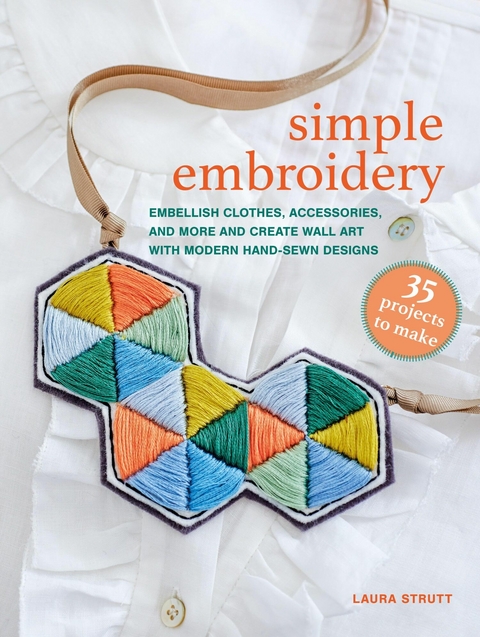
35 STYLISH step-by-step EMBROIDERY PROJECTS from expert crafter LAURA STRUTT. Includes an ILLUSTRATED GUIDE to essential embroidery stitches. Combine thread and creativity to transform plain fabric into stunning artwork and accessories. In Simple Embroidery, Laura Strutt presents 35 chic and contemporary projects that range from whimsical cacti and sparkling crystals to minimalist white designs on coloured cloth, eye-catching denim embellishments and elegant mandala wall art. The projects are thoughtfully designed to suit various skill levels, from beginners to experienced embroiderers ready to explore more advanced techniques, and are accompanied by clear, step-by-step instructions and colour charts. Packed with expert advice on everything from selecting the perfect palette to mastering finishing techniques, this book also features a comprehensive section on essential stitches. Simple Embroidery is a fantastic new edition of Modern Embroidery.
chapter 1
WALL ART
wall art basics
What better way to show off your embroidery skills than to hang your projects on the wall for all to see? You could, of course, display them in a conventional photo or picture frame, but I like to use the hoop I stitched my design in as the “frame.” The fact that it’s a standard piece of sewing equipment seems particularly appropriate!
I tend to back my wall art projects with felt. Not only is it very easy to work with, because it doesn’t fray, but it can be easily manipulated into place and secured with glue. Alternatively you can sew the felt in place using blanket stitch. Do check that the felt is neatly trimmed, so that it’s not visible around the sides of the hoop.
As the felt won’t be seen, it’s common to pick a neutral shade for the backing, but of course you can select any color you like. Double check that really bright or dark colors don’t show through the embroidery fabric from the front.
Most of the wall art projects on pages 16-37 are sewn, framed, and backed in the same way, so just follow the instructions below. Any variations from this basic method are detailed in the individual project instructions.
1 First, prepare the felt you’ll use to back the piece and hide the reverse of the stitching. Place the inner part of the embroidery hoop on the felt and draw around the outer edge with a fabric transfer pen or pencil. Neatly cut out the shape and set it aside.
2 Using pinking shears, trim the raw edges of fabric you’re using for the embroidery to prevent it from fraying. Secure the fabric in the embroidery hoop (see page 118) to create a neat, taut stitching surface.
3 Transfer your embroidery motif centrally onto the fabric (see page 117). Following the stitch guide for your chosen project, work the design in the corresponding colors and stitches.
TIP
Keep the screw fastenings of the hoop at the top of the design, so that you can thread ribbon or cord through them to hang the finished work.
4 Once the design is stitched, work a row of gathering stitches around the outer edge of the fabric, using a sewing needle and cotton thread. Draw the thread up tightly to pull the excess fabric neatly over to the back of the hoop, gathering it firmly, and knot to secure.
TIP
You may prefer to add two rounds of gathering stitches—particularly for square or oval frames. This can help to draw the fabrics in much more neatly around the shape of the frame than a single round of stitches.
5 Apply a small amount of high-tack glue around the inside edge of the hoop and press the backing felt on top to cover the back of the embroidery. Allow the glue to dry completely.
TIP
High-tack glue is incredibly sticky, although most brands dry clear. Apply it sparingly so as not to create clumps of dried glue on the finished piece.
6 Attach a hanging ribbon, cord, or leather thong to the screws at the top of the hoops if required.
Fray Check
Fray Check is a handy product that many embroiderers keep in their supplies kit. If you aren’t backing your project with felt, as above (for example, Floating Cloud, page 30), you might like to add some Fray Check to the fabric. This is a quick-drying liquid sealant that, when applied to the edges of the fabrics, will hold and secure the fibers and prevent them from fraying. It can also be used to secure the ends of trimmings and ribbons. Use it sparingly and always check on a scrap or discrete section first to make sure that it doesn’t alter the color of the fabrics.
color wheel
Made with only French knots, this striking design is easy to master, even for beginners. Tonal shades are selected to create a dramatic color-wheel effect that will add real impact to your interiors.
The template for the color wheel is just a rough guide for where the colors should be worked; if you stray outside the lines with each color, the blend of shades and tones will be much more organic than if you work directly along the given lines.
YOU WILL NEED:
Natural-colored linen blend fabric (55% linen, 45% cotton), 10-in. (25-cm) square
Neutral-colored felt, 10-in. (25-cm) square
Embroidery flosses (threads)—one skein of each, all six strands used—in the following shades:
Anchor 2 (White)
Anchor 6 (Peach)
Anchor 10 (Coral)
Anchor 11 (Mid Coral)
Anchor 13 (Dark Coral)
Anchor 24 (Mid Pink)
Anchor 35 (Dark Melon)
Anchor 48 (Very Light Dusty Rose)
Anchor 50 (Pale Geranium)
Anchor 54 (Geranium)
Anchor 90 (Light Grape)
Anchor 92 (Violet)
Anchor 100 (Dark Violet)
Anchor 109 (Dark Lavender)
Anchor 111 (Very Dark Lavender)
Anchor 128 (Very Light Baby Blue)
Anchor 145 (Mid Delft Blue)
Anchor 186 (Mid Seagreen)
Anchor 188 (Very Dark Seagreen)
Anchor 242 (Forest Green)
Anchor 244 (Dark Forest Green)
Anchor 292 (Very Light Golden Yellow)
Anchor 295 (Light Straw)
Anchor 298 (Deep Canary)
Anchor 303 (Light Tangerine)
Anchor 304 (Mid Tangerine)
Anchor 316 (Tangerine)
Anchor 342 (Light Lavender)
Anchor 851 (Very Dark Gray Green)
Anchor 975 (Very Very Light Blue)
Anchor 979 (Very Dark Baby Blue)
Anchor 1043 (Very Light Pistachio Green)
Anchor 1066 (Very Dark Turquoise)
Anchor 1092 (Light Seagreen)
Leather thong, 12 in. (30 cm) long
Small wooden bead
Fabric scissors, pinking shears, and embroidery scissors
Motif and stitch guide on page 17
Embroidery hoop, 6¼ in. (16 cm)
Pencil or tailor’s chalk
Embroidery needle
Thread conditioner (optional)
High-tack glue
FINISHED MEASUREMENTS)
6¼ in. (16 cm) in diameter
EMBROIDERY STITCHES USED)
French knots (see page 114)
STITCHING AND ASSEMBLY
1 Follow the step-by-step instructions on pages 14–15.
2 When you’ve backed the piece with felt, thread the leather thong through the fastening at the top of the hoop and thread on the small wooden bead before knotting the thong to make a hanging loop.
TIP
Be sure to take the needle back through the fabric slightly past the point where it came up from when making the French knots. This helps prevent the knot from being pulled right back through the fabric, which can damage the weave of the cloth.
colorful crystals
Add some New-Age style to your décor with this trio of crystals wall art. Worked in satin stitch featuring ombré shades, you can customize it by using your own favorite color palette: simply choose four shades of the same color along with white, light gray, and dark gray floss (thread) for outlining.
YOU WILL NEED
Cream linen blend fabric (55% linen, 45% cotton), one 10-in. (25-cm) and two 8-in. (20-cm) squares
Neutral-colored felt, one 10-in. (25-cm) and two 8-in. (20-cm) squares
Embroidery flosses (threads)—one skein of each, all six strands used—in the following shades:
For the purple crystals
Anchor 2 (White)
Anchor 90 (Light Grape)
Anchor 92 (Violet)
Anchor 94 (Mid Plum)
Anchor 100 (Dark Grape)
Anchor 235 (Dark Steel Gray)
Anchor 400 (Pewter Gray)
For the blue-green crystals
Anchor 2 (White)
Anchor 185 (Light Aquamarine)
Anchor 187 (Dark Seagreen)
Anchor 188 (Very Dark Seagreen)
Anchor 235 (Dark Steel Gray)
Anchor 400 (Pewter Gray)
Anchor 1092 (Light Seagreen)
For the pink crystals
Anchor 2 (White)
Anchor 60 (Mid Mauve)
Anchor 62 (Cyclamen Pink)
Anchor 65 (Cranberry)
Anchor 77 (Mauve)
Anchor 235 (Dark Steel Gray)
Anchor 400 (Pewter Gray)
Ribbon in toning colors to hang if required—approx. 12 in. (30 cm) per motif
Motifs and stitch guides on page 19
Fabric scissors, pinking shears, and embroidery scissors
Embroidery hoops, one 5 in. (12 cm) and two 4 in. (10 cm)
Embroidery needle
Thread conditioner (optional)
Sewing needle and cotton thread
High-tack glue
FINISHED MEASUREMENTS
5 in. (12 cm) and 4 in. (10 cm) in diameter
EMBROIDERY STITCHES USED
French knots (see page 114)
Satin stitch (see page 115)
Straight stitch (see page 116)
STITCHING AND ASSEMBLY
Follow the step-by-step instructions on pages 14–15. This design is worked largely in satin stitch; maintain an even tension to create a neat finished piece.
Use the larger hoop for this embroidery.
prickly pictures
Don’t worry if you don’t have green fingers—you can simply sew your own plants that will stay in bloom the whole year round! This collection of miniature frames is quick to stitch and makes a fun focal point for a small space. Mini frames are available in craft stores and are usually a very simple design with only two parts, making the process of trimming and securing the work quick and easy.
YOU WILL NEED
Cream linen blend fabric (55% linen, 45% cotton), 12-in. (30-cm) square
Embroidery flosses (threads)—one skein of each, all six strands used—in the following shades:
DMC 163...
| Erscheint lt. Verlag | 13.5.2025 |
|---|---|
| Verlagsort | London |
| Sprache | englisch |
| Themenwelt | Sachbuch/Ratgeber ► Freizeit / Hobby ► Handarbeit / Textiles |
| Schlagworte | BAGS • Clothing • Crafts • Crafts for Children • crafts for kids • decorations • Embroidery • furnishings • needlecraft • sewing • Stitching |
| ISBN-10 | 1-80065-539-8 / 1800655398 |
| ISBN-13 | 978-1-80065-539-3 / 9781800655393 |
| Informationen gemäß Produktsicherheitsverordnung (GPSR) | |
| Haben Sie eine Frage zum Produkt? |
 EPUB (Wasserzeichen)
DRM: Digitales Wasserzeichen
Dieses eBook enthält ein digitales Wasserzeichen und ist damit für Sie personalisiert. Bei einer missbräuchlichen Weitergabe des eBooks an Dritte ist eine Rückverfolgung an die Quelle möglich.
Dateiformat: EPUB (Electronic Publication)
EPUB ist ein offener Standard für eBooks und eignet sich besonders zur Darstellung von Belletristik und Sachbüchern. Der Fließtext wird dynamisch an die Display- und Schriftgröße angepasst. Auch für mobile Lesegeräte ist EPUB daher gut geeignet.
Systemvoraussetzungen:
PC/Mac: Mit einem PC oder Mac können Sie dieses eBook lesen. Sie benötigen dafür die kostenlose Software Adobe Digital Editions.
eReader: Dieses eBook kann mit (fast) allen eBook-Readern gelesen werden. Mit dem amazon-Kindle ist es aber nicht kompatibel.
Smartphone/Tablet: Egal ob Apple oder Android, dieses eBook können Sie lesen. Sie benötigen dafür eine kostenlose App.
Geräteliste und zusätzliche Hinweise
Buying eBooks from abroad
For tax law reasons we can sell eBooks just within Germany and Switzerland. Regrettably we cannot fulfill eBook-orders from other countries.
aus dem Bereich