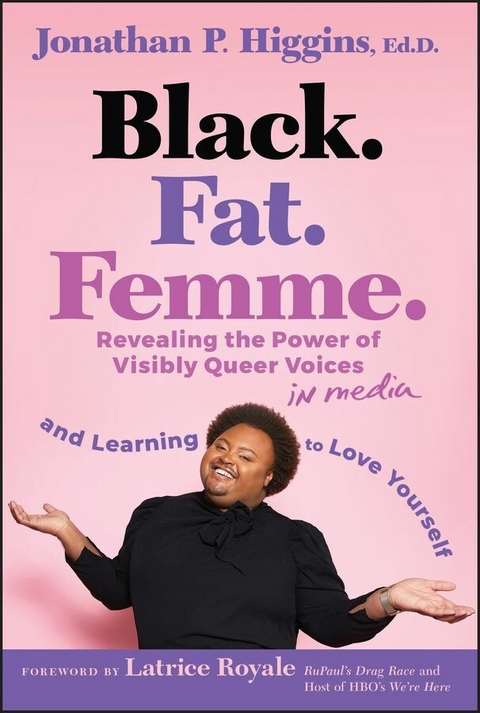
Black. Fat. Femme (eBook)
248 Seiten
Wiley (Verlag)
978-1-394-29637-8 (ISBN)
A celebration of (and how to find your own) queer intersectional identity through the lens of media
In Black. Fat. Femme: Revealing the Power of Visibly Queer Voices (in Media) and Learning to Love Yourself, educator and media critic Dr. Jonathan P. Higgins-aka Doctor Jon Paul-delivers an honest and extraordinary new take on how the author, and other Black Fat Femmes like them, have come to find and understand their identity.
You'll learn about how standing at the intersection of multiple identities, communities, and causes shapes people and how they see the world. You'll also discover how public figures like Andre Leon Talley and Latrice Royale have helped people learn who they are and what is possible in life.
Inside the book:
- An examination of the importance of real representation in the media for marginalized people
- Discussions of the pioneers who fought so hard to be authentically who they are, both onscreen and off
- Explorations of how and why Black Fat Femme people have been left out and erased from LGBTQ+ conversations
Perfect for anyone with an interest in unique voices and truly singular perspectives, Black. Fat. Femme. is a one-of-a-kind book that will help you see the world with entirely new eyes.
Jonathan P. Higgins, Ed.D., is an award-winning educator, professor, national speaker, freelance journalist, and media critic who focuses on the intersections of identity, gender, and race in entertainment. They are the creator, executive producer, and host of the Black Fat Femme Podcast and have worked on inclusion projects with Fox, the NFL, Apple, Disney, Instagram, BuzzFeed, and GLAAD.
A celebration of (and how to find your own) queer intersectional identity through the lens of media In Black. Fat. Femme: Revealing the Power of Visibly Queer Voices (in Media) and Learning to Love Yourself, educator and media critic Dr. Jonathan P. Higgins aka Doctor Jon Paul delivers an honest and extraordinary new take on how the author, and other Black Fat Femmes like them, have come to find and understand their identity. You'll learn about how standing at the intersection of multiple identities, communities, and causes shapes people and how they see the world. You'll also discover how public figures like Andre Leon Talley and Latrice Royale have helped people learn who they are and what is possible in life. Inside the book: An examination of the importance of real representation in the media for marginalized people Discussions of the pioneers who fought so hard to be authentically who they are, both onscreen and off Explorations of how and why Black Fat Femme people have been left out and erased from LGBTQ+ conversations Perfect for anyone with an interest in unique voices and truly singular perspectives, Black. Fat. Femme. is a one-of-a-kind book that will help you see the world with entirely new eyes.
Chapter 1
Always Too Much
“You're trying to zero in on something that you are never ever gonna get… .Look at you, just circling the airport. You ain't never gonna land.”
—Luther Vandross
I distinctly remember the time in my life where I realized I could sing. I would often hear one of my uncles vocalizing, and often I would mock or imitate him because I too realized I could hold a note. However, in time I would be reminded by both family and friends in school that both my speaking voice and my singing voice weren't like other boys'.
“Why do you always sound like a girl?”
A constant thing that people would ask me and a constant reminder that my voice was “soft.” While this led to me being super self‐conscious about both my speaking and my singing voice, I always remember the time in school that I sang in front of the class and one of my teachers said, “You sound like a young Luther Vandross.” I was giddy because I saw how my family responded to his music.
Being called a “young Luther Vandross” was a big deal for me because I knew my mother (and family) would always play Luther Vandross. Hell, my uncle sang “Here and Now” at my sister's wedding. Luther Vandross was and still is a big part of some of my core memories. In the words of my mother, “Luther Vandross could SANG!”
Not just sing but SANG.
I ran home and told my mother. I distinctly remember her just hugging me and smiling. She never really said much about the moment after that, but I can always remember the slight silence my mother carried around that moment when I told others that I could “sing like Luther Vandross” and how the world responded to me when I mentioned Luther being my all‐time favorite singer.
Now, for the sake of this chapter – I have to say that before I go into unpacking that moment and the importance that Luther Ronzoni Vandross Jr. has in my story – this chapter is not about whether Luther was queer. So much of what I will be discussing going forward is around the ways the world treated me like they did Luther, specifically the speculation around his sexuality and the impact that it had on his mental health. I also want to mention that this chapter does discuss his food addiction and how I believe that so much of that was fueled by the speculation around his sexuality.
Alas, being told that I was a “young Luther Vandross” was such an important moment for me – all because for years I didn't actually believe I could sing. That event ties into a pivotal moment in my life where I can remember begging my mother to take me to one of my uncle's house parties and later learning the truth about why I wasn't able to come.
Said uncle didn't want me there because, you guessed it: “I sang and acted too much like a girl.”
This was a running monologue in my head as a child, so being told by anyone that I emulated someone who I thought was “masculine” filled me with so much joy and hope. Sad, but true. This led me to memorizing almost all of his catalog, not because all of Luther's music resonated with me but because I just finally felt safe enough to sing his songs without fear of being criticized for my presentation.
The thing that was hard to negotiate around my love for Luther Vandross was the joy that he brought me and how people responded to him outside of his music. As a child, I always felt like there was something so beautiful about the way he presented and carried himself in interviews. When he performed, it was as if he was so sure about the words leaving his mouth, but more, it was the way he commanded a stage that always stuck out to me.
I can remember a moment where my mother and uncle were talking about going to see him and En Vogue in concert and my mom referring to the show as “fabulous.” When my aunt asked about the show, my mother indulged in the idea that Luther at moments “threw glitter” and was “really effeminate” in his presentation.
What my mother and uncle were both doing was what I had seen so many people in the media do to Luther during his time alive. Insinuate his sexuality and gesture to the idea that many of the songs that he sang were code for his love of men, and this signaled to me that being called a “young Luther Vandross” meant that I too loved men.
But it wasn't just my mother who was insinuating Luther's sexuality. I heard it on TV and on the radio. Snarky jokes from Wendy Williams and other radio hosts who felt like joking about his sexuality made for great content. I even once heard one of my teachers – yes, a teacher – make a comment that Luther's music was about his love for men and how they wish he would “just say that.”
What was so interesting about this time in my life was that I was watching how my family not only treated me, but how they talked about celebrities too when it came to their sexuality.
“You know, he's a little funny” is something I heard my uncles say often, specifically referencing Luther Vandross and other Black effeminate men. “Fruity” and “sweet” were other words that I would hear them use too, words that they would throw around to describe the uncertainty they had around Luther's sexuality.
I often wondered as I got older, “What if he was?” What if Luther did come out to the world and celebrate every part of himself, without leaving so much to the world to hypothesize around?
This left me not only terrified but scared that somehow the world had figured me out.
▪ ▪ ▪
There's no way I can talk about my experience as a Black Fat Femme without talking about religion and the anxiety it caused me. It's I think partly why my family – specifically my uncles – wanted to limit how much time I spent engaging the media.
Growing up a Jehovah's Witness (JW) meant that everything you did had to align with the organization. From television to music interest, anything that was considered secular meant it could cause you to stumble, meaning leave the organization.
The hardest part of being in the organization was feeling like everything I did, every move I made, was watched meticulously. If I spent too much time with the Sisters (the young women in the organization), I was being conditioned to be queer. If I spent too much time with the Brothers (the young men in the organization), I would somehow influence them to become queer/gay too.
At no time in the organization did I ever feel like I could exist without question. Because both sides of my family were Jehovah's Witnesses, I never got a relief from the organization. The challenge was always feeling like I had to pretend to be someone I wasn't – e.g. straight and overtly masculine.
The speculations around my sexuality caused my anxiety to come out in so many gross ways, from overeating to making elaborate plans of how to escape the organization. Often it was through unaliving myself. I often felt that dying would be a better solution than staying in a religion that never truly wanted me in it.
It's important for me to mention religion in this chapter (and this book) because so much of the unlearning self‐hatred I had for both my younger and teenage self started with religion. There wasn't a moment or time in my life where I ever felt like I could be my authentic self, and often a lot of that was because I was being groomed to be the “gold star” JW that both my parents and my grandparents wanted me to be.
However, that dream for them began to fall apart as I got older, as both my family and the powers that be in the organization began to hint at knowing I was queer. At one point an elder (the men who run their congregations) pulled me to the side and told me that he was watching me to make sure I wasn't going to cause other young men in the organization to stumble.
What that moment signifies is that he and everyone who had power in that organization were doing everything in their power to keep me afraid of actualizing my identity. The sad part was that my family played into this as well and treated me in the same manner, leaving me to always feel like I was somehow on trial for something I had no control over. My sister would intentionally ask me my thoughts on Lesbian, Gay, Bisexual, Transgender, Queer (LGBTQ+) people and then talk poorly about them, I assume to try to instill fear. Family members made terrible statements about being queer, and folks in the religion spent a lot time in the early '90s preaching against homosexuality, noting that having HIV or AIDS was God's way of dealing with LGBTQ+ people. They acted like being queer was some sort of death sentence.
It was like me liking Luther Vandross or wanting to be anything like him would be me admitting that I too was hiding a secret (which I was because I was so afraid). However, it's important to note that I was also very aware that the world was doing the same thing to Luther Vandross, and it taught me very early on how to protect myself in moments where I felt like my identity was under attack.
While religion and my parents were telling me what I could and couldn't watch, I was grateful to be a latchkey kid because being at home alone often meant I could tune into things I wanted to without the fear of being chastised for what I...
| Erscheint lt. Verlag | 19.3.2025 |
|---|---|
| Vorwort | Latrice Royale |
| Sprache | englisch |
| Themenwelt | Sachbuch/Ratgeber ► Gesundheit / Leben / Psychologie ► Lebenshilfe / Lebensführung |
| Geisteswissenschaften ► Psychologie | |
| Schlagworte | fat lgbtq • intersectional media • intersectional queer • lgbtq exclusion • lgbtq fat • LGBTQ identity • lgbtq media • queer identity • queer intersectional representation • Queer media • queer media representation • queer representation in the media |
| ISBN-10 | 1-394-29637-1 / 1394296371 |
| ISBN-13 | 978-1-394-29637-8 / 9781394296378 |
| Informationen gemäß Produktsicherheitsverordnung (GPSR) | |
| Haben Sie eine Frage zum Produkt? |
 EPUB (Adobe DRM)
Kopierschutz: Adobe-DRM
Adobe-DRM ist ein Kopierschutz, der das eBook vor Mißbrauch schützen soll. Dabei wird das eBook bereits beim Download auf Ihre persönliche Adobe-ID autorisiert. Lesen können Sie das eBook dann nur auf den Geräten, welche ebenfalls auf Ihre Adobe-ID registriert sind.
Details zum Adobe-DRM
Dateiformat: EPUB (Electronic Publication)
EPUB ist ein offener Standard für eBooks und eignet sich besonders zur Darstellung von Belletristik und Sachbüchern. Der Fließtext wird dynamisch an die Display- und Schriftgröße angepasst. Auch für mobile Lesegeräte ist EPUB daher gut geeignet.
Systemvoraussetzungen:
PC/Mac: Mit einem PC oder Mac können Sie dieses eBook lesen. Sie benötigen eine
eReader: Dieses eBook kann mit (fast) allen eBook-Readern gelesen werden. Mit dem amazon-Kindle ist es aber nicht kompatibel.
Smartphone/Tablet: Egal ob Apple oder Android, dieses eBook können Sie lesen. Sie benötigen eine
Geräteliste und zusätzliche Hinweise
Buying eBooks from abroad
For tax law reasons we can sell eBooks just within Germany and Switzerland. Regrettably we cannot fulfill eBook-orders from other countries.
aus dem Bereich