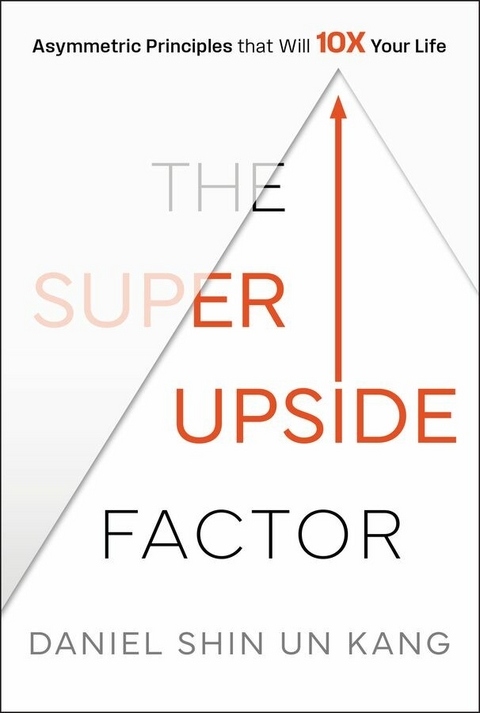
The Super Upside Factor (eBook)
275 Seiten
Wiley (Verlag)
978-1-394-25492-7 (ISBN)
A practical playbook to maximize luck in life and career
Venture capitalists manage to raise and invest trillions of dollars despite being wrong most of time through asymmetric bets - where a few big wins outsize losses by factors of 1,000x.
In The Super Upside Factor, Daniel Kang draws on his experience as a venture capitalist at Softbank Vision Fund and a Y Combinator-backed founder to adapt asymmetric principles for personal and professional life. He offers a clear framework for maximizing luck and generating outsized returns-what he calls Super Upsides. Through vivid, real-life experiments, Kang demonstrates how he put these principles into practice-from securing a book deal writing just 15 minutes a day; to recovering from a spiralling plane as a pilot; to raising millions by betting on pivotal career shift.
This book draws upon the author's firsthand experience going from no money, network, or looks to a highly successful career in entrepreneurship and venture capitalism. In this book, readers will find discussion on:
- Core concepts like the multiplier effect and black swans
- Probabilities, biases, and luck, and how to make them work for you, not against you
- Tools and first steps to create a 'life portfolio' of uncapped upsides and unlimited opportunity
Backed by decision science research and personal experimentations, the book strikes a balance between theory and practical advice, guiding readers to identify and optimize skewed life bets. Beyond the tactical elements, Kang explores the human side of applying these principles, including discussions on mental health, emotional struggles, and even tactically quitting.
The Super Upside Factor will inspire readers-even the most risk averse-to realize they are only a few Super Upsides away from extraordinary success and provide precise asymmetric principles needed to stack the odds in their favor.
A practical playbook to maximize luck in life and career Venture capitalists manage to raise and invest trillions of dollars despite being wrong most of time through asymmetric bets where a few big wins outsize losses by factors of 1,000x. In The Super Upside Factor, Daniel Kang draws on his experience as a venture capitalist at Softbank Vision Fund and a Y Combinator-backed founder to adapt asymmetric principles for personal and professional life. He offers a clear framework for maximizing luck and generating outsized returns what he calls Super Upsides. Through vivid, real-life experiments, Kang demonstrates how he put these principles into practice from securing a book deal writing just 15 minutes a day; to recovering from a spiralling plane as a pilot; to raising millions by betting on pivotal career shift. This book draws upon the author s firsthand experience going from no money, network, or looks to a highly successful career in entrepreneurship and venture capitalism. In this book, readers will find discussion on: Core concepts like the multiplier effect and black swans Probabilities, biases, and luck, and how to make them work for you, not against you Tools and first steps to create a life portfolio of uncapped upsides and unlimited opportunity Backed by decision science research and personal experimentations, the book strikes a balance between theory and practical advice, guiding readers to identify and optimize skewed life bets. Beyond the tactical elements, Kang explores the human side of applying these principles, including discussions on mental health, emotional struggles, and even tactically quitting. The Super Upside Factor will inspire readers even the most risk averse to realize they are only a few Super Upsides away from extraordinary success and provide precise asymmetric principles needed to stack the odds in their favor.
2
Defining Asymmetric Principles
My heart skipped a beat. The sharp scent of burned rubber stung my nose, accompanied by the growl of the noticeably weary engine. My driver was overtaking a car at 200 km an hour, in the beaten-up, gray Volkswagen I had matched with at the airport. I clenched on to the handle as if it'd do any good. Despite the winter chill in Berlin I felt only a moment ago, I was sweating in the middle of the Autobahn—not just from the near collision of my Uber driver, but because of my destination: headquarters of Auto1. Auto1 is a multibillion-dollar company that facilitates online trade of used cars. It's also where I held my first formal board position—though as an observer—in my career.
A few weeks earlier, I had entered the rather dimly lit board room, and grabbed a Schnittchen—an open sandwich that was too dry for my tastes—before sitting down for the hours of discussion ahead. Surrounded by industry veterans advising boards of Lufthansa and Volkswagen, my only chance of adding any value to the discussion was to do considerable work ahead of time. After the routine financial updates for the quarter, we moved quickly to the critical agenda point on the next stage of the business. The two co-founders, Christian and Hakan, navigated the discussion with charisma and data you'd come to expect from veteran founders, addressing the pointed questions from the board with clarity. The conclusion was one we had predicted before the meeting began: more capital to fuel the next stage of growth—even after the hundreds of millions SoftBank had already invested into the business.
A few days after the meeting, the C-suite asked me to fly out to Berlin to work directly with the team on fundraising, so I packed my bags. As my Uber driver swung onto Bergmannstraße, I unclenched my hand from the handle. With relief, I stepped out of the car, headed to the now familiar café to order a flat white. I took the first sip for a brief moment of calm before addressing the elephant in my mind: Should we be doubling down?
Venture investment requires judgment. There should be a clear thesis on why and how a company will generate outsized returns for investors. At SoftBank, the stakes were hundreds of millions of dollars to fund. Yet decisions had to be made with incomplete information, and consequences were hard to reverse. What made it exceptionally challenging was the complexity in the number of variables to consider. What if cost of used cars goes up, which could cut into gross margins? What if the interest rates increase, which would require more liquidity? What if inventory cycles slow, which could require a larger financing facility? What if the company can't raise in time? Even with a few “What ifs,” you can quickly see how there could be a near-infinite number of combinations of potential outcomes to consider. How does one cut through such complexity, never mind finding the perfect asymmetric opportunity for investments? And how does that translate to life decisions?
Identifying Asymmetric Opportunities
From the perspective of the present, every opportunity has a single realized past, and a range of possible future outcomes (Figure 2.1).
Figure 2.1 Range of Possible Outcomes
Each possible outcome has some probability of becoming the single realized path. And each realized path will impact you based on how you've positioned yourself. Let's call the range of possible outcomes variance; the associated probability frequency; and your position as impact. So if you're tossing a coin, variance is the range of possible outcomes, like heads, tails, and sides. Frequency is the probability, let's say it's roughly 49% chance of heads, 49% chance of tails, and 1% chance on side of the coin. And impact depends on how you've positioned yourself against the outcome, let's say a bet of $50 on heads.
Variance and frequency are objective measures, but impact is subjective based on your position. That is, the direction and magnitude of your impact is based on your position to the outcome. For example, if you toss a coin for fun, outcomes—heads, tails, or side—have no impact. In contrast, if you bet your net worth on heads for double or nothing, then outcomes will have a huge impact. Most investments are a more complex permutation of this base idea with a few more layers. Take, for example, stock market investing, and consider company performance relative to equity research analyst forecasts. Your first-order impact, barring exceptions like a financial crisis, will, roughly speaking, resemble the following based on your position:
- You don't own any financial security: No real impact.
- You own the stock: If the company falls short or exceeds by the same amount, the impact would be relatively symmetrical.
- You bought a call option: Downside is usually limited to the premium, but the upside can be huge.
- You sold a call option: Upside is usually limited to the premium, but the downside can be huge.
- You short sold: Symmetrical impacts are amplified with leverage.
Investing in asymmetric opportunities works on the same basic principles, but has unique characteristics. First, the variance of outcomes is far wider. For asymmetric upsides, the upside outcomes disproportionately outsize the cost of investment and all possible outcomes, and vice versa for asymmetric downsides. The key is to find the upward asymmetry, so when you win, you win big, and when you lose, you don't lose much. Otherwise known as skewed bets, this is how investors benefit from asymmetric opportunities.
Cutting Through Complexity: Scenario Forecasts
The obvious problem is that multibillion-dollar decisions happen to be more complex than tossing a coin to assess if an opportunity is truly asymmetric. That's even more so with the considerable number of possible outcomes to consider from the endless “what ifs.” One method investors used to cut through the complexity is sampled approximation, which we called scenario forecasts. Put simply, it's sampling the most material scenarios, out of the infinite possible outcomes. Typically, we sample at least three—though often much more—broad scenarios: upside case, base case, and downside case. These scenarios consider how multiple variables interact with each other to paint a real picture of what would happen, including a series of events that'd lead to said scenario. The approach gives a far more accurate and useful output for assessing an opportunity than thinking through an endless number of what ifs with single variables. I'll walk through a few concrete examples, particularly useful for the downside.
For emerging markets, rather than examining macroeconomic variables like interest rates, inflation, and defaults independently, we'd consider a scenario of “economic downturn.” That's because it would be odd for heavy inflation to occur on its own without corresponding movement of interest rates, and default rates. Rather than running analyses of how a single variable would change the outcome and impact, we'd incorporate material variables including the devaluation of the foreign currency against the dollar (the investment currency), rising default rates, slowdown of sales, and interest rate movements.
We run scenario forecasts to paint an accurate picture to assess the downside, without underestimating or overestimating the downside. Variables interplaying during a downward spiral of an economic meltdown are far worse than what a single “what if” would estimate. At the same time, forecasting the series of events that'd take place avoids overestimating the downside from conflating mutually exclusive scenarios. For example, the devaluation of the local currency against the dollar would impact both the revenue base and cost base. I wouldn't assume sales to fall in terms of the US dollar while assuming the invoices from three months ago in local currency to somehow increase in terms of US dollars. In fact, if the company kept most of the investments in US dollars, as most are advised to do, that'd have greater buying power than before. The downside scenario isn't blindly stressing scenarios. It's replicating what such a scenario would represent, which cuts through the complexities to accurately evaluate the opportunity.
This is the sort of work I did as a venture capitalist, though in far more detail, when considering the investment decision. What happened to Auto1? We ended up doubling down and helped raise the 255 million euros, despite the capital scarcity that hit in 2020.
Worth the Work
The following year, I found myself enjoying a much more leisurely pace of life. Sitting in the meadows of Oxford, I relished the view of the river Cherwell, made even better with a sip of espresso after rowing practice at an ungodly early hour. A sense of satisfaction washed over me as I read the news on my phone: “Auto1 goes public,” and at a valuation of almost $10 billion.1 A single outsized return can be life changing, for both investors and for you.
While billion-dollar decisions sound grand, I'd argue that your personal life decisions hold far greater significance, in terms of subjective outcomes—you'd be the one living through it. Yet, when it comes to life decisions, the same level of rigor is often lacking. There is a tendency to be...
| Erscheint lt. Verlag | 18.3.2025 |
|---|---|
| Sprache | englisch |
| Themenwelt | Sachbuch/Ratgeber ► Beruf / Finanzen / Recht / Wirtschaft ► Bewerbung / Karriere |
| Wirtschaft ► Betriebswirtschaft / Management | |
| Schlagworte | asymmetric outcomes • Business Consulting • career advice • Entrepreneurship • maximizing luck • Non-linear • Personal development • Probability Theory • professional development • Self development • Self Help • Startups • Statistics • Success • Venture Capital |
| ISBN-10 | 1-394-25492-X / 139425492X |
| ISBN-13 | 978-1-394-25492-7 / 9781394254927 |
| Informationen gemäß Produktsicherheitsverordnung (GPSR) | |
| Haben Sie eine Frage zum Produkt? |
 EPUB (Adobe DRM)
Kopierschutz: Adobe-DRM
Adobe-DRM ist ein Kopierschutz, der das eBook vor Mißbrauch schützen soll. Dabei wird das eBook bereits beim Download auf Ihre persönliche Adobe-ID autorisiert. Lesen können Sie das eBook dann nur auf den Geräten, welche ebenfalls auf Ihre Adobe-ID registriert sind.
Details zum Adobe-DRM
Dateiformat: EPUB (Electronic Publication)
EPUB ist ein offener Standard für eBooks und eignet sich besonders zur Darstellung von Belletristik und Sachbüchern. Der Fließtext wird dynamisch an die Display- und Schriftgröße angepasst. Auch für mobile Lesegeräte ist EPUB daher gut geeignet.
Systemvoraussetzungen:
PC/Mac: Mit einem PC oder Mac können Sie dieses eBook lesen. Sie benötigen eine
eReader: Dieses eBook kann mit (fast) allen eBook-Readern gelesen werden. Mit dem amazon-Kindle ist es aber nicht kompatibel.
Smartphone/Tablet: Egal ob Apple oder Android, dieses eBook können Sie lesen. Sie benötigen eine
Geräteliste und zusätzliche Hinweise
Buying eBooks from abroad
For tax law reasons we can sell eBooks just within Germany and Switzerland. Regrettably we cannot fulfill eBook-orders from other countries.
aus dem Bereich