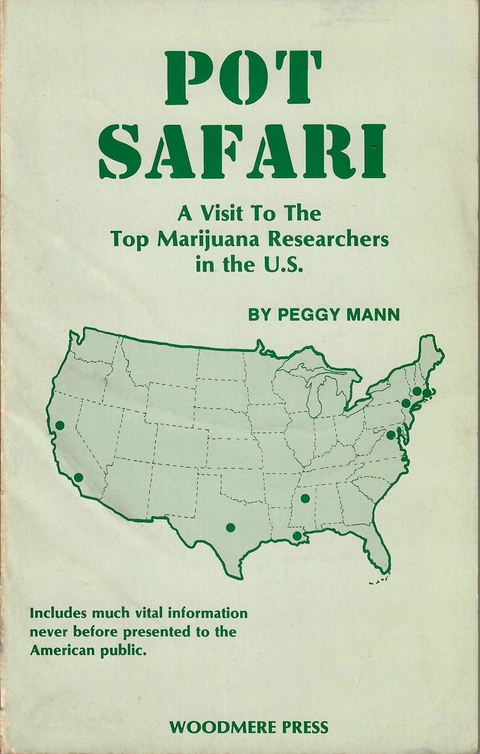
Pot Safari (eBook)
200 Seiten
Bookbaby (Verlag)
979-8-3509-9781-1 (ISBN)
Peggy Mann (born July 24, 1924, New York City - died July 19 1990, New York City). As a staff writer on the Reader's Digest magazine, and author of more than 35 books in addition to hundreds of magazine articles, Peggy Mann was best known for her writing on the health hazards of marijuana, and was honored in 1985 by the US Congress as 'The nation's number one drug abuse prevention author.' She is still known for having written more about marijuana than anyone else in the world: her books on the subject included Marijuana Alert (with a foreword by First Lady Nancy Reagan); Arrive Alive: How to Keep Drunk and Drugged Drivers off the Road; Twelve is Too Old; The Sad Story of Mary Wanna and Pot Safari: A Visit to the Top Marijuana Researchers in the US. She began her career as a children's book writer, addressing universal subjects such as a young child preparing for the birth of a sibling in That New Baby; a child who tells fibs in The Boy with a Billion Pets; parables of community life in 'Lawrence the Lion with Laryngitis' (later retitled Lawrence the Alarm Clock); an urban love story between two lonely seniors brought together by a lost cat in William the Watch Cat; and tough themes such as divorce in My Dad Lives in a Downtown Hotel and losing a parent to cancer in Two Kinds of Terrible. The latter two were made into television movies. New York City's Upper West Side was a favorite location for many of her books for young readers. Born and raised there, Peggy and her English husband, William Houlton, bought a brownstone in the 1960s on West 94th Street, where they raised two daughters. She wrote a series for and about neighborhood kids, mostly from Puerto Rico, who were often the bridges for their families into a new country. These included The Street of the Flower Boxes, which became a Peabody Award-winning television movie that inspired a movement for neighborhood beautification; The Clubhouse; How Carlos Closed the Street and The Secret Dog of Little Luis. As a young writer living in Paris in the 1950s, Peggy wrote her first adult novel, A Room in Paris, which was made into a movie with John Cassavetes as well as a Broadway play. She also wrote numerous biographies, including those of Golda Meir, Amelia Earhart, Clara Barton, Luis Muñoz Marin, Peter Still and Whitney Young, Jr. The Last Escape, a major work published in 1973, told the true story of a young woman's secret rescue mission prior to World War II. Sadly, she was diagnosed with breast cancer and passed away at the untimely age of 65. She left behind a substantial body of work focusing on subjects that had rarely been talked about.
Peggy Mann has written more magazine and newspaper articles about the health hazards of marijuana than any other writer in the world. Pot Safari (first published in 1982) is her first book on the subject. It is based on information she gathered during a four month "e;Safari"e; to visit the most important marijuana researchers in the United States. She spent from two to four days with each of them, in their laboratories. In doing so, she learned much vital information about the biological health hazards of marijuana to the body which had never before been presented the American public. Peggy Mann, was honored in 1985 at a US Congressional reception as "e;The Nation's foremost drug abuse prevention author."e;In this 2025 re-issue of Pot Safari, original source material is returned to the public with a new Foreword by Dr. Kenneth Finn, Editor of the book, Cannabis in Medicine: a Scientific Approach, plus a new Preface by Emily Dufton, author of "e;Grass Roots; the Rise and Fall and Rise of Marijuana in America, as well as additional commentary by Dr. Robert DuPont, Founder of the National Institute on Drug Abuse (NIDA). Written in an engaging and readable style, this book conveys scientific information about marijuana's harm to various systems in the body: the brain; sex and reproduction; pregnancy; lungs and heart the immune system. This book is aimed at concerned parents, educators, medical professionals, government officials as well as teenagers who are facing peer pressure to get high. In today's world legislation has decriminalised the use of marijuana and made it legal for recreational and/or medical use in most of the United States, as well as in much of the Western world. The information found in this book is a much-needed counterbalance to the tide of misinformation and the popular perception that marijuana can be beneficial to ones health. In recent years, certain medical experts on marijuana felt that this information, which is as relevant today as it was forty years ago, should be re-issued and made available to the wider public.
FOREWORD TO THIS NEW EDITION, 2025
by Kenneth Finn, MD, Editor of Cannabis in Medicine; An Evidence-Based Approach
How did we get to this point? Resurrecting this forgotten book by Peggy Mann who wrote decades ago about the harmful effects of cannabis would not be happening unless, as is the case today, serious issues and concerns remain. As the world’s marijuana industry has grown, purposely parallel to the potency of the plant’s psychoactive component, so have the unintended consequences, and the public has been duped into believing it is safe, natural, herbal, medicinal, and harmless. This is clouded by misinformation showering the public by cannabis industry and interest groups, social media, and other news and media outlets, including medical professionals who have forgotten about, or neglected evidence-based medicine, as well as their own sworn oath to “do no harm”. Enough false narratives have been thrown at the public that a lot actually sticks to the wall. Plenty of plant-based medications, from aspirin, as pain reliever, which comes from the bark of the willow tree, to Taxol, a breast cancer treatment, isolated from the pacific yew tree, have met the rigor of FDA and other scientific clinical safety and efficacy trials. Yet in the case of cannabis, where a significant amount of well documented research and study on its harmful effects to animals and humans has been known since the 1970s, the findings have somehow been overlooked and buried. Cannabis has received a free pass.
Peggy Mann was the pioneer of cannabis journalism. She investigated and told the scientific truth about cannabis decades ago, and was the first to compile the scientific evidence for public information in several publications. My personal journey on this issue as a physician specializing in pain management, began years ago after legalization of cannabis for medicinal purposes passed in Colorado in 2000 with Amendment 20, which was implemented in 2001. Over time, the vast majority of patients in Colorado were using “medical marijuana” for pain, yet still needed help from a pain medicine physician. I found patients were not substituting opioids with cannabis and actually were reporting cannabis was not helping with their pain problem most of the time. As of 2022, cannabis expansion has not helped the opioid epidemic and 2021 was a record year in drug overdoses, including prescription opioids in Colorado. Cannabis has been the casual overseer of the drug crisis. Over time, this prompted me to research what evidence was available, and edit a textbook on Cannabis in Medicine. Part of my research led me to the “out of print” books by Peggy Mann, and I was astonished at what she published 40 years ago.
Since Pot Safari was originally published in 1982, more has been learned about the health and societal effects surrounding cannabis promotion around the world, and dangers are proving to be more compelling and concerning. There have been significant increases in potency due to higher levels of the psychoactive component of marijuana (delta-9-tetrahydrocannabinol or THC). In the not-so-recent past, THC levels averaged 2-3%, and they now average nearly 20%, with concentrates averaging 40-50% THC, and now there are other products pushing nearly 100% THC (dabs, waxes, shatter). In addition, new products and delivery systems have been developed by a powerful cannabis industry, intent on placing addiction-for-profit over public health and safety. Part of the reason for reprinting this book is because much of what we may consider current and new information has actually been known for decades. Peggy Mann and those she touched and worked with on this issue have nearly all but been forgotten, but her works are now seeing new light as original source material.
The neurological and psychiatric effects are well documented and understood, as the primary target organ of marijuana is the brain. Scientific data from around the world confirms that potencies more than 10% THC may cause psychosis, and the relationship between cannabis use and schizophrenia is very strong. Since rampant promotion and expansion of cannabis use across the globe, there has been increasing documented episodes of cannabis-induced psychosis and violence, including homicides and mass shootings in the Unites States. Mental illnesses, including suicide, depression, and anxiety, have been strongly linked to cannabis use, particularly in adolescents.
Cannabis’ effects are predominantly noted in the central nervous system. It can impair one’s ability to operate a vehicle or machinery. Impacts on depth perception, reaction time, and judgment are only some of the areas of concern, and data has shown an increase of the presence of cannabis in people driving under the influence of drugs. Cannabis is now the most prevalent substance found in impaired drivers, and the percentage of cannabis-related driving fatalities are on the rise, particularly in areas with expanded cannabis programs. According to the scientific evidence, use of cannabis can significantly increase one’s risk of a fatal car accident.
People are silently struggling with cannabis addiction. Perhaps they hear that cannabis is not addictive through media outlets and cannabis industry publications. Cannabis use disorder, cannabis withdrawal, and cannabinoid hyperemesis syndrome (CHS) are well documented in the medical literature. Pervasive and rampant use of cannabis is placing a strain on an already impaired medical healthcare system, from multiple marijuana-related effects, from CHS to multi-trauma from vehicular crashes to accidental poisonings, particularly in the young.
Despite the idea of replacing opioids with cannabis during the opioid crisis being attractive, the use of cannabis for chronic non-cancer pain and cannabis for opioid replacement has not been proven to date. In actuality, national US data is proving that prescription opioid overdose deaths have continued to rise in US states which have embraced the cannabis industry, and there is no longer merely an opioid epidemic, and is now a poly drug crisis. Coinciding with increased expanded cannabis programs across the US, there has been increases in other drug related deaths, including methamphetamine, cocaine, heroin, and fentanyl, which has become national crisis in the United States.
Adolescent use currently continues to rise as social acceptance and mass marketing has increased. Social normalization of drug use regarding cannabis has led to general and overall increase in adolescent use of a variety of products. Perception of harm is hitting an all-time low around the globe. Although youth use rates may have stabilized, behaviors are becoming more dangerous, with a significant rise in youth using very high potency products by a method called dabbing. Early onset and increased frequency of use has been shown to increase the risk of depression in adulthood. Between 2012 and 2019, cannabis was the most prevalent substance found in completed teen suicide in the state of Colorado, reversing the trend where alcohol was most often found, strongly coinciding with legalization and promotion of cannabis by the state.
Cannabis effects the central nervous system although other possible effects may also be noted. For example, judgment, cognition, and balance may be negatively impacted by cannabis use and may be a concern, particularly for an aging population. Older patients may be taking several prescription medications with potential drug interactions between the components of cannabis and what they are taking with potential serious medical complications. Liver impairment, heart complications, and strokes are among the list of possible side effects of cannabis use alone or in combination with prescription and medications, among others. Pulmonary concerns also exist, particularly with recent vaping epidemic and associated lung injuries and deaths where THC takes center stage along with Vitamin E acetate.
Cannabidiol (CBD), another component of the marijuana plant, has taken a stronghold as benign, harmless, and is now being added to foods, beverages, and cosmetics, to name only a few. Although not psychoactive, it is certainly not benign. In a medical grade formulation, approved by the FDA, it’s been demonstrated to be beneficial for a narrow spectrum of pediatric seizures. Artisanal products are frequently contaminated, poorly tested and regulated, and potentially hazardous and consumers are not educated as to any risks associated with consumption of CBD products. There may be negative liver effects associated with the use of CBD products. There are also over 610 drug interactions with CBD which consumers may not be aware of and may place them at risk of an adverse reaction with their medications.
Cannabis use during pregnancy and breastfeeding is dangerous for the developing brain. THC and other components of the cannabis plant cross the placenta and interfere with brain development. In Colorado, 70% of marijuana dispensaries surveyed (N=400) recommended use of marijuana in the first trimester of pregnancy without any medical oversight or referral to a medical provider. Offspring of...
| Erscheint lt. Verlag | 18.3.2025 |
|---|---|
| Sprache | englisch |
| Themenwelt | Sachbuch/Ratgeber ► Gesundheit / Leben / Psychologie |
| ISBN-13 | 979-8-3509-9781-1 / 9798350997811 |
| Informationen gemäß Produktsicherheitsverordnung (GPSR) | |
| Haben Sie eine Frage zum Produkt? |
 EPUB (Ohne DRM)
Größe: 22,0 MB
Digital Rights Management: ohne DRM
Dieses eBook enthält kein DRM oder Kopierschutz. Eine Weitergabe an Dritte ist jedoch rechtlich nicht zulässig, weil Sie beim Kauf nur die Rechte an der persönlichen Nutzung erwerben.
Dateiformat: EPUB (Electronic Publication)
EPUB ist ein offener Standard für eBooks und eignet sich besonders zur Darstellung von Belletristik und Sachbüchern. Der Fließtext wird dynamisch an die Display- und Schriftgröße angepasst. Auch für mobile Lesegeräte ist EPUB daher gut geeignet.
Systemvoraussetzungen:
PC/Mac: Mit einem PC oder Mac können Sie dieses eBook lesen. Sie benötigen dafür die kostenlose Software Adobe Digital Editions.
eReader: Dieses eBook kann mit (fast) allen eBook-Readern gelesen werden. Mit dem amazon-Kindle ist es aber nicht kompatibel.
Smartphone/Tablet: Egal ob Apple oder Android, dieses eBook können Sie lesen. Sie benötigen dafür eine kostenlose App.
Geräteliste und zusätzliche Hinweise
Buying eBooks from abroad
For tax law reasons we can sell eBooks just within Germany and Switzerland. Regrettably we cannot fulfill eBook-orders from other countries.
aus dem Bereich