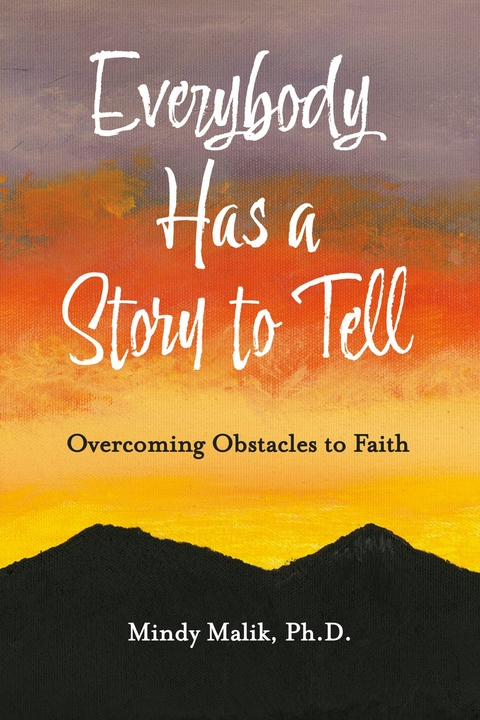
Everybody Has a Story to Tell (eBook)
196 Seiten
Bookbaby (Verlag)
979-8-3509-8781-2 (ISBN)
Dr. Mary Melinda 'Mindy' Malik is a developmental psychologist whose career focus has been teacher training and program development to support individuals with developmental disabilities. In addition to her doctoral degree in psychology, she holds a master's degree in theology from the University of Notre Dame. Over the years she has worked in faith formation, prayer and spiritual direction ministries, along with founding Prayerful Journeys, (www.prayerfuljourneys.org), dedicated to deepening the spiritual lives of others through prayer, retreats and spiritual direction.
This book contains eight stories of personal journeys of faith. In addition, four chapters cover the obstacles that challenge people most with regard to faith: scientific evidence for the existence of God, the issue of suffering, knowledge about Jesus, and ways to turn to God. An easy-to-read format distills complex topics while entertaining the reader with real life stories.
Chapter 1
My Story
Prologue
I don’t think it is possible to be truly happy without God at the center of your life. I don’t believe it is possible to be even marginally happy, without God at the center of your life. Why do I say this? As I sit to write, I wonder what I possibly could have to say that would be of value to others. What have I learned from my own story? I have learned that everyone is equally valuable in God’s eyes, and that your story is just as important as my story. But before we go there, we have to first understand that God exists, God is real. It took me 49 years to learn this, and I am 72, so I have only truly known this for about one third of my life.
Early Life
I am among the privileged in the world just to have been born in the United States to a middle-class family in 1952, and raised in suburban Maryland, right outside Washington, D.C. My story begins as a young child, raised in what was at first, a very happy nuclear family in the 1950s. My father fought in World War II, my parents married in 1946, and they had the hope and the promise of an ordered life in a peaceful world. The clear values Americans shared are chronicled in the movies of that time, when God’s name could be mentioned without worry, Going My Way, The Bells of St. Mary’s, and the Andy Hardy movies.
Picture an eight-year-old child attending Little Flower Catholic School. Picture a hardworking, compliant, scrupulous, painfully shy little girl. Picture her in a blue uniform and white blouse with a Peter Pan collar, kneeling in the church, head bowed, talking to Jesus. Picture one of the Sisters calling the class out for talking in line and asking for anyone who talked in line to confess and receive punishment. Hmmm, this presented an ethical dilemma for me at the time. I had talked, but the only thing I had said to the others was, “Be quiet!” If I did not confess, because I had talked, that would be another sin, a lie. So, I came forth with the other confessors. I had not yet learned about situation ethics. Now one time, I really had laughed when the boys locked someone in the cabinet, and those who laughed all had to stay after school and stand to contemplate the crucifix. Five minutes into this penance, Sister said to me, “Mary Melinda, you may go, because you usually are well behaved.” I walked home from school by myself that day.
I loved singing in the choir. Sister Martin Marie was our choir leader, a very tall slim nun in full habit. I couldn’t understand why my parents never came to hear me sing. I begged my Dad, a Catholic, to come to midnight Mass to hear me sing the special hymns and carols we had been practicing so fervently. He dutifully dropped me off and picked me up, but he didn’t stay to hear me sing. He did attend the shorter Masses, however, always sitting in the last seat as close to the door as possible. I remember an image of him with head bowed, praying fervently. I did not know until much later that he had an anxiety disorder and that I would inherit it. It was very difficult for him to be confined with large groups of people, so he always sat near the exit.
One day in November of 1963, we were in choir practice, singing at the top of our lungs as Sister Martin Marie led us. Suddenly another Sister darted in and whispered something into her ear. She looked at us, and in a loud voice said, “On your knees!” She began to pray the rosary with us. When we returned to class it was announced over the loudspeaker that President Kennedy had been shot and was dead. We were all sick inside and terribly sad. My parents were bereft when I got home. We all watched the funeral on television, the motorcade, the coffin, little John-John saluting his daddy. I did not know at the time that this event was ushering in the shift in our culture from the post WWII promise of the American dream, to a society that would become violent, amoral, and agnostic, authorizing a variety of ways to walk away from God. How could I know? I was only 11 at the time. But honestly, no one else really knew either.
Another childhood bookmark was me as a nine-year-old going to confession. I was sitting in the Church reading the missal with a list of many possible sins. As a child, I suffered from scrupulosity. As I prayerfully reviewed the list, I was suddenly stymied by a new sin I had never heard of before – doubting your faith! Oh my, I sunk into my pew. Just the past week, in religion class we had studied the resurrection of Jesus, and I remembered thinking, “How could a man possibly rise from the dead? That just seems impossible!” This definitely sounded like doubting your faith. I began to get anxious. I knew that an additional sin was failing to confess a sin you knew you had committed! Oh, woe is me, I was caught. What would the priest say to this meek nine-year-old? I walked into the black box. I confessed. The unknowing priest missed the mark, the first opportunity a priest had to protect me from the onslaught of the evil spirit’s future plot for my agnosticism. Ah, Screwtape (C.S. Lewis’ satirical tempter character) planning ahead! The priest did not say to me what I would now say to someone who came to me with this at any age. My counsel would be: “It is normal to have doubts. God gave us reason so we may reflect about these matters. Faith is choosing God in spite of our doubts. Faith is turning in God’s direction. God does the rest when we turn in His direction.” Instead the priest said – “It is not okay to doubt your faith. Jesus rose from the dead. Your penance is…” In walked shame; then in, walked righteous indignation. Now within my nine-year-old mind began the seed of what would later become the skill of analytical thinking. When I went back to my pew to say my penance, I knew in my gut, and in my heart, that he was wrong about one thing. I wanted to believe with all my heart that Jesus had risen from the dead. But it could not be a sin to doubt. The reason I knew this was the simple and real use of logic. I reasoned, “The thought that Jesus might not have risen from the dead just popped into my head! I didn’t choose that thought. So, it can’t be a sin. I knew a sin was defined as something that you chose to do that was wrong, and I had not chosen that thought. The priest was wrong.” Note to my nine-year-old independent thinking self: priests can be wrong.
However, I was much more greatly helped by my Catholic education than ever was I hurt. I did not ever suffer abuse as some children did at the hands of clergy, nor did I ever hear of it happening back then. For the most part, the priests and nuns that I knew were kind, modest people who loved God. I still greatly love our nuns and priests today.
My life as a child in Washington, D. C. was probably the happiest time in my life in an earthly sense. We were a family, my sister, brother and I with two loving parents in a neighborhood of kids that played outside all of the time when we were not in school or doing our homework. In the summers, we stayed out until nine at night, playing freeze-tag, gorilla tag, Monopoly, or composing our one edition newspaper called “The Gang Nes,” (because one of the authors accidentally omitted the “w” in the title). We lived in a two-story house with a front porch just big enough for roller skating. The large yard had mature trees, and an apple tree in the middle that I used to climb and sit in, happily watching the ants climbing up and down the trunk. At the far side, there was a large open fenced area that became the baseball diamond for the neighborhood gang, complete with a dugout made of overhanging vines where the players would wait for their turn to bat.
As a very shy child, it took me years to begin to gain confidence. Within the neighborhood gang (for which our large yard with the baseball diamond was the focal point), I began to gain that confidence. One day, as I was walking around the neighborhood, I spied a young girl about 12 standing on a hill in madras shorts and a cutoff sleeved cool shirt wearing a large pin that said, “The Beatles bug me.” I happened to be wearing a pin that said, “I love Paul” (the Beatle Paul, that is). We read each other’s buttons in silence. These were the days of Beatlemania. We instantly became best friends. The first time I went into her house was by climbing a trellis and toppling in through the window to see her Beatle posters. Having a best friend for the first time in my life helped to build the confidence that had just started to bud within me. I did not know it was possible to be this happy. And all along I was still praying at church, at school, and at home, trusting God would always be there to watch over me.
My sister, my brother and I all felt so happy to be in the neighborhood gang and to live in the house that everyone came to, and to play games in the night under the streetlights. We thought it was possible to be this happy. In adulthood, I wrote a poem about it.
When Gangs Were Good
I have never felt such freedom since.
Fearless nights,
Children, all streaming out of their houses
To meet on the streets
Under lampposts that lit
A world of sparkling...
| Erscheint lt. Verlag | 28.4.2025 |
|---|---|
| Sprache | englisch |
| Themenwelt | Sachbuch/Ratgeber ► Gesundheit / Leben / Psychologie ► Lebenshilfe / Lebensführung |
| ISBN-13 | 979-8-3509-8781-2 / 9798350987812 |
| Informationen gemäß Produktsicherheitsverordnung (GPSR) | |
| Haben Sie eine Frage zum Produkt? |
 EPUB (Ohne DRM)
Größe: 1,5 MB
Digital Rights Management: ohne DRM
Dieses eBook enthält kein DRM oder Kopierschutz. Eine Weitergabe an Dritte ist jedoch rechtlich nicht zulässig, weil Sie beim Kauf nur die Rechte an der persönlichen Nutzung erwerben.
Dateiformat: EPUB (Electronic Publication)
EPUB ist ein offener Standard für eBooks und eignet sich besonders zur Darstellung von Belletristik und Sachbüchern. Der Fließtext wird dynamisch an die Display- und Schriftgröße angepasst. Auch für mobile Lesegeräte ist EPUB daher gut geeignet.
Systemvoraussetzungen:
PC/Mac: Mit einem PC oder Mac können Sie dieses eBook lesen. Sie benötigen dafür die kostenlose Software Adobe Digital Editions.
eReader: Dieses eBook kann mit (fast) allen eBook-Readern gelesen werden. Mit dem amazon-Kindle ist es aber nicht kompatibel.
Smartphone/Tablet: Egal ob Apple oder Android, dieses eBook können Sie lesen. Sie benötigen dafür eine kostenlose App.
Geräteliste und zusätzliche Hinweise
Buying eBooks from abroad
For tax law reasons we can sell eBooks just within Germany and Switzerland. Regrettably we cannot fulfill eBook-orders from other countries.
aus dem Bereich