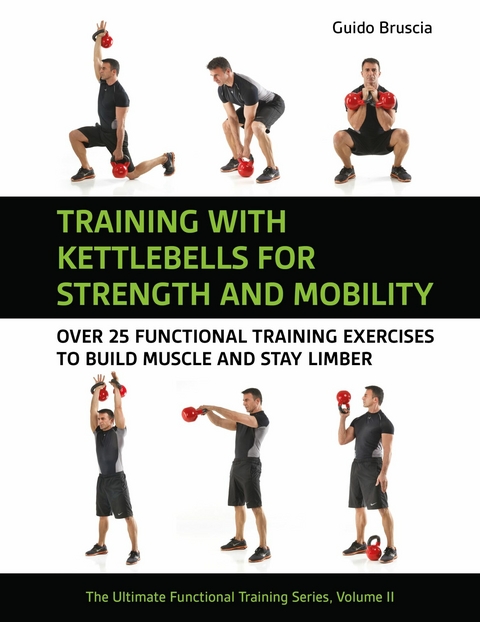
Training with Kettlebells for Strength and Mobility. (eBook)
200 Seiten
Meyer & Meyer Fachverlag und Buchhandel GmbH
978-1-78255-558-2 (ISBN)
Guido Bruscia is a master trainer who is well known worldwide for functional and kettlebell training. He is the technical director of the Functional Training School, and he also teaches at institutions for fitness and bodybuilding coaches and personal trainers. He has written several bestselling books. He invented Personal Care, an innovative method of personal training with the goal of revolutionizing the lives of its students. Guido lives in Rimini.
Volume II in the Ultimate Functional Training Series, Training With Kettlebells for Strength and Mobility, contains more than 25 functional kettlebell exercises that improve strength, build muscle, and reduce the risk of injury. Functional training includes those exercises which prepare the body for daily activities, and the best part of functional training is that it is simple to master and fits within the busiest lifestyle. The exercises are grouped into their targeted areas: lower body, core, and upper body. After progressing in strength and mobility by mastering the bodyweight exercises found in volume I, you will build on your foundation as you progress in strength and fitness by adding additional kettlebell weight. Also included are sample training plans for strength, hypertrophy, and toning which can be implemented into any workout routine, at home or at the gym. No training should be undertaken without first mastering the theory behind it. Before diving into the exercises, you are given the theory and background on the uses and benefits of functional training. With Kettlebell Training, you will revolutionize your health and athletic performance! The Ultimate Functional Training Series is a compilation of the best functional training exercises in four volumes: Training With Bodyweight, Training With Kettlebells, Training With Medicine Balls, and Training With Sandbags.
PART I – THEORY
CHAPTER 1
THE LOCOMOTOR APPARATUS
1.1PRESENTATION
Every time we think about a sporting activity, we associate it with the concept of motion.
This process is so widespread and natural that we don‘t think about its underlying reason why. During courses, students who are interested in and passionate about training sometimes ask me why it is necessary to know stuff that has no apparent connection with a horizontal bench or a squat.
The answer is that gymnastics, in its broadest sense, is an empirical science; it stands apart from scientific bases which interact constantly with sporting exercise in gyms or outdoors. For this reason, you will often find not only various definitions, but also examples which refer back to practice.
The locomotor apparatus is the structure that allows a person to move in relation to space and the outside world. For practical purposes, it is subdivided into an active part and a passive part. The active part is made up of muscles, tendons, and ligaments. The inactive part is composed of bones and joints. Each is briefly discussed in the following sections.
1.1.1The active part of the locomotor apparatus: Muscles, tendons, and ligaments
MUSCLES
The term muscle, from the Latin musculus (from mus, rat, because some movements are reminiscent of a rat darting about), indicates an organ made of biological tissue with the ability to contract.
The muscles are subdivided into:
■Smooth, or involuntary, muscles
Commanded by the autonomic nervous system, they encase the walls of several organs and corporeal systems, enabling or improving their functionality with their contraction.
■Striated skeletal, or voluntary, muscles
Commanded by the central nervous system, they encase the skeleton, and, by their contraction (shortening), they determine the bone levers’ movement.
A peculiar type of striated muscle is the myocardium, which is commanded by the autonomic nervous system.
TENDONS
Tendons are bands of connective tissue with poor elasticity, and their function is to anchor the muscles to the bones. Their role is to transmit tension from muscles to the bone levers, thus allowing their movement.
LIGAMENTS
Ligaments are sheaves of connective tissue with varying percentages of collagen fibers that link bones at the joints. The ligaments‘ purpose is to limit articular movement which would risk creating lesions were it to continue. For example, the knee‘s collateral medial and lateral ligaments support the anterior and posterior cruciate ligaments in limiting the articulation‘s intra- and extrarotation movements in order to avoid lesions to the knee itself.
1.1.2The passive part of the locomotor apparatus: Bones and joints
BONES
Bones are specialized tissues with great mechanical resistance. They are divided into:
■Long bones (humerus, femur, tibia, radius): These are composed of an elongated body known as diaphysis and by terminal extremities known as epiphysis; they determine raw movements, which are characterized by wide articular excursions.
■Short bones (vertebrae): They have a similar diameter in all three spatial dimensions.
■Irregular bones (facial bones, the patella): These bones are characterized by variable dimensions and shape.
■Flat bones (pelvis, sternum, skull): Their function is protecting internal organs.
Don‘t be misled by bone tissue in the passive part of the locomotor apparatus: The bone is a highly active and dynamic tissue. In fact, from birth, the bone undergoes a remodeling process, involving the change and overlap of catabolic and anabolic phases. The catabolic phases are stimulated by micro organelles called osteoclasts, and the anabolic phases are activated by other specialized cells called osteoblasts. The piezoelectric effect gives the input for an increased bone tissue synthesis activity.
What does it involve? During motor activity, bone segment compression generates an electric depolarization of the bone membrane at the load points. This creates a greater localized need for the reconstructive osteoblasts. This explains why weight training, as demonstrated by several studies, has turned out to be an excellent remedy to contrast osteoporosis.
JOINTS
Joints are the junction hubs between two or more bone segments around which bones rotate.
According to their configuration and degree of mobility, joints can be classified as follows:
■Synarthroses: These are fixed, fibrous joints with little or no possibility of movement.
■Amphiarthroses: These joints are semi-mobile; they are often cartilaginous (e.g., vertebrae).
■Diarthroses: These are the mobile, synovial joints capable of a greater degree of movement. In terms of movement range, the most significant are the enarthroses (e.g., shoulder and hip), with spherical-shaped, multi-axial articular surfaces.
1.2MUSCLE ACTION
For clarity, I have simplified the different muscular actions, adding the technical definition in parentheses.
■Flexion: When two bone segments move closer to each other (the moving part draws away from the horizontal plane). Example: brachial biceps, femoral biceps
■Extension: When two bone segments move away from each other (the moving part draws nearer to the horizontal plane). Example: brachial triceps, femoral quadriceps
■Adduction: When a bone segment draws closer to the median sagittal line (the moving part draws closer to the sagittal plane). Example: thigh adductors group
■Abduction: When a bone segment draws away from the median sagittal line (the moving plane draws away from the median sagittal plane). Examples: gluteus minimus and gluteus medius, high tensor fascia, deltoid
■Torsion: Movement of the trunk around the vertical axis.
■Rotation: Movement of a limb on its longitudinal axis.
■Intrarotation: Rotation of a bone segment in the medial direction, in other words, toward the inside (movement toward the anterior frontal plane).
■Extrarotation: Rotation of a bone segment in the lateral direction, in other words, toward the outside (movement toward the posterior frontal plane).
Each muscle performs several movements, which must be differentiated in order to better define exercises and their completion. For example, flexion and extension take place when the limbs aren‘t bearing weight. Bending, however, takes place when the limbs are bearing weight, as when completing a push-up. We may therefore notice that what is commonly referred to as flexing the arms is defined more correctly as bending the arms.
1.3ROLE OF THE INDIVIDUAL MUSCLES
Based on the role they play in movement, we may differentiate muscles as:
■Agonist muscles: They play the main role in a specific action. Example: pectoral muscles in the horizontal bench press.
■Antagonist muscles: In the same action, they play an opposite role to the agonist muscles. Example: the trapezius muscle in the horizontal bench press.
■Synergistic muscles (from the Greek sun-ergo, “working together”): They help and support the agonist muscles. Examples: the triceps and anterior deltoid muscles in the horizontal bench press.
■Neutralizing muscles (stabilizers): They stabilize a bone segment, allowing other muscles to execute a certain action.
■Fixator muscles: They act as stabilizers, but they that is not their only role. They block a segment in the position that is appropriate to a movement or an action. Examples: pectoralis and latissimus dorsi muscles in parallel bars exercises.
1.4ARTICULAR FEATURES OF MUSCLES
In gyms, muscle articulation is mostly disregarded, if not completely ignored.
Yet muscle articulation is of fundamental importance in understanding how to teach various exercise methods. Muscle articulation is defined as:
■monoarticular, those muscles that control only one joint and are inserted on bone levers that are paired by one joint only; and
■bi- or multiarticular, those muscles that cross over two or more joints.
In order to understand the importance of this distinction, let me remind you that when a muscle is biarticular, it should be stimulated with biarticular movements in order to be fully trained.
The most common example is that of the biceps brachii. Though it is a biarticular muscle, the biceps brachii is usually trained with monoarticular movements—the upper arm is kept steady against the trunk while only the forearm moves. To be...
| Erscheint lt. Verlag | 1.4.2025 |
|---|---|
| Sprache | englisch |
| Themenwelt | Sachbuch/Ratgeber ► Sport |
| ISBN-10 | 1-78255-558-7 / 1782555587 |
| ISBN-13 | 978-1-78255-558-2 / 9781782555582 |
| Informationen gemäß Produktsicherheitsverordnung (GPSR) | |
| Haben Sie eine Frage zum Produkt? |
 EPUB (Adobe DRM)
Kopierschutz: Adobe-DRM
Adobe-DRM ist ein Kopierschutz, der das eBook vor Mißbrauch schützen soll. Dabei wird das eBook bereits beim Download auf Ihre persönliche Adobe-ID autorisiert. Lesen können Sie das eBook dann nur auf den Geräten, welche ebenfalls auf Ihre Adobe-ID registriert sind.
Details zum Adobe-DRM
Dateiformat: EPUB (Electronic Publication)
EPUB ist ein offener Standard für eBooks und eignet sich besonders zur Darstellung von Belletristik und Sachbüchern. Der Fließtext wird dynamisch an die Display- und Schriftgröße angepasst. Auch für mobile Lesegeräte ist EPUB daher gut geeignet.
Systemvoraussetzungen:
PC/Mac: Mit einem PC oder Mac können Sie dieses eBook lesen. Sie benötigen eine
eReader: Dieses eBook kann mit (fast) allen eBook-Readern gelesen werden. Mit dem amazon-Kindle ist es aber nicht kompatibel.
Smartphone/Tablet: Egal ob Apple oder Android, dieses eBook können Sie lesen. Sie benötigen eine
Geräteliste und zusätzliche Hinweise
Buying eBooks from abroad
For tax law reasons we can sell eBooks just within Germany and Switzerland. Regrettably we cannot fulfill eBook-orders from other countries.
aus dem Bereich