Tennis For Dummies (eBook)
575 Seiten
For Dummies (Verlag)
978-1-394-25467-5 (ISBN)
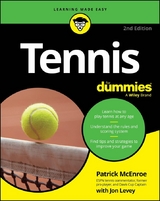
Learn the basics of tennis so you can hit the courts, improve your game, and follow the pros
This updated edition of Tennis For Dummies takes you into the world of tennis today. You'll learn the history of the game, the rules, the latest gear, the hottest strategies, and everything else you need to know to get into this popular racquet sport. This easy-to-understand guide shows you what it takes to improve each time you step on the court, and puts you in the middle of the pro tennis action so you can enjoy the matches everyone is talking about. You'll learn to equip yourself with the right apparel, racquet, and accessories, so you're ready to play. Get tips for perfecting your strokes and shaping up with physical conditioning, plus dealing with common tennis injuries. You'll also explore the finer points of tennis etiquette, both on the court and as a spectator.
- Discover how the game of tennis is played, with helpful illustrations and court diagrams
- Master the mental game so you can get the most out of yourself each and every time you pick up a racquet
- Understand the rules of tennis, the varieties of the game, and the scoring system
- Learn about the most prominent players, matches, and tournaments
This is a great Dummies guide for readers who want to learn the basics of tennis, so they can go out and play, or enjoy watching tournaments in person or on television. Beginners who need a general introduction and current players who want to take their game to the next level will love the quick-and-easy tips inside.
Patrick McEnroe is an American former tennis pro and current tennis analyst and broadcaster. He was the captain of the U.S. Davis Cup Team and is a codirector at the John McEnroe Tennis Academy in New York. He is regularly seen on ESPN, where he serves as a match analyst.
Jon Levey has been working in tennis media since 2000. In various roles at Tennis magazine and Tennis.com, he has covered every facet of the game from the pro tours to the recreational level.
Learn the basics of tennis so you can hit the courts, improve your game, and follow the pros This updated edition of Tennis For Dummies takes you into the world of tennis today. You'll learn the history of the game, the rules, the latest gear, the hottest strategies, and everything else you need to know to get into this popular racquet sport. This easy-to-understand guide shows you what it takes to improve each time you step on the court, and puts you in the middle of the pro tennis action so you can enjoy the matches everyone is talking about. You'll learn to equip yourself with the right apparel, racquet, and accessories, so you're ready to play. Get tips for perfecting your strokes and shaping up with physical conditioning, plus dealing with common tennis injuries. You'll also explore the finer points of tennis etiquette, both on the court and as a spectator. Discover how the game of tennis is played, with helpful illustrations and court diagrams Master the mental game so you can get the most out of yourself each and every time you pick up a racquet Understand the rules of tennis, the varieties of the game, and the scoring system Learn about the most prominent players, matches, and tournaments This is a great Dummies guide for readers who want to learn the basics of tennis, so they can go out and play, or enjoy watching tournaments in person or on television. Beginners who need a general introduction and current players who want to take their game to the next level will love the quick-and-easy tips inside.
Chapter 2
Meet Me on the Court
IN THIS CHAPTER
Walking around the dimensions of the court
Looking at the different court surfaces
People make tennis courts out of all kinds of materials — only the dimensions of the playing surface stay the same from court to court. In this chapter, I show you around the court and explain all about the various types of courts you may encounter. I also explain how the different court surfaces can impact your game.
Court Dimensions
The tennis court, which you can see in Figure 2-1, is a rectangle measuring 78 feet long and 27 feet wide for singles and 36 feet wide for doubles. The doubles alleys (on either side of the singles court) account for the extra width of the doubles court. (See Chapter 5 for more information about playing doubles.)
Net height
The court is divided into two equal halves by the net, which is anchored to the net posts just outside the boundary lines that make up the court. The net is usually made of a soft, mesh material, and it customarily has an adjustment strap in the center; you use the adjustment strap to achieve regulation net height.
© John Wiley & Sons, Inc.
FIGURE 2-1: The stock-in-trade of singles and doubles players.
The net is supposed to be 36 inches high at the center strap and 42 inches high at either side of the court. Unfortunately, nets with center straps at some public courts are about as rare as basketball rims with nets! Not to worry. You don’t really need a center strap. Just take a tape measure and check the center height of the net. If it’s below 36 inches, raise the net by using the crank on one of the net posts. If it’s above 36 inches, turn the crank to lower the net. Don’t worry about the height at the sides. When the net is 36 inches high at the center, you’ll be fine. All that said, there’s no need to get crazy about the net height. As long as it looks reasonably close, play ball.
NO PLAYING IN THE ALLEY
Occasionally, you may see (or even play on) a dedicated singles court, a court without doubles alleys. Although most singles games are played on a court also designed for doubles, you can’t play doubles on a dedicated singles court, which is why so few of them exist. You may also come across some courts that have singles sticks (wooden sticks used to raise the net height to the 42-inch regulation on the singles sidelines on courts with a doubles alley). Singles sticks essentially serve as net posts, but these are for real sticklers and aren’t required to play.
Line measurements
The baselines define the farthest end of the court on both sides of the net (see Figure 2-2). The baselines are the same regardless of whether you’re playing singles or doubles.
Right smack in the middle of the baseline, you see a small hash mark, which divides the court into two equal parts. The center hash mark becomes important when you serve (see Chapter 11).
The lines at the longer sides of the rectangle are called the sidelines. The sidelines are the only boundary lines that differ for singles and doubles. The singles sidelines run parallel to and inside of the sidelines created by the doubles alleys.
Inside the court you find the service lines, which are perpendicular to the sidelines and parallel with the baselines and the net. The service lines are 21 feet from the net, and each service line is divided in half by a centerline. The centerline lines up perfectly with the hash mark that divides the baseline.
The service lines, the centerlines, and the net create four distinct boxes, which are called the service boxes. You find two service boxes on either side of the net, each service box measuring 21 feet long and 13½ feet wide.
© John Wiley & Sons, Inc.
FIGURE 2-2: Getting up close and personal with the court lines.
DON’T HEM ME IN
Using different sidelines for singles and doubles may seem confusing, but don’t worry — nobody, not even a beginner, has any trouble focusing on the correct sidelines for the game they’re playing. It’s a snap, I promise you. You may also come across courts with lines for 10 and Under (10U) tennis, which has a shortened area for young juniors, or even lines for pickleball. All these lines may seem to give the court a more chaotic appearance, but none of it gets in the way when you’re playing regulation tennis.
On each side of the net, the centerline divides the service boxes into an ad side and a deuce side, as shown in Figure 2-3. When you serve from the deuce side of the court, your serve needs to clear the net and land inside your opponent’s deuce-side service box when you keep score (see Chapter 11 for the details on serving). And when you serve from the ad side, the ball must land inside your opponent’s ad-side service box.
© John Wiley & Sons, Inc.
FIGURE 2-3: The centerline splits the service boxes into two sides — the ad side and the deuce side.
Court Surfaces
Tennis court surfaces come in three main flavors: hard, clay, and grass. Each surface offers its own unique qualities. Surfaces even have different colors, smells, and feels. Most important, each surface treats the ball differently, depending on how soft or hard the surface is and the material from which it’s made.
A tennis ball bounces higher off a hard surface than a soft one. If you don’t believe me, take a tennis ball out to the sidewalk. Drop the ball from waist height on the pavement, noticing how high the ball bounces. Then do the same on the grass right next to the sidewalk. (You may want to wait until it gets dark to try this little experiment; otherwise, you may get some strange looks from the neighbors.)
The different court surfaces also impact both how high and how fast the ball bounces. A soft, gritty surface like clay “grabs” a ball momentarily as it bounces, and the friction slows it down. This often results in a fairly high bounce. Cement is a hard surface. A ball dropped onto a cement court from above may bounce high, but when it meets the surface with some velocity, at an angle, it skids off and keeps going before it can bounce very high. A ball will always bounce low on grass, but it won’t slow down very much even though grass is a soft surface. That’s because grass is very slick and slippery. But that shouldn’t concern you too much, because tennis is rarely played on grass anymore.
Low bounce, high bounce, hard or soft surface — what’s the big deal? Imagine that you’re on the strangest tennis court ever built — half of the court is cement, and the other side is clay. A ball machine fires balls to both sides of the court. The machine throws all balls with the same speed and force, and you stand at the baseline. Your task is to start at the centerline and run out to catch the ball after it bounces on the appropriate side of the court. When a ball hits the clay side, it bounces right up and slows down a little, and you don’t have to move too fast to get to and catch the ball. When the ball hits the cement side, it skids away with a lower bounce, and you really have to motor to get to the ball and catch it. In other words, court surface can have a major impact on how you play.
TESTING THE SPEED OF THE COURT
Whenever you play at a court new to you, hit a few balls around at the very start just to get a feel for the surface speed, or ask the other players about the court’s surface properties. The speed of the court will affect the timing you use in your strokes, and how quickly you’ll need to move to the ball to be on time to make good returns.
When you’re used to a court of a certain speed and leave it to play on one that is significantly slower or faster, it may take you up to 20 minutes to adjust your timing and movement to the new surface.
Simply stated, you generally have to move faster to get to the ball on hard surfaces. However, the surer footing compared to a loose surface like clay is why some players find it easier to move on a hard court. This confusing truism leads to some even more confusing tennis terminology (see Table 2-1).
TABLE 2-1 Fast versus Slow Courts
| Surface | Speed | Explanation |
|---|
| Hard (hard courts, grass courts, most synthetic courts) | Fast | The surface increases ball speeds, so you really have to move it in order to get to the ball when you play on a hard court. |
| Soft (clay courts, some synthetic courts) | Soft | The surface slows the ball down, so you don’t have to move as fast, but you may have to play harder or longer. You also end up running a lot because it’s easier for both players to get to the ball in time and return it, which keeps a point going longer. |
Real tennis fanatics refer to how slow or fast a court is as the court’s speed. If I ever hear you talk like that, I’ll know that you’ve really caught the tennis...
| Erscheint lt. Verlag | 17.2.2025 |
|---|---|
| Sprache | englisch |
| Themenwelt | Sachbuch/Ratgeber ► Sport |
| Schlagworte | ATP Tour • beginner tennis • how play tennis • how play tennis book • Tennis • Tennis basics • tennis beginner book • tennis exercise • tennis instruction • tennis instruction book • tennis lessons • tennis rule book • tennis rules • tennis training • US Open |
| ISBN-10 | 1-394-25467-9 / 1394254679 |
| ISBN-13 | 978-1-394-25467-5 / 9781394254675 |
| Informationen gemäß Produktsicherheitsverordnung (GPSR) | |
| Haben Sie eine Frage zum Produkt? |
 EPUB (Adobe DRM)
Kopierschutz: Adobe-DRM
Adobe-DRM ist ein Kopierschutz, der das eBook vor Mißbrauch schützen soll. Dabei wird das eBook bereits beim Download auf Ihre persönliche Adobe-ID autorisiert. Lesen können Sie das eBook dann nur auf den Geräten, welche ebenfalls auf Ihre Adobe-ID registriert sind.
Details zum Adobe-DRM
Dateiformat: EPUB (Electronic Publication)
EPUB ist ein offener Standard für eBooks und eignet sich besonders zur Darstellung von Belletristik und Sachbüchern. Der Fließtext wird dynamisch an die Display- und Schriftgröße angepasst. Auch für mobile Lesegeräte ist EPUB daher gut geeignet.
Systemvoraussetzungen:
PC/Mac: Mit einem PC oder Mac können Sie dieses eBook lesen. Sie benötigen eine
eReader: Dieses eBook kann mit (fast) allen eBook-Readern gelesen werden. Mit dem amazon-Kindle ist es aber nicht kompatibel.
Smartphone/Tablet: Egal ob Apple oder Android, dieses eBook können Sie lesen. Sie benötigen eine
Geräteliste und zusätzliche Hinweise
Buying eBooks from abroad
For tax law reasons we can sell eBooks just within Germany and Switzerland. Regrettably we cannot fulfill eBook-orders from other countries.
aus dem Bereich