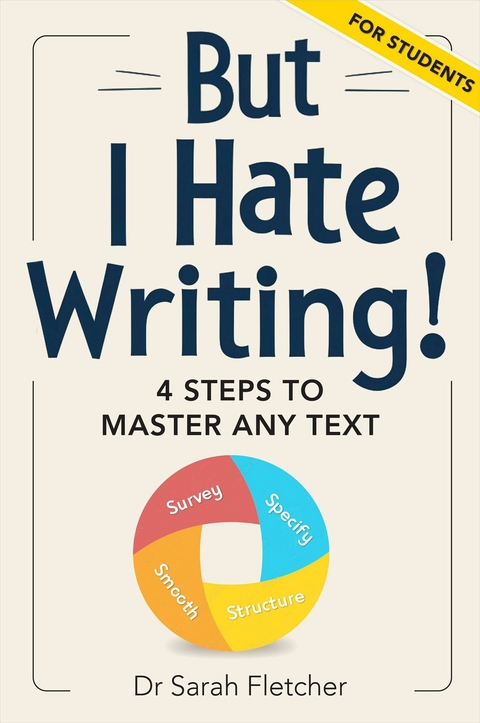
But I Hate Writing! (eBook)
64 Seiten
Vivid Publishing (Verlag)
978-1-923078-67-3 (ISBN)
Dr Sarah Fletcher is an accredited linguist with the Australian Linguistic Society. She is an experienced workplace manager in the field of higher and vocational education and holds a PhD in Applied Linguistics from the University of New South Wales. She is a member of the Applied Linguistics Association of Australia, the Australian Systemic Functional Linguistics Association and the Australasian Academic Integrity Network. After many years of teaching formal writing skills in different contexts, she created the Fletcher's 4S Method in 2023 to help adults achieve clarity, precision and purpose in their written communication.
You've found this book because you hate writing. It's never really been your strength. Now you're at university and you have been asked to write a 'case study style report'. You aren't sure what that is, and you're embarrassed to ask. You are already a busy student with no spare time to develop your writing skills. Just the THOUGHT of giving up your precious time to learn to write an essay or report fills you with dread. After all, you have three different types of written assignments due next week how can you possibly learn to write them all in time? This handbook will show you a quick and simple, tried and tested method to create any type of written academic assignment. In less than 60 minutes, you'll be ready to go! In fact, you can get started before you even finish this book.
Part Two: The Fletcher’s 4S Method
What is the Fletcher’s 4S Method?
The method is comprised of four simple steps to help ensure that those who use it can achieve their goals and desired outcomes through written communication. It is designed as a cyclical, lifelong development process that can be begun at any step and repeated frequently. It is intended to give those who use it control over the process of writing and lead to increased confidence, motivation and even enjoyment.
In this section of this book, I will show you how to use the following 4-step process to write effectively in any context:
1) Specify: What do I need to write?
2) Structure: How do I write it?
3) Smooth: How can I revise and enhance my writing?
4) Survey: How effective was my writing, and how can I achieve greater outcomes in the future?
In other words, you can approach the steps like this:
| Specify | Structure | Smooth | Survey |
| I need to create a piece of writing, and I need to know how to get started | I know how my writing should look, I have gathered the information I need, and now I need to start writing it | I have drafted a piece of writing, and I need to edit and revise it | I have completed a piece of writing, and I need to reflect on the process, feedback and outcomes |
As mentioned above, this process is intended to be cyclical. What that means is you can start at any step, depending on your needs at the time. If you complete Step 4 and find that your writing has not achieved your desired outcome, you can cycle back to Step 3, or even to earlier steps, and begin again from there.
You do not have to complete all four steps every time you write something. For instance, if you have already completed a piece of writing, you could skip the first two steps and work through Steps 3 and 4 to ensure it will achieve its intended outcomes. As your confidence increases, you will be able to work through the steps more quickly and easily.
If this is your first time using the method and/or if you lack confidence as a writer, it is recommended that you begin at the beginning and work your way through all the steps. It is also recommended that you continue to apply all the steps to each piece of writing you create until you have arrived at your own place of ‘readiness’ (i.e., the point where you feel comfortable skipping steps). The ultimate aim of this method is to give you as much control over your writing process as possible in order to increase your confidence in your abilities and motivation to write.
Now let us explore each of these steps in greater detail.
Step 1: Specify
The first step in the Fletcher’s 4S Method shows you how to define exactly what you need to do. For example, you have been asked to write a report at university. The trouble is, you are unsure of what a report should look like, or what it should include. How is it meant to be formatted? What are the essential sections? What would be the appropriate tone? To make things appear more complex, reports can also differ between fields of study, so you will need to ensure that the report you are creating will be suitable for your specific field. It is crucial to understand the task fully before beginning to write – this will save you a great deal of time and effort in the long run. This step will show you how to refine each written task you are most likely to encounter in your educational institution.
How is academic writing defined, in general?
The purpose of academic writing is to communicate ideas and information to the community in a disciplinary area, or field of study. To maintain its credibility, it is based on existing and/or current research. It is aimed at other students, professionals and researchers in the particular field of study rather than at the general public, so it is written in a more complex style with specialist terminology that will be understood by a specific audience. Students are required to write in academic style at university because citing others’ research is required for assessment purposes. This skill needs to be developed and assessed for two primary reasons:
1) If you decide to study at postgraduate level, you will need to carry out your own research. To do that, you will need to be able to refer to others’ research and express your own methods and results in a way that your disciplinary community will understand. Research can only make a valuable contribution to the field if it is communicated, and communicated effectively.
2) Whether you decide to study at postgraduate level or not, your university has a reputation to maintain and a responsibility to contribute to the research community at large. Everything you submit in writing in your field of study is a contribution to that field in your university’s name. Your university is required to uphold the academic integrity of each disciplinary field it represents. It must ensure that everything is written in the same established style and format as it would be in the wider community.
Aside from the integration of research and evidence, academic writing has some other characteristics that set it apart from other types of writing. It is highly structured, which we will explore further in this section of the book. It is critical, meaning it requires you to uncover many different ideas about a topic and make decisions about which aspects you agree or disagree with and why. It should be objective and balanced as opposed to biased. Your personal opinions have no place in academic writing, and you are not trying to appeal to your audience’s emotions, as we may see in articles written for the media. You will need to write in a formal style and tone, using (and avoiding) several features that we will learn about in the next section of this book.
The reason you may find academic writing so challenging is that at university, you are expected to write in the same style to the same standards as experts in your field, who are submitting journal articles and books for publication. This skill takes time to develop and master, which is time you often do not have. This book has been written to help you speed up the process.
Each type of writing has a unique structure and linguistic features. These features include specific vocabulary, style and tone. We will discuss those in further detail later in this book. First, though, we will discuss the structural elements.
When explaining the importance of structure in writing, I often use the analogy of building a house. If you were tasked with this, what would you do first? Would you start buying the furniture? Perhaps you would choose the paint colours? Or would you start constructing the roof? Common sense dictates that it is far more likely that you would first draw up a plan and then lay the foundations. Only when you had a strong foundation in place would you be able to continue the construction. In the case of writing an academic text, the equivalent of drawing up a plan is deciding on your purpose and audience, as we discussed above. Once you have done that, the next step is to choose the most effective structure for your text.
When people write, they often focus on choosing the right words and tone from the beginning and worry about their grammar and spelling. Of course, these elements are critical, just as selecting the right furniture and colour scheme for your new home will be crucial to its appeal. However, you should not start by thinking about those aspects. They can be decided on and refined later, after you have planned what needs to be achieved and created a solid structure on which to build. We will discuss these aspects in detail later in this book.
Recognising different types of writing and how they are constructed will make it easier for you to create your own. This will also help you understand the purpose of each type. In this section of the book, I will provide you with a handy guide to the most common types of academic text types and their stages of construction. When you are tasked with creating a certain assignment, all you need to do is refer to the relevant table in this section and you will know exactly what is expected. It is important to note that some structural stages are optional, and these will be indicated in the tables.
What kinds of assignments will I need to write?
Some of the most common types of written academic texts include:
• Abstract
• Annotated bibliography
• Argument/discussion essay
• Case study (essay or report style)
• Critical review
• Descriptive/explanation essay
• Dissertation/thesis
• Literature review
• Narrative essay
• Persuasive essay
• Reflective essay
• Research proposal
• Report
You may need to write other types of assignments from time to time, but in most cases, the above types are those you are most likely to encounter.
How do I know what these assignments should look like?
Recognising different assignment types and how they are constructed will make it easier for you to create your own. Your assignment instructions should...
| Erscheint lt. Verlag | 14.2.2025 |
|---|---|
| Sprache | englisch |
| Themenwelt | Sachbuch/Ratgeber ► Beruf / Finanzen / Recht / Wirtschaft ► Bewerbung / Karriere |
| ISBN-10 | 1-923078-67-4 / 1923078674 |
| ISBN-13 | 978-1-923078-67-3 / 9781923078673 |
| Informationen gemäß Produktsicherheitsverordnung (GPSR) | |
| Haben Sie eine Frage zum Produkt? |
 EPUB (Ohne DRM)
Größe: 168 KB
Digital Rights Management: ohne DRM
Dieses eBook enthält kein DRM oder Kopierschutz. Eine Weitergabe an Dritte ist jedoch rechtlich nicht zulässig, weil Sie beim Kauf nur die Rechte an der persönlichen Nutzung erwerben.
Dateiformat: EPUB (Electronic Publication)
EPUB ist ein offener Standard für eBooks und eignet sich besonders zur Darstellung von Belletristik und Sachbüchern. Der Fließtext wird dynamisch an die Display- und Schriftgröße angepasst. Auch für mobile Lesegeräte ist EPUB daher gut geeignet.
Systemvoraussetzungen:
PC/Mac: Mit einem PC oder Mac können Sie dieses eBook lesen. Sie benötigen dafür die kostenlose Software Adobe Digital Editions.
eReader: Dieses eBook kann mit (fast) allen eBook-Readern gelesen werden. Mit dem amazon-Kindle ist es aber nicht kompatibel.
Smartphone/Tablet: Egal ob Apple oder Android, dieses eBook können Sie lesen. Sie benötigen dafür eine kostenlose App.
Geräteliste und zusätzliche Hinweise
Buying eBooks from abroad
For tax law reasons we can sell eBooks just within Germany and Switzerland. Regrettably we cannot fulfill eBook-orders from other countries.
aus dem Bereich