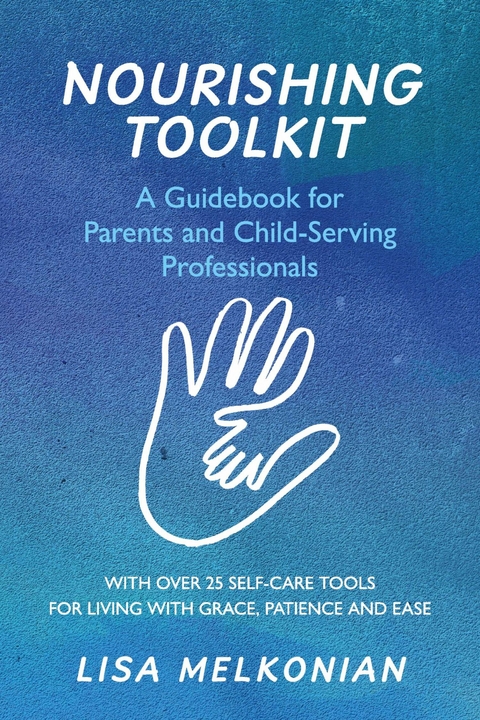
Nourishing Toolkit (eBook)
88 Seiten
Bookbaby (Verlag)
979-8-3509-8383-8 (ISBN)
Lisa Melkonian is a Master Certified Early Childhood Educator, who has worked with children from various backgrounds with many different combinations of needs, disabilities, and hardships. She believes that every child is an individual and that children don't need fixing, they need support. Her certifications in yoga, meditation, and other healing modalities allow her to work with children in a holistic way that supports their body, mind, and spirit. She is also committed to serving the adults that work with children. She writes a Substack newsletter about her teaching experiences and how to help young children and their caregivers thrive in an ever-changing world. You can read more of her work at www.NsChildrensWellness.com.
Parents, guardians, and child-serving professionals want to do their best when caring for their children, but today's world is so intense that these individuals are suffering from stress and burnout. All this pressure makes it difficult to take care of themselves and show up for their children. Lisa Melkonian, M.Ed, RYT 400 writes about her experience as a special education preschool teacher and how the pressures of her career led her to a path of personal development and self-care. Through learning and practicing various health and wellness tips, she became better equipped to support her young students that came from various backgrounds with many different combinations of needs, disabilities, and hardships. "e;Nourishing Toolkit"e; is a self-help book that guides parents and child-serving professionals on how to take better care of themselves and live a life with more grace, patience, and ease. This guidebook provides a self-assessment tool called the Nourishment Check-In to determine areas of unbalance in the reader's life. Broken down into seven sections inspired by the chakra system, a concept rooted by ancient Indian spiritual traditions, this guidebook helps readers determine which areas in their life need the most support, followed by specific strategies on how to heal, transform, and restore their well-being. In Section One, readers will learn how to ground themselves so that they can live in the present moment and think clearly. Section Two shows readers how to feel and process difficult emotions, followed by Section Three, where readers will learn how to improve their self-worth and step into a place of empowerment. Section Four shows readers how to have compassion for themselves and others. In Section Five, readers will learn how to use their voice to speak their truth. Section Six shows readers how to access their intuition and trust their instincts. The final part is Section Seven, where readers will learn how to have faith and trust the process of life.
Introduction
Children are our future. As parents and child-serving professionals, it is our job to raise them, guide them, and love them into adulthood so that they can lead the world into an age of compassion and kindness.
In order to help our children successfully cross over into adulthood, whether they are our own children, our nieces or nephews, our students, or another young person in our lives, we ourselves need to be well. People who have, care for, or work with children know how challenging that charge can be. These people know how much energy this responsibility takes. If we adults do not take good care of ourselves, it will be difficult to show up for them.
As a former special education preschool teacher, I learned this lesson quickly. I had to give 15 three-, four-, and five-year-olds lots of attention and care. I had to manage a classroom, plan lessons, and write detailed Individualized Education Plans for my special education students. I had to work for administrators and around all the politics involved with the education system. I had to navigate relationships with other teachers, paraprofessionals, and parents. There was never a dull moment. Each and every day was different. And overall, I loved it. Becoming a teacher was a dream come true. I finally found my purpose, which is to nurture, teach, and love children.
As much as I loved my career in education, being a teacher was stressful. So many things needed to be done in so little time and that made it difficult to focus and stay centered. I was in a constant state of anxiety. All these deep feelings came up that I would numb with alcohol, food, and TV. I had no concept of boundaries and said “yes” to everything. I did not know how to express my thoughts and feelings in a healthy way. I did not have a spiritual practice where I consistently connected to my higher self. And I felt like I had to control everything and play God.
I knew that if I did not do something, then I would not make it as a teacher. As great as the education system was, there was little to no professional development focusing on stress management techniques for educators. I began doing my own research and experimenting with different self-care techniques. I learned about Kundalini yoga and meditation through searching online, practicing alongside a DVD, and eventually, taking part in a weekly in-person class. During this time of exploration, I came across other forms of meditation, including Emotional Freedom Technique (EFT), which I will discuss more in depth later.
A few years into my career in education, I decided to seek recovery from alcohol use disorder. My recovery mentors taught me many things, including how to set healthy boundaries and the power of journaling every day. I became obsessed with self-help and the benefits of spirituality. I found myself pouring over books about yoga, spirituality, and personal development; attending yoga trainings and intuitive development classes; and, finally, becoming a yoga teacher myself, certified in Kundalini yoga and children’s yoga.
With these newfound tools and practices, I noticed my classroom teaching starting to improve. I was calmer and more patient with my students. Whenever stress started to creep into my headspace, I could call upon any number of strategies that would bring me quick (and discrete) relief. I had more compassion for anxious parents and challenging coworkers. My intuition grew stronger, helping me make decisions both big and small. The faith that something profound was guiding me along the right path was potently reassuring.
Part of my mission in life is to help those who support children thrive as they navigate an ever-changing world. The purpose of this guidebook is to offer parents and child-serving professionals knowledge on how to nourish and take care of themselves. These tools are important because, in order to guide, love, and nurture our children, we ourselves need to be happy, healthy, and balanced.
For this guidebook, I organized my favorite tips into seven sections, inspired by the chakra system, a concept rooted in ancient Indian spiritual traditions, particularly Hinduism and some later forms of Buddhism. The word chakra means wheel or disk in Sanskrit. It describes seven energy centers or points in the subtle body—that part of our being comprising our intellect, our memories, our ego, and so many other immaterial aspects of our makeup—that are believed to correspond to specific physiological, psychological, and spiritual functions.
The following is a brief overview of the seven main chakras:
- Root Chakra (Muladhara): Located at the base of the spine, it is associated with stability, grounding, and survival instincts.
- Sacral Chakra (Svadhisthana): Positioned in the lower abdomen, it is linked to creativity, sexuality, and emotions.
- Solar Plexus Chakra (Manipura): Situated in the upper abdomen, it is associated with personal power, confidence, and self-esteem.
- Heart Chakra (Anahata): Located in the center of the chest, it is connected to love, compassion, and emotional balance.
- Throat Chakra (Vishuddha): Found in the throat area, it is linked to communication, self-expression, and authenticity.
- Third Eye Chakra (Ajna): Positioned between the eyebrows, it is associated with intuition, perception, and spiritual insight.
- Crown Chakra (Sahasrara): Located at the top of the head, it is linked to higher consciousness, spiritual connection, and enlightenment.
Practitioners of yoga, meditation, and various spiritual traditions often work with the chakra system to balance and align these energy centers to achieve physical, mental, and spiritual well-being. It is important to note that the chakra system is a symbolic and metaphysical concept, and beliefs about it may vary among different spiritual and cultural traditions. In this guidebook, the chakra system will be used to categorize different self-care tools that correspond to those aspects of your life that need the most attention.
Loving Disclaimer
As you work through this guidebook and practice the exercises and techniques, please remember to be kind to yourself, especially if you are struggling with your child (whether it is your own or one that you are working with). The work of caring for children, while incredibly rewarding, can get especially difficult and heavy at times, so the last thing I want for you is to take this book too seriously. Have fun, get curious, and be willing to laugh (yes, sometimes at yourself). Remember to have a sense of humor, not sweat the small stuff and learn to laugh at these tough experiences, even if it is just for a moment.
Nourishment Check-In
The following is a check-in you can use to determine if you have any areas of malnourishment or unbalance in your life. I have organized it by areas of need represented by each of the seven chakras.
As you go through each prompt, please be kind to yourself. Many of the prompts represent learned behaviors, adaptive measures, or subconscious attitudes developed as a child in times of need or as part of your circles’ social conditionings (think circles like family, religion, or socioeconomic background). Do not use this check-in to make yourself feel bad or inferior. Instead, see this exercise as a simple way to develop an awareness of the areas in which you need help. Only after we cultivate awareness can we then take steps to make changes and care for ourselves.
Read each prompt, take a moment to evaluate how it makes you feel in the present moment, then mark it with one of the following numbers:
Never a Problem: 0
Occasionally a Problem: 1
Often a Problem: 2
Chaotic Living (Root Chakra)
| 1. | You feel like you are in “survival mode.” | ______ |
|---|
| 2. | You are unfocused and not living in the present moment. | ______ |
|---|
| 3. | You feel unstable and insecure. | ______ |
|---|
| 4. | You have acted unreliable and irresponsible. | ______ |
|---|
| 5. | You feel disconnected from yourself and others. | ______ |
|---|
| 6. | It... |
|---|
| Erscheint lt. Verlag | 8.4.2025 |
|---|---|
| Sprache | englisch |
| Themenwelt | Sachbuch/Ratgeber ► Gesundheit / Leben / Psychologie ► Lebenshilfe / Lebensführung |
| ISBN-13 | 979-8-3509-8383-8 / 9798350983838 |
| Informationen gemäß Produktsicherheitsverordnung (GPSR) | |
| Haben Sie eine Frage zum Produkt? |
 EPUB (Ohne DRM)
Größe: 1,4 MB
Digital Rights Management: ohne DRM
Dieses eBook enthält kein DRM oder Kopierschutz. Eine Weitergabe an Dritte ist jedoch rechtlich nicht zulässig, weil Sie beim Kauf nur die Rechte an der persönlichen Nutzung erwerben.
Dateiformat: EPUB (Electronic Publication)
EPUB ist ein offener Standard für eBooks und eignet sich besonders zur Darstellung von Belletristik und Sachbüchern. Der Fließtext wird dynamisch an die Display- und Schriftgröße angepasst. Auch für mobile Lesegeräte ist EPUB daher gut geeignet.
Systemvoraussetzungen:
PC/Mac: Mit einem PC oder Mac können Sie dieses eBook lesen. Sie benötigen dafür die kostenlose Software Adobe Digital Editions.
eReader: Dieses eBook kann mit (fast) allen eBook-Readern gelesen werden. Mit dem amazon-Kindle ist es aber nicht kompatibel.
Smartphone/Tablet: Egal ob Apple oder Android, dieses eBook können Sie lesen. Sie benötigen dafür eine kostenlose App.
Geräteliste und zusätzliche Hinweise
Buying eBooks from abroad
For tax law reasons we can sell eBooks just within Germany and Switzerland. Regrettably we cannot fulfill eBook-orders from other countries.
aus dem Bereich