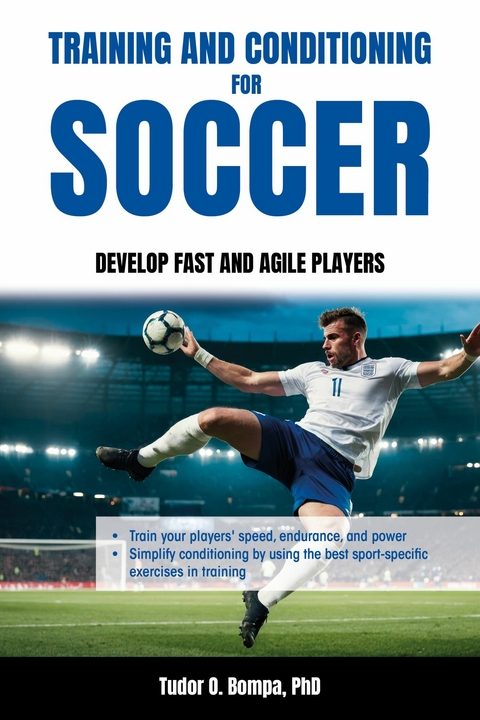
Training and Conditioning for Soccer (eBook)
256 Seiten
Meyer & Meyer Fachverlag und Buchhandel GmbH
978-1-78255-555-1 (ISBN)
Tudor O. Bompa, PhD, revolutionized many aspects of Western training methods when he introduced his groundbreaking theory of periodization in Romania in 1963. Dr. Bompa also applied his principle of periodization to the development of strength, speed, agility, and endurance. He has personally trained 11 Olympic medalists (four gold), and he has served as a training and planning consultant to eight other Olympic and world champions as well as an adviser to coaches and athletes worldwide.
Training and Conditioning for Soccer is the perfect book to help coaches introduce strength and conditioning into their training programs. The best training for soccer players is both sport and game specific, and practices are often spent perfecting tactics and techniques. But this is not the full picture. Players must also be fast and agile, and they must have speed and endurance- all achieved with strength training and conditioning. In this book, coaches are introduced to the sport of soccer and the fundamentals of the game; physiological demands and training methodology needed to develop strength and power are part of the basics of training. They are also given the best training methods for developing game- and position-specific endurance. The book also touches briefly on those more popular yet ineffective training methods used today, clarifying why the methods presented here are superior for training speed and agility in soccer players. Finally, coaches are given examples of training models, including how to create their own models that will train their players in all aspects of the game. They will also find example training plans for each physical ability that should be developed as well as the best strength training exercises to incorporate into soccer practice. Written by Tudor Bompa, the creator of periodization training, this is the best guide for introducing strength training into soccer practice to develop faster and more agile players!
CHAPTER 2
THE SCOPE OF PHYSICAL TRAINING IN SOCCER: MAKING FAST, AGILE, AND RESILIENT PLAYERS
KEY POINTS
•The Scope of Physical Training in Soccer
•Selected Pitfalls in Contemporary Soccer Training
•We Need Fast Players!
•Muscle Structure and Functions
•Strength Training and Neuromuscular Adaptation
•How Strength and Power Is Produced
Chapter 1 familiarized you with the specific elements of the physiology of soccer. Now we can begin discussing physical training and the development of the dominant motor abilities in soccer, starting with strength, power, speed, and agility, and ending up with game and position-specific endurance.
The scope of physical training in soccer, and the entirety of part II of this book, is not just to illustrate how to develop the physical abilities of soccer players but to also suggest how to transform a player into an authentic athlete. An athlete with superior physical abilities, such as strength, will always make a player faster, more agile, and more capable of playing an aggressive game.
Most players on the pitch are just players, and they play the game only with the potential they currently have. When soccer is played by better athletes, the game looks different, with superior qualities, such as powerful technical moves and fast penetrations into the opponent’s side on the field, faster and longer sprints, more abrupt changes of direction, and an improved rhythm of the game.
The quality of the game also improves as a result of applying the methodology of energy systems training, from alactic to lactic and aerobic systems. The use of these three energy systems must be planned in such a way that will allow the coach to alternate energy systems and facilitate recovery and regeneration between training sessions and games.
Strength training should not be considered just as a method to lift heavy weights, or to build big muscles! In soccer, strength has to be considered as the foundation of all soccer-specific motor abilities.
In a very condensed form, the main objectives of strength training are:
•to overcome resistance (e.g., gravity, opponents),
•to use specific training methodology to increase power, speed, and agility and maximize quickness, and
•to use a specific methodology to improve speed endurance, muscle endurance, or the capacity to perform long duration, nonstop, technical, and tactical actions throughout the game.
Selected Pitfalls in Contemporary Soccer Training
Our intent in this book is to discuss science-based training concepts and to offer better and more efficient, practical training methodology and methods. The following list summarizes an analysis of the present state of training in soccer:
•The determinant physical abilities in soccer are power, speed, agility, and soccer-specific, position-specific endurance.
•Most programs for developing the physical attributes in soccer have good intentions, but they miss the mark. Often, they are the victims of misleading and inappropriate methods promoted by the latest trends in fitness training, which are unrelated to soccer training.
•Most contemporary fitness drills in soccer are organized in bouts of 4–8 seconds! Why? Because some of the gadgets, accessories, and drills currently used in soccer are that long! However, the duration of the game is 90 minutes, and the main energy used during the game—70% of the total—is supplied by the aerobic system. This is why we have to ask the question: how can you train the physiological needs of soccer (70% aerobic, 15% anaerobic, and 15 % anaerobic) with drills that tax just the alactic energy system? When and how are the other energy systems taxed in soccer, lactic acid and aerobic, trained? Did you ever compare soccer training methodology proposed by commercialism with what science and methodology is suggesting?
•The energy requirement of the game is a scientific reality, but some strength and conditioning coaches overemphasize the alactic system.
•Strength, power, maximum speed, and agility are also trained with some exercises of short duration, targeting the phosphagen energy system. However, some fitness coaches often neglect developing maximum strength (MxS), power, maximum speed, and game and position-specific endurance.
Most coaches are always looking for young players who are talented and fast. Some players are equipped with the abilities needed in soccer: speed and power. Others are not. Genetics also play a role in players’ abilities—that is the proportions between muscle fibers type: the white fast-twitch (FT) fibers or the red slow-twitch (ST) fibers.
A coach wants a player who has a higher proportion of FT muscles. Simply, this player is naturally suited for soccer as they will be fast and agile. When a young player inherits a higher proportion of ST fibers, his or her talent is mostly for aerobic-dominant, endurance sports, since the red fibers are very effective in supplying oxygen to the working muscles. Marathoners are a great example of the importance of ST muscle fibers: 82% of total muscles fibers are ST, whereas 18% are FT muscles. In the case of soccer, the proportion is visibly different: 58% ST vs. 42% FT (Costill et al, 1976; Van Someren, 2006).
But players and coaches shouldn’t despair if a young player who may not be genetically talented at soccer shows potential because this person still has a chance to become a good player by improving power, speed, and quickness. The best way trainers can help them develop is by exposing them to strength training (part III). Using good, sport-specific strength-training exercises and stressing maximum strength (MxS) can increase the force of the player. As a result, the player’s capacity to generate higher force—and consequently increased speed and agility—is facilitated by activating a higher number of FT muscle fibers. This increased physiological potential will translate into the capacity to apply higher force, making the player faster and more agile.
One might then expect that fitness training for soccer must be very specific to match the physiological makeup of this game. The reality, however, is different, since the majority of fitness training in contemporary training without the ball is not soccer specific for two reasons:
1.Despite what a trainer may plan to develop power, speed, agility, and reactivity, most drills are low speed, low intensity, the exact opposite of the expectations of some strength and conditioning (S&C) instructors. To achieve this objective, drills have to be high intensity to enable the player to recruit FT muscle fibers in action. Without recruiting these fibers, a player cannot be expected to improve speed, agility, and quickness.
2.Often the duration of a drill is far too short to have any effect on the development of soccer-specific lactic acid and aerobic endurance.
Strength Training and Neuromuscular Adaptations
When a player is exposed to strength training, the body is progressively adapting via structural and physiological changes. These functional changes are directly proportional to the intensity/load, quantity/volume, and frequency of training. The resulting benefit from quality strength training is the load (intensity), particularly in speed- and power-dominant sports. Higher loads invariably result in increased strength. As the player’s capacity to overcome resistance increases, he becomes stronger, directly improving power, sprinting speed, and agility. As explained in the following chapters, the adaptation to high loads translates into increased recruitment of the FT muscle fibers. The higher the recruitment of FT muscle fibers, the higher the improvement of speed and agility, essential physical qualities in soccer. Nobody can increase power, speed, or agility without first improving strength.
Since the 1900s, the early years of strength training, many strength-training enthusiasts asserted that strength was determined mainly by a muscle’s size, or the cross-sectional area. This is why strength training for sports was directly influenced by bodybuilding methodology: to build big muscles. Although, to some degree this is visible even nowadays, strength-training research since the 1970s (by authors such as Sale, Schmidtbleicher, Duchateau, Zatsiorsky, Clark, and Weyand, etc.) has focused on the neural component of the physiology of strength. Furthermore, the essential role of the nervous system in strength training for sports was well documented by Broughton (2001).
As already mentioned, the load in strength training is an essential contribution to the type of strength and its neuromuscular adaptations. This is why when S&C trainers decide on the type of strength training to incorporate for their players, they have to consider that there are two specific types of training loads, each with their own specific physiological adaptations and benefits:
1.Lower loads, below 70% 1 repetition maximum (1RM), improve intermuscular coordination, or the ability of the prime movers (the muscles that perform the dominant technical actions) to learn to work together in unison and with good coordination and to perform a skill with lower resistance (high-frequency coordination, medium-speed sprints, and...
| Erscheint lt. Verlag | 1.3.2025 |
|---|---|
| Sprache | englisch |
| Themenwelt | Sachbuch/Ratgeber ► Sport |
| ISBN-10 | 1-78255-555-2 / 1782555552 |
| ISBN-13 | 978-1-78255-555-1 / 9781782555551 |
| Informationen gemäß Produktsicherheitsverordnung (GPSR) | |
| Haben Sie eine Frage zum Produkt? |
 EPUB (Adobe DRM)
Kopierschutz: Adobe-DRM
Adobe-DRM ist ein Kopierschutz, der das eBook vor Mißbrauch schützen soll. Dabei wird das eBook bereits beim Download auf Ihre persönliche Adobe-ID autorisiert. Lesen können Sie das eBook dann nur auf den Geräten, welche ebenfalls auf Ihre Adobe-ID registriert sind.
Details zum Adobe-DRM
Dateiformat: EPUB (Electronic Publication)
EPUB ist ein offener Standard für eBooks und eignet sich besonders zur Darstellung von Belletristik und Sachbüchern. Der Fließtext wird dynamisch an die Display- und Schriftgröße angepasst. Auch für mobile Lesegeräte ist EPUB daher gut geeignet.
Systemvoraussetzungen:
PC/Mac: Mit einem PC oder Mac können Sie dieses eBook lesen. Sie benötigen eine
eReader: Dieses eBook kann mit (fast) allen eBook-Readern gelesen werden. Mit dem amazon-Kindle ist es aber nicht kompatibel.
Smartphone/Tablet: Egal ob Apple oder Android, dieses eBook können Sie lesen. Sie benötigen eine
Geräteliste und zusätzliche Hinweise
Buying eBooks from abroad
For tax law reasons we can sell eBooks just within Germany and Switzerland. Regrettably we cannot fulfill eBook-orders from other countries.
aus dem Bereich