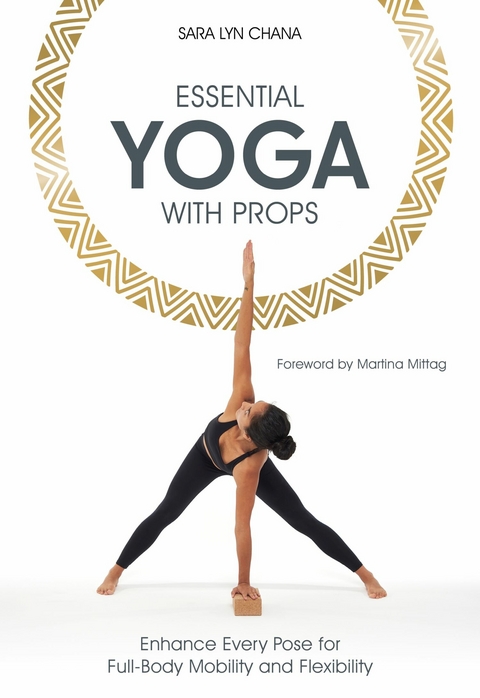
Essential Yoga With Props (eBook)
208 Seiten
Meyer & Meyer Fachverlag und Buchhandel GmbH
978-1-78255-549-0 (ISBN)
Sara Lyn Chana is a yoga teacher, Pilates trainer, and certified journalist with more than 10 years of professional experience. She completed her 500 hours of yoga teacher training in Hatha, Ashtanga, and Vinyasa Yoga in Goa and Rishikesh, India. In addition to her online yoga programs, she organizes international retreats, training for yoga teachers, as well as one-on-one online coaching for yoga teachers. With her 17-year ballet career and intensive practice in martial arts, her teaching style combines physical awareness with mental strength.
Essential Yoga With Props is the perfect guide for yoga practitioners at all levels. Those new to yoga are given basic, yet valuable, instruction on correct yoga postures, whereas the use of yoga props gives experienced yogis the opportunity to challenge themselves by improving their form and attaining precise body alignment. Those with physical disabilities and who may struggle with their own mobility and balance are encouraged to practice the asanas with the support of props. Within this book are the most important and fundamental asanas, variations, and sequences for strength and alignment, supported stretches, relaxation, and centering and strengthening the core. By following the sequences and using yoga props, the yogi can better understand each of the yoga poses and how precise execution can affect total-body flexibility and mobility. Specific muscles groups are targeted, stretched, and strengthened with the use of yoga blocks and straps. The second half of the book provides restorative yoga exercises supported by blankets and bolsters to relax muscles, joints, and the nervous system. Finally, yoga teachers will find Essential Yoga With Props useful as it gives them the tools to innovatively design their lessons so that they meet students where they are in their personal practice. Using props makes yoga accessible to everyone. Achieve stability, mobility, and flexibility with Essential Yoga With Props!
4
STRENGTH
& Alignment
Tadasana—Mountain Pose
Tada = Mountain
Tadasana, the Mountain Pose, is the foundation for all standing poses in Hatha Yoga. Even B.K.S Iyengar knew how demanding an upright and healthy posture is and referred to it as “the art of flawless standing.”
Depending on the Tradition, there are various interpretations of Tadasana. In the Sun Salutation sequence, the upright stance is also referred to as Samasthithi, which translates to “Steadiness.” In all its variations, this asana aims to improve posture.
By assuming the posture of a mountain, we build bodily tension and engage the muscles from head to toe. The mindfulness required in establishing the pose also demands our mental focus. It serves as the perfect preparation for practicing sequences of standing asanas.
Tadasana with a block
Alignment of the feet
1.Place the yoga block between the insides of your feet.
2.Activate your feet by lifting the balls of the feet while keeping the toes firmly on the ground.
3.Lift the heels and extend them backward before firmly grounding the outer edge of the foot on the mat. The heel bone should feel wide as a result. The ankle bones are aligned precisely parallel to each other.
Notice the difference when you remove the block from between your feet. The foot's arch should still be lifted and the sole firmly grounded.
The feet are the foundation of the posture. Their alignment significantly affects the alignment of the knees, hips, and spine. The block aids in heightening your awareness of your feet in an upright stance and guides you in activating the arches.
Alignment of the knees
1.Place the yoga block between the insides of your knees.
2.Extend your legs and activate the thigh muscles to lift the kneecaps upward. Press the insides of your knees into the block. Keep the gluteal muscles relaxed.
The resistance of the block activates the knees and helps focus on engaging your thigh muscles. This is particularly helpful for individuals with bowlegs or knock-knees to enhance posture and protect the knees.
Alignment of the pelvis
1.Place the yoga block between your thighs.
2.Press the insides of your thighs against the block. Bring your feet closer together so the pressure is evenly distributed on both sides.
3.Roll the insides of your thighs inward as if you were trying to move the block backward.
4.At the same time, activate your gluteal muscles and move your tailbone forward as if you were trying to push the block forward.
5.Slide the front of your thighs backward.
Stay in this pose for several deep breaths.
The activation of the leg muscles aims at the inner rotation of the thighs. This provides better stability for the posture and enables proper pelvis alignment.
Tadasana with a strap
Relief of the pelvis/sacroiliac joints
1.Place the strap around the middle part of your pelvis.
2.Bend your knees slightly and tighten the strap, ensuring it's snug around the outside of the pelvic bones and noticeable in the center of the sacrum.
Stay in this pose for several deep breaths.
By applying gentle pressure on the pelvic bones, the strap sensitizes awareness of the hips. This especially benefits those with hip issues and relieves the sacroiliac joint.
Alignment of the shoulders/chest opening
1.Place the strap around the forearms at shoulder width.
2.Lift the sternum and push the arms down, extending the fingertips toward the mat.
3.Push the outer sides of your forearms into the strap as if trying to widen it sideways.
4.Turn the palms forward and the thumbs further outward.
Stay in this pose for several deep breaths. Notice how the sternum lifts higher with each breath, creating space within the sides of the body. As you exhale, let the shoulders sink lower. The area between the shoulder blades relaxes.
To emphasize the activity of the upper arms, you can raise the arms straight overhead. The distance between the shoulders and ears should remain the same.
The activation of the arms against the resistance of the strap brings the shoulders outward and the shoulder blades closer together. This results in chest opening, positively impacting breathing and widening the heart space.
Uttanasana—Standing Forward Bend
Uttana = stretch
Uttanasana, the standing Forward Bend, is also known as the intense forward stretch. By bending the torso over the stretched legs, the entire back of the body is stretched, especially the back of the legs.
The legs and core muscles should be especially activated to stabilize the body in the inversion. The head-down position slows down the heartbeat, and the body's stress level can be reduced.
Forward Bends always involve an introverted posture, allowing the release of thoughts and mental heaviness. This calming effect on the nervous system is particularly beneficial for exhaustion caused by stress, anxiety, or depression.
Uttanasana with two blocks
Activation of the back of the legs/pelvic alignment
1.Stand with your back against a wall. Place two flat blocks vertically between your heels and the wall. The feet are hip width apart.
2.Come forward with a straight back into Ardha Uttanasana—the Half-Forward Bend.
3.Put your hand on your hips and roll the buttocks up and back so you can firmly push the sit bones into the wall.
4.Bring your fingertips to the mat, inhale, and with a long spine, bend over the stretched legs.
5.Exhale and relax the torso downward toward your thighs.
Stay in this pose for several deep breaths. With each exhale, let yourself sink deeper into the stretch.
The support of the wall and the blocks helps maintain the straight alignment of the pelvis. The hips are often imbalanced and not properly aligned, which is challenging to correct in free space. This alignment prevents the habit of a tilted pelvic posture and enhances the stretch of the backs of the legs.
Uttanasana with two blocks and a strap
Pelvic alignment/activation of the back of the legs
1.Step into the loop of the strap with both feet. Hold the outer edges of the strap in both hands.
2.Place both feet on the front part of the strap. Bend forward from the hips and place the back part of the strap on the tailbone. Ensure the buckle of the strap is within reach.
3.Bend both knees gently and tighten the strap to encircle your pelvis firmly.
4.Slowly lift the buttocks and straighten the legs against the resistance of the strap. If you don't feel enough support, change the width of the strap.
5.Slide the outer sides of your thighs into the strap to keep it taut. Lift the kneecaps and the inner sides of your ankles gently.
6.Place your hands on two vertically upright blocks. The blocks should be directly under your shoulders.
7.Inhale and lengthen the spine forward from the hips into Ardha Uttanasana—the Half-Forward Bend.
8.As you exhale, bring your hands down to the mat and ease into Uttanasana—the complete Forward Bend. It's okay to bend both knees, slightly relieving tension in the strap. Keep the lower back elongated, letting the upper body gently descend onto the thighs.
Stay in this pose for several deep breaths. Sink deeper into the Forward Bend with each exhale.
The strap keeps the pelvis in a snug alignment with the legs, enabling the lumbar spine to extend backward. This actively stretches the back of the legs, ensuring the lower back maintains its length before the bend. The stabilization of the hips provides relief to the lower back.
Uttanasana variation with a block
Shoulder stretch/chest opening
1.Hold a block between your hands behind your back. Press the palms into the block to activate the front shoulder and chest muscles.
2.Inhale, roll your shoulders back, away from your ears, and extend your arms to open your chest even further.
3.Breathe out and bend forward over the stretched legs into Uttanasana.
Stay in this pose for a few deep breaths. Notice how your chest expands more with each inhale. Let yourself gradually sink deeper into the Forward Bend with each exhale. Lower the block back to your buttocks slowly and rise with a long back.
This variation of Uttanasana helps people with stiff shoulders and shortened chest muscles to open the chest further. This deepens the breath and relaxes the neck...
| Erscheint lt. Verlag | 1.3.2025 |
|---|---|
| Sprache | englisch |
| Themenwelt | Sachbuch/Ratgeber ► Gesundheit / Leben / Psychologie |
| Sachbuch/Ratgeber ► Sport ► Fitness / Aerobic / Bodybuilding | |
| ISBN-10 | 1-78255-549-8 / 1782555498 |
| ISBN-13 | 978-1-78255-549-0 / 9781782555490 |
| Informationen gemäß Produktsicherheitsverordnung (GPSR) | |
| Haben Sie eine Frage zum Produkt? |
 EPUB (Adobe DRM)
Kopierschutz: Adobe-DRM
Adobe-DRM ist ein Kopierschutz, der das eBook vor Mißbrauch schützen soll. Dabei wird das eBook bereits beim Download auf Ihre persönliche Adobe-ID autorisiert. Lesen können Sie das eBook dann nur auf den Geräten, welche ebenfalls auf Ihre Adobe-ID registriert sind.
Details zum Adobe-DRM
Dateiformat: EPUB (Electronic Publication)
EPUB ist ein offener Standard für eBooks und eignet sich besonders zur Darstellung von Belletristik und Sachbüchern. Der Fließtext wird dynamisch an die Display- und Schriftgröße angepasst. Auch für mobile Lesegeräte ist EPUB daher gut geeignet.
Systemvoraussetzungen:
PC/Mac: Mit einem PC oder Mac können Sie dieses eBook lesen. Sie benötigen eine
eReader: Dieses eBook kann mit (fast) allen eBook-Readern gelesen werden. Mit dem amazon-Kindle ist es aber nicht kompatibel.
Smartphone/Tablet: Egal ob Apple oder Android, dieses eBook können Sie lesen. Sie benötigen eine
Geräteliste und zusätzliche Hinweise
Buying eBooks from abroad
For tax law reasons we can sell eBooks just within Germany and Switzerland. Regrettably we cannot fulfill eBook-orders from other countries.
aus dem Bereich