Grind Line (eBook)
232 Seiten
Newtype (Verlag)
978-1-952421-41-9 (ISBN)
A former linguist with the National Security Agency in West Berlin during the Cold War, Keith Gave covered the National Hockey League for nearly 30 years. He spent 15 years with the Detroit Free Press, preceded by three years at the Chicago Bureau of the Associated Press and followed by four years in Dallas, with the Morning News. He won numerous awards for his work in Detroit and Dallas, including national recognition for investigative reporting out of Russia - work that formed the basis for his first book, 'The Russian Five, A Story of Espionage, Defection, Bribery and Courage' (2018). He was on the AP staff in Chicago that was a finalist for the Pulitzer Prize for its coverage of the Tylenol-cyanide murders in 1982. And his editors at the Dallas Morning News nominated him for a Pulitzer Prize for Commentary in 1999. Gave left the newspaper industry in a career change in 2001 to teach college English and to advise journalism students, several of whom are prospering in the news industry. At the age of 65, he returned to the classroom to earn his MFA while writing 'The Russian Five' and working on the documentary of the same name that won multiple audience awards. The book was also translated into Russian and Slovakian. It was a best-seller in Russia as well. His other books include 'Vlad The Impaler, More epic tales from Detroit's '97 Stanley Cup Conquest' (2021), essentially a sequel to his first book, and 'A Miracle Of Their Own, A team, a stunning gold medal and newfound dreams for American girls' (2022). He lives in northern Michigan with his wife, Jo Ann, trying to keep up with their three golden retrievers - Conroy, Dante and Garp.
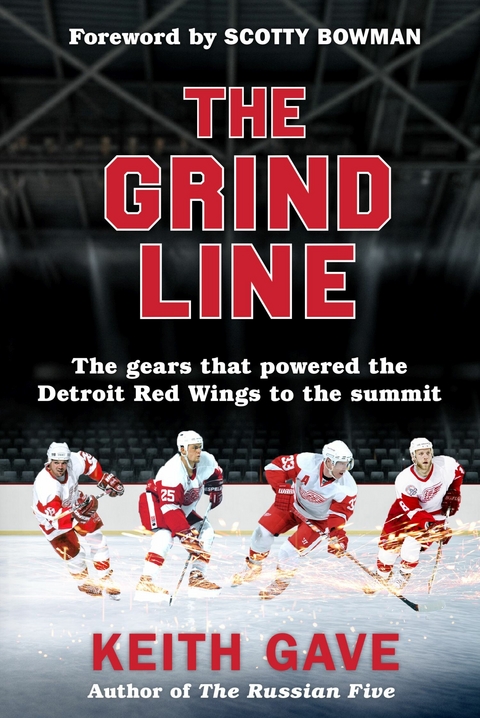
"e;Hockey Hall of Fame Coach Scotty Bowman: 'Those four guys, they made all the difference'The Grind Line, featuring some of the most popular athletes in Detroit sports history, is one of the most successful units in the history of the National Hockey League, and without peer among so-called 'fourth' lines, for those who insist on numbering them. Kris Draper, flanked by Kirk Maltby and Joe Kocur, and later Darren McCarty, deserve their rightful place in Detroit shoulder to shoulder with The Production Line the most famous line in NHL history: Gordie Howe and Ted Lindsay alongside Sid Abel, and later Alex Delvecchio, four men whose numbers hang from the rafters at Hockeytown's Little Caesars Arena. This book argues and has the receipts to prove it that the Grind Line was every bit as important in its era (1997-2009) as the Production Line was in the dynastic 1950s. This is the remarkable story of how the Red Wings acquired all four players, one of them in a trade that cost Detroit $1 for a player who went on to become only the fifth man to play more than 1,000 games for the club. Another was acquired in a trade that was widely considered a minor-league deal. The other two had to plead their way back to the NHL with Detroit after it appeared their careers were over. One of them had been playing beer-league senior hockey before his second chance, and he made it count by winning three Stanley Cup rings with the team. Bowman, the Hall of Famer widely considered to be the greatest coach in the history of the sport, wrote the foreword to this book. And it's only fitting since he was most responsible for putting the line together and deploying it with lethal results. "e;
INTRODUCTION
Ukes, Krauts and Coneheads
Clark Gilles rose from the bench at his stall, and the New York Islanders’ dressing room immediately went silent.
“I remember, he was like John Wayne, or The Marlboro Man,” teammate Bryan Trottier told a radio interviewer. Gilles, the National Hockey League’s preeminent power forward on a team at the cusp of winning four straight Stanley Cup titles, was a man who believed that actions spoke louder than words. So when he spoke, people tended to listen. Carefully.
The subject of the moment was naming his line—a serious business in hockey circles. Nicknaming forward lines was once upon a time one of the more colorful traditions in the sport, one that has waned in recent years. For that, we can blame free agency’s revolving door; players move from team to team with such frequency that three guys playing together long enough to establish an identity, and maybe earn a nickname, is fairly rare. (The Perfection Line in Boston was the recent exception that proved the rule as the calendar rolled into the 2020s.)
We can also blame the coaching carousel. With so much pressure to win in today’s 32-team NHL, coaches are quick to mix things up, try different line combinations at the first sign of adversity. For most, it’s a matter of acting swiftly or risk hitting the unemployment line. That carousel slows for no man.
Line naming—the topic Gilles was about to address—is an inexact art form. Nicknames often originate in the media. Some clever writer or broadcaster up in the press box will refer to a certain group with a colorful moniker it winds up in the sports pages or on the air, and it sticks. Sometimes, as in the case of the Islanders at that moment, a name will come from the team’s public relations/marketing staff. And soon, the team hopes, it will adorn pricey merchandize in the club’s souvenir shop.
Other times, it’ll come straight from the players, as Gilles would soon decree.
It didn’t take long after coach Al Arbour put them together for the line of Gillies, Trottier and Mike Bossy to find success. Trottier, the playmaking center who played a sterling 200-foot game; Gillies, whose size and toughness made it impossible to move him from the front of the net; and Bossy, arguably the greatest pure goal scorer in the history of the game. They were electric together, and it didn’t take long for one of the forward thinkers in the Isles’ media department to suggest a public campaign to name the group.
At the time, as Trottier recalls in his book (“All Roads Home, A Life On And Off The Ice,” McLelland and Stewart, 2022) and in interviews, there were some worthy line names around the league. Like the French Connection in Buffalo, the Triple Crown Line in Los Angeles, among others. So in a meeting with the players that included the media and members of the club’s executive staff, the marketing man started to unveil the plan. Until then, the unit—which at times deployed other wingers before Bossy—had been known locally as the LILCO Line. That was the household acronym for the Long Island Lighting Company, the power conglomerate that provided the juice to light the red lamp behind the goaltenders, as the line did with spectacular regularity. A good name, to be sure, but it didn’t get much play beyond the New York metropolitan area. This group deserved something better, according to prevailing wisdom.
“We need a good name for our Trottier-Gillies-Bossy line,” the PR guy said, “so we’re going to have a contest, open it up to everyone—fans, the media. . .”
That’s when Gillies slowly rose, ending the marketing guy’s message in mid-sentence.
“First of all, it’s not the Trottier-Gillies-Bossy line,” the big man said. “It’s the Gillies-Trottier-Bossy line.” And no one argued.
“He always wanted his name first. We didn’t care,” Trottier said as he recalled the moment.
Gillies continued: “And there ain’t gonna be no contest. You can just call us The Trio Grande.”
Discussion over. Dynasty at the starting gate.
“Clarkie, I love that. It’s the best name ever!” Trottier told him later.
“Thank you,” Clark responded. And so it was.
“What made our line so successful was a friendship, a chemistry, a bond all three of us shared,” Trottier told a CBC interviewer.
The Trio Grande (GRAN-day, say it right like Gilles declared) led the Islanders to four straight Stanley Cup titles in the early 1980s. All three were inducted into the Hockey Hall of Fame. And if there were a hall of fame for line nicknames, The Trio Grande would be there as well.
Here, in no particular order, are a few others that should be considered, as well:
The Production Line
Detroit Red Wings – Ted Lindsay, Sid Abel and Gordie Howe, one of the most iconic lines in the history of the sport. Rarely has a unit like this identified more with a city, producing points and Stanley Cup titles with the same, workmanlike consistency as the city’s blue-collar workers on the automotive production plants. The line finished 1-2-3 in scoring in 1949-50. Lindsay led the way with seventy-eight points; Abel contributed sixty-nine and Howe sixty-eight. The Wings went on to defeat Toronto for the Stanley Cup that spring and continued to produce.
It also had two later iterations:
Production Line II, with Alex Delvecchio succeeding the retired Abel in a seamless transition.
Production Line III, with Frank Mahovlich replacing Lindsay at left wing after General Manager Jack Adams sent Lindsay packing with an ill-advised trade to Chicago.
The French Connection
Buffalo Sabres – Rick Martin, Rene Robert and Gilbert Perreault. Named after the popular movie at the time, the trio was a fixture at The Aud from 1972-79, dazzling audiences and leading the Sabres to the Stanley Cup Final in 1975.
The Triple Crown Line
Los Angeles Kings – Dave Taylor, Marcel Dionne and Charlie Simmer. A line fit for Kings, regal in every way, and one of the league’s most prolific scoring units. In 1979-80 the group produced 146 goals, 328 points and played as a unit in the NHL All-Star Game at the Montreal Forum.
The Legion of Doom
Philadelphia Flyers – John LeClair, Mikael Renberg and Eric Lindros. If ever a unit commanded to be named, it was this one. Several nicknames were tossed around when the unit was formed in 1995: Bob’s Big Boys (referring to GM Bobby Clarke), The Doom, Gloom and Zoom Line, the JEM Line (initials of their first names) and The Crazy Apes. And why not? LeClair stood 6-foot-3 and weighed 226 points. Lindros went 6-4, 240, and Renberg 6-2, 235. They looked and sometimes acted the part of modern-day Broad Street Bullies. Which prompted Flyers teammate Jim Montgomery to suggest that the three “look like the Legion of Doom out there.” The name stuck. For the record, their last appearance together was against Detroit. One of the most physically dominant and feared lines of all-time—at least until they faced the Red Wings in the 1997 Stanley Cup Finals, when they pretty much went AWOL. They were never seen together again.
The GAG Line
New York Rangers – Vick Hadfield, Jean Ratelle and Rod Gilbert. Lines tagged with letters are generally uninspiring. Most often, they represent initials of the three players’ first or last names, creating a kind of shorthand for sports writers and fans. Not this one. And the joke (gag) was on the opponents, as the brightest line on Broadway in the early 1970s produced at a rate of more than a goal a game. Goal a game. Get it?
The Kraut Line
Boston Bruins – Bobby Bauer, Woody Dumart and Milt Schmidt. The NHL was never shy about celebrating its diversity, even as an upstart league barely a decade old when the Bruins formed this trio, all proud of their German heritage. After growing up together in Kitchener, Ontario, a German enclave that boasts the world’s largest Oktoberfest outside of Germany. The three played together from the late 1930s to the mid-1940s—and Bruins fans cheered them all through World War II.
The Uke Line
Boston Bruins – Johnny Buyck, Bronco Horvath and Vick Stasiuk. Another dominant Bruins line from 1957-61, all very proud of their Ukrainian ancestry.
The Punch Line
Montreal Canadiens – Maurice Richard, Elmer Lach and Toe Blake. Named for its offensive explosiveness, and rightly so. The line dominated for four years in the 1940s, helping to win the Stanley Cup twice. In the 1944-45 season, the trio finished 1-2-3 in league scoring, Lach with eighty points, Richard with seventy-three and Blake with sixty-seven.
The Century Line
Pittsburgh Penguins – Before Sid and Gene, even before Mario and Jaromir, there was Syl Apps Jr., Lowell MacDonald and Jean Pronovost, who helped put a beleaguered expansion club on the NHL map. They had an uncommon ability to produce points for a team that was overmatched most nights. They combined for more than 100 goals and 200 points in four straight seasons in the 1970s, leading the Penguins to their first two seasons finishing above .500 in the standings.
The Coneheads
United States of America Men’s National Team – 1980...
| Erscheint lt. Verlag | 11.2.2025 |
|---|---|
| Sprache | englisch |
| Themenwelt | Sachbuch/Ratgeber ► Sport |
| ISBN-10 | 1-952421-41-1 / 1952421411 |
| ISBN-13 | 978-1-952421-41-9 / 9781952421419 |
| Informationen gemäß Produktsicherheitsverordnung (GPSR) | |
| Haben Sie eine Frage zum Produkt? |
 EPUB (Ohne DRM)
Größe: 5,9 MB
Digital Rights Management: ohne DRM
Dieses eBook enthält kein DRM oder Kopierschutz. Eine Weitergabe an Dritte ist jedoch rechtlich nicht zulässig, weil Sie beim Kauf nur die Rechte an der persönlichen Nutzung erwerben.
Dateiformat: EPUB (Electronic Publication)
EPUB ist ein offener Standard für eBooks und eignet sich besonders zur Darstellung von Belletristik und Sachbüchern. Der Fließtext wird dynamisch an die Display- und Schriftgröße angepasst. Auch für mobile Lesegeräte ist EPUB daher gut geeignet.
Systemvoraussetzungen:
PC/Mac: Mit einem PC oder Mac können Sie dieses eBook lesen. Sie benötigen dafür die kostenlose Software Adobe Digital Editions.
eReader: Dieses eBook kann mit (fast) allen eBook-Readern gelesen werden. Mit dem amazon-Kindle ist es aber nicht kompatibel.
Smartphone/Tablet: Egal ob Apple oder Android, dieses eBook können Sie lesen. Sie benötigen dafür eine kostenlose App.
Geräteliste und zusätzliche Hinweise
Buying eBooks from abroad
For tax law reasons we can sell eBooks just within Germany and Switzerland. Regrettably we cannot fulfill eBook-orders from other countries.
aus dem Bereich