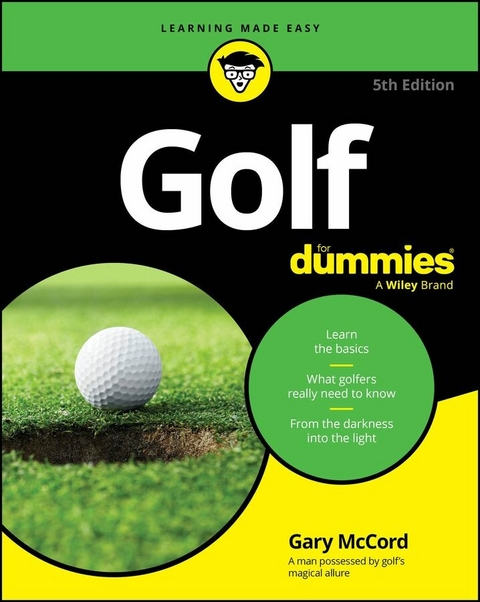
Golf For Dummies (eBook)
573 Seiten
For Dummies (Verlag)
978-1-394-28106-0 (ISBN)
Level up your own golf game, or enjoy the sport as a spectator
Golf is a great sport for all types of people. It's a low impact form of exercise, a social activity, and it gets you outdoors. Golf For Dummies teaches you the rules of the game and gives you tips on improving your play. If you're more of a spectator, you'll love this book's coverage of the latest golf trends and the best players on the pro courses. Helpful illustrations make it easy to understand how golf really works, so you can step onto the green with confidence. In this new edition, you can learn all about new golf formats and recent changes to the rulebook. Ready to play a round?
- Understand golf basics, perfect your swing, and master the mental game
- Follow simple instructions and diagrams to improve your grips and stances
- Learn how the sport of golf is changing, at the amateur and professional levels
- Improve your golf game with advice from a championship-winning golfer
This is a great Dummies guide for anyone looking for a general introduction to the sport, as well as current players who want to take their game to the next level. Have fun when you hit the links!
Gary McCord is a former American professional golfer who competed in more than 400 PGA Tour events and won two PGA Tour Champions tournaments. He is also a pro golf commentator and author. McCord has written several books, including Just a Range Ball in a Box of Titleists. In 1996, he appeared as himself in the Kevin Costner movie Tin Cup.
Chapter 1
Loving a Crazy Old Game
IN THIS CHAPTER
Beginning with a little golf history
Understanding what makes the game special
Looking into golf course basics
Playing the smart way
Adding golf to your lifestyle
Golf is simple. Golf is great. Golf will drive you nuts and keep you coming back for more.
It’s deceptively simple: You’ve got clubs and a ball. Your job is to knock the ball into a series of holes laid out in a large, grassy field. You encounter hazards on the way; and by the time you finish the 18th hole, you may want to go to the clubhouse bar, order a beverage, and tell innocent strangers how every bounce went against you that day. That’s probably not what happened, but golfers always need a shoulder to cry on. And if you’re a golfer at heart, you’ll empathize with everyone else who plays the most frustrating, maddening, wonderful game in the world. You’ll play for relaxation, challenge, companionship, and a chance to enjoy the great outdoors. You’ll also get so frustrated you wonder why anybody would spend time and money on such a ridiculous pursuit. Then one day you’ll shoot your best score ever, and you’ll know why.
In this chapter, I introduce you to the game and provide the basics you’ll need to get started. Here’s hoping you get some smiles along the way.
Understanding Golf’s Origins
Golf dates back to medieval Scotland, where Macbeth ruled in the 11th century. Not the Shakespeare character but the real Scottish king old Shakey based his play on! Some historians say the sport began when Scottish shepherds used long, wooden crooks to knock rocks at rabbit holes.
The first printed reference to golf came in 1457, when Scotland’s King James II banned “gowf” so that his subjects could concentrate on their archery — the better to beat the English in battle. Years later James’s descendants, including his great-great-granddaughter Mary, Queen of Scots, embraced the game. (The original golf widow, she scandalized Britain by playing golf in the days after her husband, Lord Darnley, was murdered.)
The wooden golf balls of those early days gave way to featheries — leather pouches stuffed with goose feathers — and then gutty balls made from gutta percha, a rubber from Malaysia. In 1860, one of the best Scottish golfers, Tom Morris of St. Andrews, organized the Open Championship, which many Americans call the British Open. That tournament launched modern professional golf. Scottish immigrants introduced Americans to the game, which went on to become one of the world’s most popular sports. The rest is history — along with colorful cursing and fun.
Knowing Why Golf Is So Special
You’ve probably heard about business leaders making huge deals on the golf course. It’s true. Back in 1901, zillionaires Charles Schwab and Andrew Carnegie met at St. Andrews Golf Course in New York to make the $480 million deal that created U.S. Steel. Countless handshakes later, the game has earned a reputation as the ultimate networking game. And while business leaders, like the rest of us, actually spend much of their time on the course looking for wayward golf balls, it’s true that golf can bring great networking opportunities.
And that’s about the 167th-most-important reason to take up the game. Better reasons include spending time with friends, staying in shape, challenging yourself, and enjoying some of the best scenery you’ll ever see. (Tennis courts are all pretty much the same, but each golf course is different, and many are designed to show off their gorgeous surroundings.) Golf is physical, mental, and even spiritual challenge — it tests your skill and your will. It tests your self.
And it’s a game for a lifetime. Lots of people played football or basketball in high school, but how many are returning punts or grabbing rebounds when they’re 50 or 60 years old? I know 70-year-old golfers who have “shot their age,” meaning they carded a score of 70 or better. I’m one of them. The term means that your score for a full round is the same or less than your chronological age. Here’s hoping you play the game long enough to shoot your age someday!
The most important reason to play, though, is that golf is magic — and totally addictive. After it becomes part of your life, you can barely imagine living without it.
It’s also difficult. Otherwise, everybody would be out there earning millions on the PGA (Professional Golfers’ Association) and LPGA (Ladies Professional Golf Association) tours. As I see it, there are two main reasons why:
- The ball doesn’t move on its own.
- You have, on average, about three minutes between shots.
In other words, you don’t react to the ball as you do in most sports. A baseball gets thrown, hit, and spat on. A football gets passed, tossed, kicked, and carried. A basketball gets shot, rebounded, and dribbled. But a golf ball just sits there, daring you not to lose it.
In most sports, you have only an instant to react to the action — natural athletic instincts take over, and you move to the ball. In golf, you get far too long to think about what you’re doing. Thinking too much — worrying about what might go wrong with the next shot — can make your worst fears come true.
Maybe golf would be easier if the ball moved and you were running after it. Then you could stop worrying and react. But if it were easy, it wouldn’t be golf.
Like many sports, golf has a language all its own. If you’re just starting out, you’ll encounter many terms that might be unfamiliar as you go through this book. Dogleg. Waggle. Double eagle. But don’t worry! You’ll find them all defined in Appendix A at the back of the book.
Breaking Down a Typical Course
Most courses have 18 holes, although some have only 9. The 19th hole is golfspeak for the clubhouse bar — the place where you can guzzle an Arnold Palmer (a mix of iced tea and lemonade) or a John Daly (a spiked Arnold Palmer) and regale your friends with tales of how the rub of the green went against you. (See Appendix A for more on golf jargon.) Seaside courses are called links — the parts of Scotland where the game began were the link between beach and farmland. Many people use “links” to mean any golf course, but purists stick to the correct usage: A links is a course by the water.
Most courses are between 5,500 and 7,000 yards. A few monsters are longer, but leave those courses to the pros you see on TV. It’s a good idea to start at the shorter yardages and work your way up. It’s also important to start each hole from the proper set of tees — a topic I’ll get to later in this section.
You may have heard the word, par, which is the number of strokes a good golfer should take to finish a particular hole. Every hole is a par-3, a par-4, or a par-5. (Par-2s are for minigolf; the exceedingly rare par-6 hole is usually a gimmick.) On a par-5 hole, for example, a typical par consists of a drive (the first swing from the tee), two more full swings, and two putts. Two putts to the hole (also known as a cup) is the most you want to take on every green.
Three putts are poison. Don’t worry if you take three putts on a green when you’re starting out in the game because it’ll happen. If you take only one, congratulations! That’s a bonus. See Chapter 10 for my surefire putting tips. For now, remember that during an ideal round of golf, half your strokes will be putts. A good day with your putter can make up for a bad day with every other club in your golf bag.
Many courses have a total par of 72, often consisting of ten par-4s (40 regulation strokes), four par-3s (12), and four par-5s (20). But you can find golf courses with total pars of anywhere from 62 to 74. Table 1-1 lists each type of hole’s regulation strokes and the yardages that generally determine par on a hole for men and women. It’s worth noting that these guidelines don’t always refer to precise yardages, but rather to what the United States Golf Association (USGA) calls a hole’s “effective playing length.” A 460-yard hole that goes straight uphill, for instance, may be a par-5 for men.
TABLE 1-1 Shooting for Par
| Par | Regulation Strokes | Regulation Yardages |
|---|
| Women | Men |
|---|
| Par-3 | 1 swing, 2 putts | 200 yards or less | 260 yards or less |
| Par-4 | 2 swings, 2 putts | 200–420 yards | 240-490 yards |
| Par-5 | 3 swings, 2 putts | 370–600 yards | 450–710 yards |
Source: USGA
That’s the big picture.
You often find different teeing areas on each hole, allowing you to play the hole from different lengths based on your skill level. Pay attention to these...
| Erscheint lt. Verlag | 7.2.2025 |
|---|---|
| Sprache | englisch |
| Themenwelt | Sachbuch/Ratgeber ► Sport |
| Schlagworte | basic golf • basic golf book • beginning golf • beginning golf book • funny golf book • Golf • golf 101 • golf 101 book • Golf Basics • golf beginner book • golf book • Golf etiquette • Golf handbook • golfing for beginners • golf lessons • Golf Rules • how to golf |
| ISBN-10 | 1-394-28106-4 / 1394281064 |
| ISBN-13 | 978-1-394-28106-0 / 9781394281060 |
| Informationen gemäß Produktsicherheitsverordnung (GPSR) | |
| Haben Sie eine Frage zum Produkt? |
 EPUB (Adobe DRM)
Kopierschutz: Adobe-DRM
Adobe-DRM ist ein Kopierschutz, der das eBook vor Mißbrauch schützen soll. Dabei wird das eBook bereits beim Download auf Ihre persönliche Adobe-ID autorisiert. Lesen können Sie das eBook dann nur auf den Geräten, welche ebenfalls auf Ihre Adobe-ID registriert sind.
Details zum Adobe-DRM
Dateiformat: EPUB (Electronic Publication)
EPUB ist ein offener Standard für eBooks und eignet sich besonders zur Darstellung von Belletristik und Sachbüchern. Der Fließtext wird dynamisch an die Display- und Schriftgröße angepasst. Auch für mobile Lesegeräte ist EPUB daher gut geeignet.
Systemvoraussetzungen:
PC/Mac: Mit einem PC oder Mac können Sie dieses eBook lesen. Sie benötigen eine
eReader: Dieses eBook kann mit (fast) allen eBook-Readern gelesen werden. Mit dem amazon-Kindle ist es aber nicht kompatibel.
Smartphone/Tablet: Egal ob Apple oder Android, dieses eBook können Sie lesen. Sie benötigen eine
Geräteliste und zusätzliche Hinweise
Buying eBooks from abroad
For tax law reasons we can sell eBooks just within Germany and Switzerland. Regrettably we cannot fulfill eBook-orders from other countries.
aus dem Bereich