


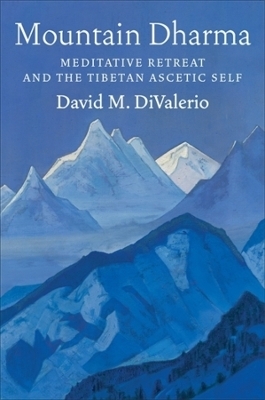
Mountain Dharma
Meditative Retreat and the Tibetan Ascetic Self
Seiten
2025
Columbia University Press (Verlag)
9780231220217 (ISBN)
Columbia University Press (Verlag)
9780231220217 (ISBN)
An emphasis on practicing meditation in yearslong retreats—whether in a cave or a cloister, alone or with a small number of peers—has been a defining feature of Tibetan Buddhism throughout its entire history. Although the life stories and writings of the Himalaya’s most famous hermits are well known, the history of this tradition and the details of its practice have largely remained a mystery.
A groundbreaking exploration of individual long-term meditative retreat in Tibetan Buddhism, Mountain Dharma tracks developments in ascetic discourse and practice from the twelfth century to the twentieth. David M. DiValerio provides a comprehensive reading of texts that offer instruction on the eremitic endeavor, comparing how dozens of authors have treated six key orienting concerns: place, people, food, sources of danger, the spiritual lineage, and time. The book traces a genealogy of the Tibetan ascetic self, demonstrating an increasing tendency to adopt practices that contrast the meditator with earlier generations of enlightened masters, defining the latter-day retreatant as a being in time. By viewing instructions for how to live in retreat as technologies of self, this book sheds new light on how the history of this tradition has been driven by evolving notions of personhood.
Methodologically innovative and richly sourced, Mountain Dharma sets a new standard for the historical study of asceticism.
A groundbreaking exploration of individual long-term meditative retreat in Tibetan Buddhism, Mountain Dharma tracks developments in ascetic discourse and practice from the twelfth century to the twentieth. David M. DiValerio provides a comprehensive reading of texts that offer instruction on the eremitic endeavor, comparing how dozens of authors have treated six key orienting concerns: place, people, food, sources of danger, the spiritual lineage, and time. The book traces a genealogy of the Tibetan ascetic self, demonstrating an increasing tendency to adopt practices that contrast the meditator with earlier generations of enlightened masters, defining the latter-day retreatant as a being in time. By viewing instructions for how to live in retreat as technologies of self, this book sheds new light on how the history of this tradition has been driven by evolving notions of personhood.
Methodologically innovative and richly sourced, Mountain Dharma sets a new standard for the historical study of asceticism.
David M. DiValerio is associate professor of history and religious studies at the University of Wisconsin–Milwaukee. He is the author of The Holy Madmen of Tibet (2015) and translator of The Life of the Madman of Ü (2016).
Acknowledgments
Introduction
1. The Prescriptive Literature for Individual Retreat
2. Locating the Ascetic Self
3. Isolating the Ascetic Self
4. Nourishing the Ascetic Self
5. Preserving the Ascetic Self
6. Forming the Ascetic Self
7. The Tibetan Ascetic Self in Time
Conclusion
Appendix. Prescriptive Texts for Individual Retreat
Notes
Works Cited
Index
| Erscheinungsdatum | 04.08.2025 |
|---|---|
| Zusatzinfo | 1 Maps |
| Verlagsort | New York |
| Sprache | englisch |
| Maße | 156 x 235 mm |
| Themenwelt | Sachbuch/Ratgeber ► Gesundheit / Leben / Psychologie ► Entspannung / Meditation / Yoga |
| Geschichte ► Teilgebiete der Geschichte ► Religionsgeschichte | |
| Geisteswissenschaften ► Religion / Theologie ► Buddhismus | |
| ISBN-13 | 9780231220217 / 9780231220217 |
| Zustand | Neuware |
| Informationen gemäß Produktsicherheitsverordnung (GPSR) | |
| Haben Sie eine Frage zum Produkt? |
Mehr entdecken
aus dem Bereich


aus dem Bereich
von der Antike bis zur Gegenwart
Buch | Softcover (2025)
C.H.Beck (Verlag)
CHF 16,80


