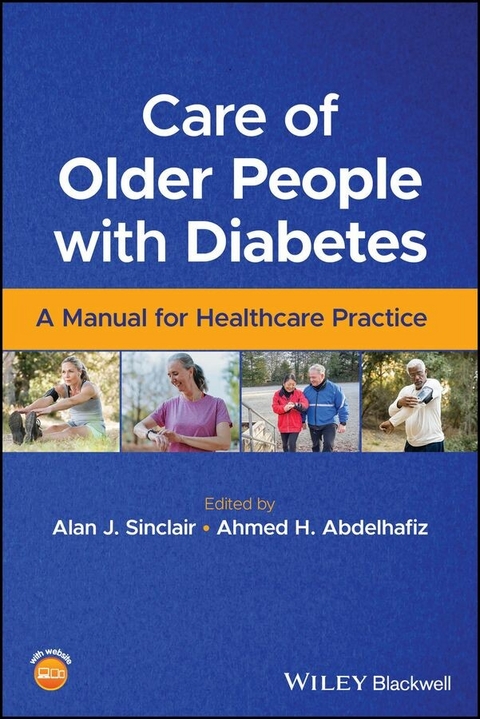
Care of Older People with Diabetes (eBook)
707 Seiten
Wiley-Blackwell (Verlag)
978-1-394-20505-9 (ISBN)
A concise and accessible overview to the treatment of diabetes in older patients
Care of older people is rapidly becoming one of the most important components of the healthcare profession. An ageing population provides new challenges for the healthcare industry and drives new demand for healthcare professionals with dedicated elder care experience and training. Few aspects of care for older patients are more important than diabetes, a condition characterized by its unique challenges and clinical heterogeneity.
Care of Older People with Diabetes offers a concise and readable introduction to the essentials of this vital clinical practice. Building on the knowledge contained within the successful Diabetes in Old Age textbook series, this book brings to bear the work of global experts in the field to provide a working reference for students and early career healthcare professionals alike. Anyone with an interest in caring for older patients with diabetes should find this a lucid and invaluable resource.
Care of Older People with Diabetes readers will also find:
- One to two clinical case questions per chapter with model answers
- Clear and easy-to-follow division into Background, Key Facts, and Key Management aspects
- A minimum of 10 key references per chapter
Care of Older People with Diabetes is ideal for medical and nursing students, early career doctors, senior nurses, and all other members of the healthcare team.
Alan J. Sinclair is a former Professor of Medicine at the University of Bedfordshire and Dean of the Beds & Herts Postgraduate Medical School. He was the first England national clinical lead for diabetes in older people and has established the Foundation for Diabetes Research in Older People (fDROP). He has led national and international clinical guideline development and advised organisations such as the UK government, Diabetes UK, ABCD, IDF, IAGG and many more.
Ahmed H. Abdelhafiz is a consultant geriatrician with a subspeciality interest in diabetes in older people based at Rotherham General Hospital, UK. He has written widely in the area of diabetes, ageing, and frailty. He has sat on several national and international writing groups on care home diabetes.
A concise and accessible overview to the treatment of diabetes in older patients Care of older people is rapidly becoming one of the most important components of the healthcare profession. An ageing population provides new challenges for the healthcare industry and drives new demand for healthcare professionals with dedicated elder care experience and training. Few aspects of care for older patients are more important than diabetes, a condition characterized by its unique challenges and clinical heterogeneity. Care of Older People with Diabetes offers a concise and readable introduction to the essentials of this vital clinical practice. Building on the knowledge contained within the successful Diabetes in Old Age textbook series, this book brings to bear the work of global experts in the field to provide a working reference for students and early career healthcare professionals alike. Anyone with an interest in caring for older patients with diabetes should find this a lucid and invaluable resource. Care of Older People with Diabetes readers will also find: One to two clinical case questions per chapter with model answers Clear and easy-to-follow division into Background, Key Facts, and Key Management aspects A minimum of 10 key references per chapter Care of Older People with Diabetes is ideal for medical and nursing students, early career doctors, senior nurses, and all other members of the healthcare team.
Characteristics and Care Needs
Ahmed H. Abdelhafiz1, Ann Middleton2 and Alan J. Sinclair3,4
1 Department of Geriatric Medicine, Rotherham General Hospital, Rotherham, UK
2 Person living with diabetes; Diabetes UK Research Steering Group, Droitwich Spa, UK
3 King’s College London, London, UK
4 Foundation for Diabetes Research in Older People, Droitwich Spa, UK
Key Points
- Diabetes prevalence is increasing in older people.
- Diabetes in old age is associated with related complications and morbidities.
- Geriatric syndromes, including frailty, are common in older people with diabetes.
- Physical and mental dysfunction are consequences of diabetes complications in old age, which may lead to disability.
- Owing to their complex needs, care delivery in older people with diabetes (both type 1 and type 2) should be structured, cover all clinical and non‐clinical settings and involve families and carers.
Introduction
With increasing life expectancy and urbanisation of lifestyle, the prevalence of diabetes is increasing, particularly in older people. From the age of 60 years, the lifetime risk of developing diabetes is around 22.4% for women and 18.9% for men [1]. In addition to the traditional micro‐ and macrovascular complications of diabetes, in old age, diabetes is associated with a high comorbidity burden and increased prevalence of geriatric syndromes, including cognitive and physical dysfunction. Sarcopenia and frailty are emerging as new complications in older people with diabetes. Risk factors that lead to this morbidity burden include shared factors that predispose to diabetes (such as obesity and insulin resistance), diabetes‐related factors (such as persistent hyperglycaemia and repeated episodes of hypoglycaemia) and diabetes‐associated factors, such as cardiovascular complications.
Diabetes in old age, whether type 1 or type 2, is a disabling disease because of its multimorbidity burden, which increases the risk of premature mortality, increases the risk of disability and care‐home admission, and places a substantial burden on individuals and healthcare systems. This chapter reviews the characteristics of older people with diabetes and the care needs that reflect their complex condition (Figure 1). It is meant to be read as applying to type 1 and type 2 diabetes and may also be applicable in parts to type 3c diabetes, where other diseases may affect the pancreas and lead to diabetes such as haemochromatosis.
Figure 1: The impact of old age and diabetes on the characteristics of older people with diabetes and the relevant consequences.
Characteristics
Older people with diabetes are likely to have long duration of the disease, which leads to complications, associated morbidities, multiple organ dysfunction and polypharmacy. The prevalent conditions and their consequences in older people with diabetes are summarised in Box 1. Geriatric syndromes are prevalent, including physical and cognitive dysfunction leading to frailty and eventually disability. Furthermore, diabetes is associated with accelerated loss of muscle strength and muscle quality that directly lead to sarcopenia [2]. Diabetes‐related complications, such as renal impairment, and diabetes‐associated comorbidities, such as hypertension, increase the likelihood of frailty. Diabetes increases the risk of dementia by at least twofold [3]. Frailty is also associated with increased risk of cognitive dysfunction [4] and a functional decline that leads to increased risk of falls, hospitalisation, dependency, disability and institutionalisation [5]. In addition to the physical and cognitive consequences, frailty affects the metabolic characteristics of older people with diabetes, which may influence diabetes trajectory, choice of hypoglycaemic agents and goals of therapy. Frail older people with diabetes can be metabolically different with a spectrum that starts from a sarcopenic obese (SO) phenotype at one end to an anorexic malnourished (AM) phenotype at the other end. These two phenotypes will have different metabolic characteristics as detailed in Table 1. The SO phenotype is characterised by unfavourable metabolic profile of increased insulin resistance, persistent hyperglycaemia and dyslipidaemia. The AM phenotype is characterised by anorexia of ageing, malnutrition and significant weight loss, which reduce insulin resistance [6].
Box 1: Characteristics of Older People with Diabetes
Prevalent Conditions
- Long duration of diabetes
- Multiple morbidities
- Polypharmacy
- Vascular complications
- Geriatric syndromes
- Physical dysfunction
- Cognitive dysfunction
- Organ dysfunction
- Frailty
- Disability
Consequences
- Frequent falls
- Weight loss
- Malnutrition
- Weakness
- Fatigability
- Recurrent hypoglycaemia
- Hypoglycaemia unawareness
- Atypical presentation of hypoglycaemia
- Increased self‐care needs
- Institutionalisation
Table 1: Frailty metabolic phenotypes in older people with diabetes.
| Factor | Sarcopenic obese | Anorexic malnourished |
|---|
| Dominance | Obesity and sarcopenia | Anorexia and malnutrition |
| Energy intake | Increased | Reduced |
| Weight | Continuous gain | Continuous loss |
| Visceral fat | Increased | Reduced |
| Insulin resistance | Increased | Reduced |
| Cholesterol levels | High | Low |
| Albumin levels | Normal | Low |
| Hyperglycaemia | More likely | Less likely |
| Diabetes trajectory | Progressive | Regressive |
| Hypoglycaemic therapy | Likely intensification | Likely deintensification |
| Weight‐limiting hypoglycaemic agents | More suitable | Not suitable |
| Important goal of therapy | Reduction of cardiovascular risk | Maintenance of quality of life |
Care Needs
The care of older people with diabetes is challenging because of their complex needs. Care needs should consider the heterogeneous nature of this group of patients. Care plans should, therefore, be individualised and should cover both physical and mental health and goals of therapy are appropriately tailored for each individual taking into account his views and wishes.
Physical Function
In older people, diabetes is associated with increased loss of muscle mass, strength and reduced muscle quality, which leads to the development of sarcopenia and frailty and, eventually, disability. This functional decline will lead to impairment in executing activities of daily living and diabetes‐related self‐care. Sarcopenia and frailty should therefore be regularly screened for in these patients. Progressive resistance training exercise programmes, together with diet rich in proteins and vitamin D may improve muscle strength and function [7]. Diet should not be too restrictive but shold be healthy and tailored to reflect personal choices. Hypoglycaemic therapy can then be adjusted accordingly to avoid unnecessarily weight loss and malnutrition and to maintain quality of life.
Mental Function
The ability for self‐care in older people declines with the development of cognitive dysfunction. Therefore, screening for dementia is important if poor compliance with self‐care tasks or repeated hypoglycaemia is observed. Depressive illness is common in older people with diabetes and is associated with worse outcomes. The relationship of depression and diabetes is bidirectional; the presence of one increasing the risk of the other. Healthcare professionals should therefore be actively screening for depression in older people with diabetes. Screening for physical and mental function is summarised in Box 2.
Box 2 Screening for Physical and Mental Dysfunction in Older People with Diabetes
Sarcopenia: SARC‐F Scale
- Strength (difficulty lifting a weight of 4.5 kg/10 lb)
- Assistance in walking (difficulty walking across a room)
- Rising from a chair (difficulty in transferring from chair to bed)
- Climbing stairs (difficulty in climbing a flight of stairs)
- Falls (number of falls in past year)
Scoring
Score 0 if no difficulty, 1 if some difficulty, 2 if unable to carry out task, no falls = 0, 1–3 falls = 1, ≥4 falls = 2.
A total score of ≥4 indicates a high risk of adverse outcomes from sarcopenia.
Frailty: FRAIL Scale
- Fatigued (self‐reported)
- Resistance (unable to climb a flight of...
| Erscheint lt. Verlag | 31.1.2025 |
|---|---|
| Sprache | englisch |
| Themenwelt | Sachbuch/Ratgeber ► Gesundheit / Leben / Psychologie |
| Medizin / Pharmazie ► Medizinische Fachgebiete ► Innere Medizin | |
| Schlagworte | Clinical gerontology • dementia • Diabetes Education • diabetes monitoring • Diabetes research • diabetes self-care • frailty • Geriatric health • Geriatrics • Internal Medicine • long term care • Sarcopenia • Type 1 Diabetes • type 2 diabetes |
| ISBN-10 | 1-394-20505-8 / 1394205058 |
| ISBN-13 | 978-1-394-20505-9 / 9781394205059 |
| Informationen gemäß Produktsicherheitsverordnung (GPSR) | |
| Haben Sie eine Frage zum Produkt? |
 EPUB (Adobe DRM)
Kopierschutz: Adobe-DRM
Adobe-DRM ist ein Kopierschutz, der das eBook vor Mißbrauch schützen soll. Dabei wird das eBook bereits beim Download auf Ihre persönliche Adobe-ID autorisiert. Lesen können Sie das eBook dann nur auf den Geräten, welche ebenfalls auf Ihre Adobe-ID registriert sind.
Details zum Adobe-DRM
Dateiformat: EPUB (Electronic Publication)
EPUB ist ein offener Standard für eBooks und eignet sich besonders zur Darstellung von Belletristik und Sachbüchern. Der Fließtext wird dynamisch an die Display- und Schriftgröße angepasst. Auch für mobile Lesegeräte ist EPUB daher gut geeignet.
Systemvoraussetzungen:
PC/Mac: Mit einem PC oder Mac können Sie dieses eBook lesen. Sie benötigen eine
eReader: Dieses eBook kann mit (fast) allen eBook-Readern gelesen werden. Mit dem amazon-Kindle ist es aber nicht kompatibel.
Smartphone/Tablet: Egal ob Apple oder Android, dieses eBook können Sie lesen. Sie benötigen eine
Geräteliste und zusätzliche Hinweise
Buying eBooks from abroad
For tax law reasons we can sell eBooks just within Germany and Switzerland. Regrettably we cannot fulfill eBook-orders from other countries.
aus dem Bereich