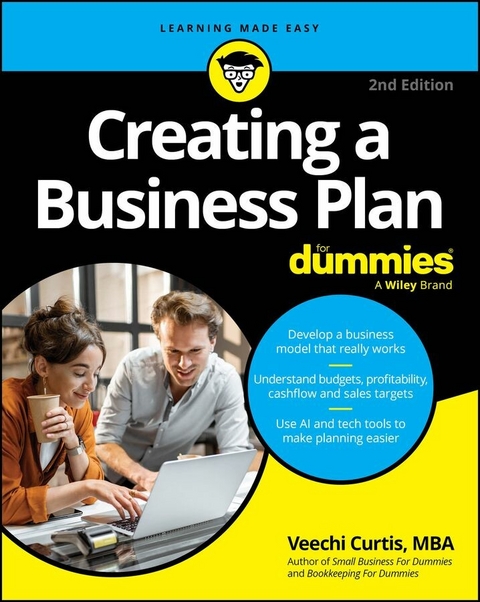
Creating a Business Plan For Dummies (eBook)
390 Seiten
For Dummies (Verlag)
978-1-394-23732-6 (ISBN)
Learn how to create a sound, profitable business plan that will take your business to the next level
Whether you're starting a new business or you're looking to revitalise your strategy, Creating a Business Plan For Dummies covers everything you need to know. This step-by-step guide shows you how to figure out whether your business idea will work. With Dummies, your business plan can be a simple process that you tackle in stages. You'll identify your strategic advantage, discover how to gain an edge over your competitors and transform your ideas to reality using the latest tools (including AI!).
No matter what type of business you have - products or services, online or bricks-and-mortar - you'll learn how to create a start-up budget and make realistic projections. How will you predict and manage your expenses? When will your business break even? Dummies will help you assemble a financial forecast that leaves you confident in your calculations! Learn how to review potential risk, experiment with different scenarios to see if you're on the right track and hone your mindset for a better work-life balance.
- Establish a smart business model that really works
- Identify your edge, get ahead of competitors and win the game
- Create an elevator pitch and a one-page business plan to woo investors
- Demystify financial projections, build a budget and create cashflow
- Work smarter by taking advantage of the latest AI and online business tools
Having a good plan is the first step to success for any business. Getting it right can mean the difference between big trouble and big profits. Creating a Business Plan For Dummies gives you the detailed advice you need to guide your business all the way from concept to reality.
Veechi Curtis specializes in mentoring small businesses, helping business owners find the secrets to their own success. She is the author of the bestselling Small Business For Dummies and Bookkeeping For Dummies.
Learn how to create a sound, profitable business plan that will take your business to the next level Whether you're starting a new business or you re looking to revitalise your strategy, Creating a Business Plan For Dummies covers everything you need to know. This step-by-step guide shows you how to figure out whether your business idea will work. With Dummies, your business plan can be a simple process that you tackle in stages. You ll identify your strategic advantage, discover how to gain an edge over your competitors and transform your ideas to reality using the latest tools (including AI!). No matter what type of business you have products or services, online or bricks-and-mortar you ll learn how to create a start-up budget and make realistic projections. How will you predict and manage your expenses? When will your business break even? Dummies will help you assemble a financial forecast that leaves you confident in your calculations! Learn how to review potential risk, experiment with different scenarios to see if you re on the right track and hone your mindset for a better work-life balance. Establish a smart business model that really works Identify your edge, get ahead of competitors and win the game Create an elevator pitch and a one-page business plan to woo investors Demystify financial projections, build a budget and create cashflow Work smarter by taking advantage of the latest AI and online business tools Having a good plan is the first step to success for any business. Getting it right can mean the difference between big trouble and big profits. Creating a Business Plan For Dummies gives you the detailed advice you need to guide your business all the way from concept to reality.
Chapter 1
Letting Your Plan Take Flight
IN THIS CHAPTER
Getting started without another moment’s hesitation
Applying a scorecard to your business idea
Deciding what elements to include in your plan
Revisiting and checking your plan
Understanding why business planning is harder than it looks
Tricking yourself into doing the deed
Abusiness plan is as much a way of thinking as it is a document. Some of the most important elements of a business plan can be done while talking with colleagues, walking along the beach or taking time out over a cup of coffee.
Key to a business planning mindset is a willingness to be objective about strategy, the ability to think of your business as something that’s separate from you, and the discipline to analyze your financials (even if you’re not naturally good with numbers).
Importantly, a business plan doesn’t necessarily require days or weeks of your time. I often recommend to people they approach their plan in bite-sized chunks, whether this be redesigning pricing strategies, spending time researching competitors, or experimenting with different pricing models.
In this chapter, I talk about who a business plan is for, what goes into a plan, and how you might start thinking about your business model. I also explain why it can be hard to be objective and motivated about planning for your business, and share a few insights into how to keep yourself on track.
Getting Your Feet Wet
In Creating a Business Plan For Dummies, 2nd edition, I place less emphasis on the importance of creating a written plan and more on why planning is best viewed as a frame of mind. The neat thing about this way of thinking is that you can start with your plan at any time, even if you know you have only one hour free this week and you’re flying overseas for a holiday the next.
Planning can even be fun once you get started. Some of my best business ideas have come to me while lying in the hammock on holidays, digging up weeds in the garden or having a quiet coffee.
Thinking about success and failure
I’m sure you’ve heard of the adage that if you spend time working on your business — rather than just working in your business — you have a better chance of realizing success. However, I was talking with some friends the other day about this book, and one of them asked me just how much difference a business plan makes to the success or failure of that venture. Later, because I couldn’t help myself, I spent many hours going down the rabbit hole of studies people have done on this topic. After all those hours, all I could confirm was that a neat, definitive answer on this question does not exist.
One reason such an answer is elusive is that the very definition of success or failure is fraught. Relatively few business owners go bankrupt or lose their life savings when their business idea goes wrong. Similarly, few business owners achieve private-helicopter-mega-wealth success. Instead, most businesspeople land somewhere in the middle, working pretty hard to achieve a reasonable, but not exceptional, standard of living.
However, even if lottery-like luck isn’t on your side, my observation is that the disciplined thinking a business plan engenders provides you with an edge over others. Maybe you won’t join the ranks of the mega-rich just yet, but you’ll likely make higher profits than those of your peers who are without a plan.
Choosing your dance partners
Unless you’ve run a business before, creating a business plan almost certainly needs a little help from outside. The good news is that all you have to do is ask. Consider the following sources:
-
Business planning courses: In my opinion, a structured course spread over several weeks or even months is the very best possible way to accumulate basic planning skills. Not only do you have the discipline of working on your plan at least once a week, but you also usually receive expert mentoring from the teacher or teachers, as well as peer support from other people in a similar position to you.
- Business advisory centers: Depending on where you are in the world, business advisory centers have different names and structures. However, most state and federal governments fund some form of free advisory centers.
- Business consultants: While I warn against delegating the whole planning process to outsiders, expert consultants can be a great resource, especially if you retain control and ownership of your plan.
- Your accountant: I strongly recommend that you do your own financial projections, rather than delegating this task to a bookkeeper or accountant. (I explain just how in Chapters 7 through to 13.) However, after you have made your best attempt, consider asking your accountant to review your figures, and help you to identify anything that doesn’t make sense or seems unrealistic.
- Your lawyer: In Chapter 14, I talk about managing risk, including protecting your name and your brand, and limiting liability through company structures. Your lawyer is an excellent source of advice for this part of the planning process.
- Friends and family: Not only is the advice of friends and family usually free, but these people also understand you like nobody else. Support and encouragement from friends and family is invaluable on those doubtful days when you think you (and your new business idea) may be crazy.
- Your spouse/life partner: Last but not least. Need I say more?
Even if you don’t have all of the skills required to create a plan, you won’t find a better motivator for acquiring these skills than the feast-and-famine of your business venture. Experience is a generous teacher.
Deciding who this plan is for
The easy answer to the question of who your plan is for is you, of course. Your plan is an ongoing process, not a massive document that you create every year or so. When you create a business plan for your own use only, you can pick a structure, time and format that work well for you.
Of course in real life, the impetus for most business plans is to seek capital, either from an investor or via a bank loan. In Chapter 15, I explain how to frame your plan according to your audience: Investors are typically more interested in a high rate of return and the excitement of a clever business idea; banks are usually more interested in collateral, consistent trading results and your personal credit rating.
Regardless of who is likely to read your plan, I strongly suggest that when it comes to the financials — sales targets, income projections, profit projections and so on — you be consistent. Don’t have one version of financials for your own purposes, and another spruced-up version for the bank.
I remember my first job after graduating, working for a small but growing company. Money was always tight and we were forever presenting new plans and cashflow projections to prospective lenders. Part of my job was to ‘massage’ the figures to show that while cash was desperate in the coming six months or so (and hence a loan was required), things would soon turn the corner and, within a couple of years, we would be awash with funds. I discovered how easy it was to manipulate figures. By adding 10 per cent to sales, trimming expenses by the same amount, and maybe increasing the gross profit a little, I could transform dire predictions into something that looked amazing. The trouble was these figures were pure fiction. The manipulated scenarios inevitably created a false sense of security, and led to some pretty poor long-term decision-making.
The moral of the tale? Don’t get hoodwinked into ‘selling’ your plan and exaggerating your likely success. Stay as realistic as possible. This tactic helps you gain respect from any likely investors and keeps you grounded as to what lies ahead.
Subscribing to a business planning app
In this book, I try to provide you with all the information you need to build your plan. You may be wondering how to use this book alongside the many business planning apps available.
Even with this book to hand, a business planning app undoubtedly makes the process easier. Apps such as Bizplan, Enloop, LivePlan and PlanGuru help you to structure each section of your plan, can offer suggested wording based on your industry, and are excellent for creating financial forecasts, particularly if numbers doesn’t come naturally to you.
I suggest you weigh up the pros and cons for yourself by subscribing to a service such as www.liveplan.com for a month or so. The monthly fee is usually fairly modest, and represents a small financial commitment for what is potentially a significant saving of your time.
I’ve written this book so it can go hand in hand with any business planning app, aiming to provide guidance as to what’s important, and what’s not. For example, almost anyone can explain the concept of strategic advantage in a few sentences, and most planning apps simply provide a definition, followed by a template where you can write your own. However, in real life, I find that strategic advantage is super tricky to understand and it’s for this reason that I devote two whole chapters to the subject (Chapters 2 and 3),...
| Erscheint lt. Verlag | 27.1.2025 |
|---|---|
| Sprache | englisch |
| Themenwelt | Sachbuch/Ratgeber ► Beruf / Finanzen / Recht / Wirtschaft ► Bewerbung / Karriere |
| Wirtschaft ► Betriebswirtschaft / Management | |
| Schlagworte | AI business tools • AI Tools • Australia • bookkeeping • Break-Even • Budget • business costs • Business expenses • business finance • Business Model • Business Ownership • Business planning • business planning app • business profit • Business Strategy • business structure • Business Tax • business tools • Buying a business • Cashflow • Competitor analysis • Customer service • Entrepreneurship • Fathom • Financial Projections • Financial Statements • gross profit • hiring • Jirav • managing a team • managing employees • margins • Marketing • Marketing channels • maximise profit • Net Profit • Planful • Pricing • Profit margin • run a business • Sales Forecasting • Small Business • small business guide • Spendesk • start a business • Start-up • sustainable business • SWOT analysis LivePlan • Target Market • Upmetrics • work-life balance |
| ISBN-10 | 1-394-23732-4 / 1394237324 |
| ISBN-13 | 978-1-394-23732-6 / 9781394237326 |
| Informationen gemäß Produktsicherheitsverordnung (GPSR) | |
| Haben Sie eine Frage zum Produkt? |
 EPUB (Adobe DRM)
Kopierschutz: Adobe-DRM
Adobe-DRM ist ein Kopierschutz, der das eBook vor Mißbrauch schützen soll. Dabei wird das eBook bereits beim Download auf Ihre persönliche Adobe-ID autorisiert. Lesen können Sie das eBook dann nur auf den Geräten, welche ebenfalls auf Ihre Adobe-ID registriert sind.
Details zum Adobe-DRM
Dateiformat: EPUB (Electronic Publication)
EPUB ist ein offener Standard für eBooks und eignet sich besonders zur Darstellung von Belletristik und Sachbüchern. Der Fließtext wird dynamisch an die Display- und Schriftgröße angepasst. Auch für mobile Lesegeräte ist EPUB daher gut geeignet.
Systemvoraussetzungen:
PC/Mac: Mit einem PC oder Mac können Sie dieses eBook lesen. Sie benötigen eine
eReader: Dieses eBook kann mit (fast) allen eBook-Readern gelesen werden. Mit dem amazon-Kindle ist es aber nicht kompatibel.
Smartphone/Tablet: Egal ob Apple oder Android, dieses eBook können Sie lesen. Sie benötigen eine
Geräteliste und zusätzliche Hinweise
Buying eBooks from abroad
For tax law reasons we can sell eBooks just within Germany and Switzerland. Regrettably we cannot fulfill eBook-orders from other countries.
aus dem Bereich