


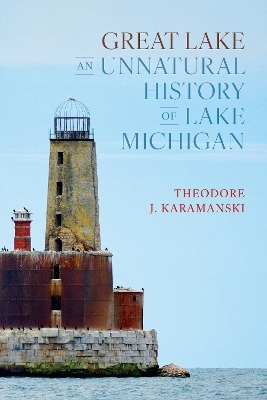
Great Lake
An Unnatural History of Lake Michigan
Seiten
2026
University of Michigan Regional (Verlag)
978-0-472-04006-3 (ISBN)
University of Michigan Regional (Verlag)
978-0-472-04006-3 (ISBN)
- Lieferbar (Termin unbekannt)
- Portofrei ab CHF 40
- Auch auf Rechnung
- Artikel merken
Shaping America’s great watery wilderness
Looking down from outer space a vast expanse of blue appears in the heart of North America. Of the magnificent chain of inland seas, only one of those bodies of water—Lake Michigan—is entirely within the boundaries of the United States. Lake Michigan has been uniquely shaped by its relationship with humans, since its geological evolution took place at the same time as Paleo-Indian peoples interacted with the changing environment. Each generation of humans has altered the lake to suit society’s changing needs, dredging harbors, building lighthouses, digging canals and channels, filling in shallows, and obliterating wetlands.
Great Lake is a comprehensive survey of the manifold ways Americans, from the first Native American communities to the present age, have abused, nurtured, loved, and neglected this massive freshwater resource. Extending 307 miles from north to south, the lake cuts across climatic, environmental, and physiographic zones, from the prairies of Illinois to the boreal forests of the north. Bordered by large cities like Chicago and Milwaukee as well as smaller Wisconsin resorts and northern Michigan mines and mill towns, the lake touches people in urban centers and countryside. Thus, the history of Lake Michigan combines the history of frontier resource extraction, agricultural abundance, industrialization, and dense urbanization in the American heartland. Great Lake is the story of the ever-escalating and divergent demands Americans have placed on Lake Michigan, how the lake’s ecosystem responded to those changes, and how together they have shaped the modern American Midwest.
Looking down from outer space a vast expanse of blue appears in the heart of North America. Of the magnificent chain of inland seas, only one of those bodies of water—Lake Michigan—is entirely within the boundaries of the United States. Lake Michigan has been uniquely shaped by its relationship with humans, since its geological evolution took place at the same time as Paleo-Indian peoples interacted with the changing environment. Each generation of humans has altered the lake to suit society’s changing needs, dredging harbors, building lighthouses, digging canals and channels, filling in shallows, and obliterating wetlands.
Great Lake is a comprehensive survey of the manifold ways Americans, from the first Native American communities to the present age, have abused, nurtured, loved, and neglected this massive freshwater resource. Extending 307 miles from north to south, the lake cuts across climatic, environmental, and physiographic zones, from the prairies of Illinois to the boreal forests of the north. Bordered by large cities like Chicago and Milwaukee as well as smaller Wisconsin resorts and northern Michigan mines and mill towns, the lake touches people in urban centers and countryside. Thus, the history of Lake Michigan combines the history of frontier resource extraction, agricultural abundance, industrialization, and dense urbanization in the American heartland. Great Lake is the story of the ever-escalating and divergent demands Americans have placed on Lake Michigan, how the lake’s ecosystem responded to those changes, and how together they have shaped the modern American Midwest.
Theodore J. Karamanski is Professor Emeritus at Loyola University Chicago. His most recent book is Mastering the Inland Sea: How Lighthouses, Navigational Aids, and Harbors Transformed the Great Lakes and America.
Acknowledgements
List of illustrations
Introduction
Map of Lake Michigan Area
Chapter 1 Ice
Chapter 2 Canoes
Chapter 3 Sails
Chapter 4 Steam
Chapter 5 Sewars
Chapter 6 Steel
Chapter 7 Amenity
Chapter 8 Invasive Species
Chapter 9 The Lake Abides
| Erscheinungsdatum | 04.01.2026 |
|---|---|
| Zusatzinfo | 20 Illustrations |
| Sprache | englisch |
| Maße | 152 x 229 mm |
| Themenwelt | Sachbuch/Ratgeber ► Geschichte / Politik ► Regional- / Landesgeschichte |
| Sachbuch/Ratgeber ► Natur / Technik ► Natur / Ökologie | |
| Geisteswissenschaften ► Geschichte ► Regional- / Ländergeschichte | |
| ISBN-10 | 0-472-04006-5 / 0472040065 |
| ISBN-13 | 978-0-472-04006-3 / 9780472040063 |
| Zustand | Neuware |
| Informationen gemäß Produktsicherheitsverordnung (GPSR) | |
| Haben Sie eine Frage zum Produkt? |
Mehr entdecken
aus dem Bereich



aus dem Bereich
eine Geschichte der Vereinigten Staaten von 1950 bis heute
Buch | Hardcover (2024)
Klett-Cotta (Verlag)
CHF 48,95


