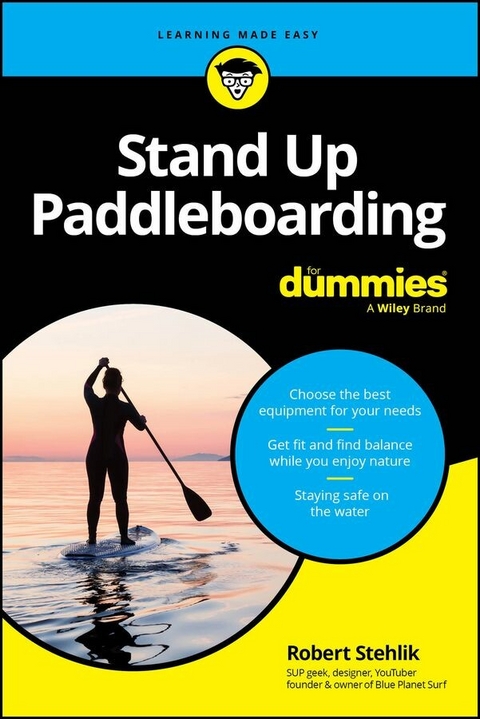
Stand Up Paddleboarding For Dummies (eBook)
360 Seiten
For Dummies (Verlag)
978-1-394-27630-1 (ISBN)
An easy and accessible guide for one of the fastest growing water sports in the world
Looking for a way to get some exercise out on the water and have a blast while you're at it? Then it's time to try stand up paddleboarding!
Stand Up Paddleboarding For Dummies walks you through absolutely everything you need to know to get started with this fun, exciting, and healthy activity. It's packed with illustrations, graphics, and easy-to-understand tips that make it a snap to do everything from choosing your first board to respecting the marine life you'll see while you're in the water.
This book will prepare you for your new hobby so you can feel safe, knowledgeable, and comfortable with the ins and outs of this rapidly growing sport. You'll also find:
- Essential safety tips, including how to maintain your balance on the board and helpful stretches you can do before and after your next stand up paddleboarding session
- A list of common rookie mistakes-and how to avoid them-so you can get a head start on your new pastime
- Equipment basics that will help you choose the gear that's right for you on your first try
Stand Up Paddleboarding For Dummies is a great book for people ready to take on a cool and healthy new activity, as well as the perfect gift for that active and fun-loving person in your life who can't get enough of being out on the water. Grab a copy today!
Robert Stehlik is the founder and owner of Blue Planet Surf, a global SUP and surf brand. Robert is a certified instructor and instructor trainer through the Professional Stand Up Paddle Association, and he has taught thousands to SUP through lessons and coaching. He has also competed in the Paddleboard World Championship race over 10 times.
An easy and accessible guide for one of the fastest growing water sports in the world Looking for a way to get some exercise out on the water and have a blast while you're at it? Then it's time to try stand up paddleboarding! Stand Up Paddleboarding For Dummies walks you through absolutely everything you need to know to get started with this fun, exciting, and healthy activity. It's packed with illustrations, graphics, and easy-to-understand tips that make it a snap to do everything from choosing your first board to respecting the marine life you'll see while you're in the water. This book will prepare you for your new hobby so you can feel safe, knowledgeable, and comfortable with the ins and outs of this rapidly growing sport. You'll also find: Essential safety tips, including how to maintain your balance on the board and helpful stretches you can do before and after your next stand up paddleboarding session A list of common rookie mistakes and how to avoid them so you can get a head start on your new pastime Equipment basics that will help you choose the gear that's right for you on your first try Stand Up Paddleboarding For Dummies is a great book for people ready to take on a cool and healthy new activity, as well as the perfect gift for that active and fun-loving person in your life who can't get enough of being out on the water. Grab a copy today!
Chapter 1
What’SUP? Paddling While Standing up through History
IN THIS CHAPTER
Discovering the earliest recorded examples of paddling in a standing position
Focusing on the early pioneers of the sport
Getting a glimpse of SUP’s popularity and potential future
Stand up paddleboarding (SUP) may seem to many like a modern invention, but the roots of this sport stretch far back to ancient civilizations. In its current form, SUP has only been around since the early 2000s, when Laird Hamilton and Dave Kalama picked up paddles during a 2004 photoshoot and realized how practical and fun standing and paddling on a big surfboard with a long paddle was. Since then, modern SUP has become a global phenomenon and undergone rapid growth.
I was fortunate enough to learn how to SUP back in 2007 from some of the early pioneers of the sport. Ever since, I’ve been passionate not only about participating in the sport myself but also about sharing the sport and stoke with others — which I hope to do in this chapter.
Paddling in a Standing Position: Ancient History
Humans have long been drawn to the water and paddling while standing up has been a natural evolution for many societies throughout history. So many early records of paddling while standing exist that it seems to be deeply rooted in human nature. In some places, the technique was born from necessity for fishing and transportation, while in others it became a cultural practice.
One of the earliest examples of standing up while paddling dates back as far as 3,000 years ago along the Peruvian coast, where fishermen used crafts called caballitos de totora (reed horses; see Figure 1-1) to navigate through the surf to fish in coastal waters. Paddlers could use a long paddle to steer these rafts, made from bundled reeds, from a kneeling or standing position. Paddling on the knees was more stable because of the lower center of gravity, but standing up on their reed crafts allowed the fishermen to stretch their legs, get a better view of the fish, and have more leverage on their paddles.
LuisAlexanderMJ/Adobe Stock Photos
FIGURE 1-1: A caballito de totora.
In Israel, a similar style of paddling emerged with the hasake — large, wide-bodied boats propelled by a standing rider with a long, two-sided paddle as shown in Figure 1-2. Early records of these crafts date back to the Roman Empire, and they’re still being used in the Mediterranean Sea today (mostly by skilled lifeguards as a rescue tool, but also for fishing and recreation). In many ways, the hasake is a precursor to the modern stand up paddleboard; wide and stable, it’s designed for utility and allows the paddler to stand up comfortably while navigating ocean waves and turbulent waters.
Rafael Ben-Ari/Adobe Stock Photos
FIGURE 1-2: A modern hasake off the Israeli coast.
Indigenous communities across the world have long engaged in stand up paddling. People in Polynesia, North America, Southeast Asia, Africa (see Figure 1-3), and New Zealand have all stood and paddled canoes and boats for a variety of reasons: fishing, transportation, navigation, and cultural ceremonies. These practices show that standing up while paddling has played an integral role in human survival and culture over millennia.
You can find countless other examples of paddling while standing up, including the gondoliers of Venice, loggers navigating rivers and rapids on wooden logs, and canoeists.
bandanar/Adobe Stock Photos
FIGURE 1-3: African woman paddling a dugout canoe.
Surveying the Rise of SUP Surfing in Hawaii
While Polynesian canoes were mostly paddled in a sitting position, it was not uncommon for ancient Polynesians to paddle standing up, allowing a better vantage point of the reef below, making it easier to spot fish, and to get a better view of the horizon, weather, and other things in the distance.
The modern version of stand up paddling on a big surfboard began to evolve in the early 20th century, specifically in Waikiki, Hawaii. When the first hotels opened there in the early 1900s, the local surfers began to make a living as surf instructors, lifeguards, and entertainers. These locals were known as beach boys and would paddle out on large surf boards and outrigger canoes (canoes with side float attachments) to introduce tourists to riding waves. Taking a canoe paddle on a surfboard allowed them to paddle faster as they gave lessons. Paddling on a large surfboard with a paddle became known as beach boy surfing; the Hawaiian name for it is Hoe he’e nalu (stand, paddle, surf a wave).
Allow me to introduce you to some of the main beach boy surfers of yesteryear:
-
Duke Kahanamoku was born in 1890 to parents from prominent Hawaiian ohana (families). He grew up in Waikiki, close to Queen’s Beach, where his statue, shown in Figure 1-4, stands today. Duke spent much of his youth at the beach, where he developed his surfing and swimming skills. He was a powerful swimmer and started breaking world records at local swim meets. He went on to win the gold medal in the100-meter freestyle at the 1912 Stockholm Olympics, followed by several other Olympic medals. He is also credited with introducing surfing to Australia, during a visit in 1914, and later to California, where he performed as an actor in Hollywood.
Australian lifeguards that Duke trained gave him an early surf ski, a big wooden board with a long two-sided paddle, as a gift. Duke Kahanamoku paddled this board and caught waves standing up with the long paddle.
To find out more about Duke Kahanamoku’s legacy, check out the 2021 documentary Waterman.
Torval Mork/Adobe Stock Photos
FIGURE 1-4: Duke Kahanamoku statue.
SUPSURFIN’ USA
In California, a standout pioneer of stand up paddleboard surfing was Ron “Canoe” Drummond, who famously surfed waves in a canoe while standing up in Dana Point. Drummond was a wild man, known for his eccentric style and creativity, combining the elements of canoeing and surfing to create something new and different.
- In 1940, John “Zap” Zapotocky moved from Pennsylvania to Waikiki and was inspired by watching Duke Kahanamoku. He ordered a custom-made long wooden paddle and started using it with his large longboard to ride the waves in Waikiki. Zap went on to be one of the sport’s most enduring figures, SUP surfing in Waikiki until he was in his 90s. He witnessed the sport becoming a global phenomenon before he passed away in 2013.
- Well-known Waikiki Beach Boy John “Pops” Ah Choy used a large wooden surfboard and long paddle to teach surfing and take photos of tourists. His sons Bobby and Leroy Ah Choy carry on the legacy and host an annual Pops Ah Choy Surf Fest in Waikiki.
Breaking down the Modern SUP Revolution: Blame Laird
The modern era of SUP surfing started at an Oxbow photoshoot on the south shore of Maui in 2004. Laird Hamilton and Dave Kalama were surfing on big longboards in offshore winds. They noticed that they could just stay standing up on their boards after catching a wave while the offshore breeze would carry them back out to the lineup. Dave decided to get a couple of canoe paddles from his car, and he and Laird had a blast using them while standing on the boards.
They immediately ordered longer paddles from Malama Chun, a local paddle maker, and started designing specialized boards for SUP surfing. Their experimentation and the influence they had as well-known watermen sparked the creation of modern stand up paddleboarding. That’s why surfers like to “Blame Laird” for the popularity of SUP surfing.
Kindling the SUP flame
As the popularity of the sport began to grow, it quickly caught the attention of the global water sports community. On Oahu, Brian Keaulana picked up the sport and introduced a beach boy surfing division to the Buffalo Big Board Surfing Classic at Makaha in 2003, making it the first official SUP contest. The competition spurred rapid development of the sport, and both equipment and technique evolved quickly.
Keaulana, Dave Parmenter, and Todd Bradley started a company called C4 Waterman that was dedicated to developing SUP-specific boards, paddles, and equipment. Paddlesurf Hawaii and C4 Waterman were the first SUP-specific production boards available, and my business, Blue Planet Surf, was the distributor. Early adopters provided strong demand — so strong that it was impossible to keep up with in the early days of the sport. We held SUP clinics to introduce people to the sport, and I was fortunate enough to learn it from the best.
SUP quickly grew beyond its surfing roots into new disciplines, such as cruising, touring, racing, and downwinding, which accelerated growth. In 2006, the 32-mile Molokai to Oahu (M2O) Paddleboard World Championships introduced a SUP division. (Kevin Horgan won that race in 7 hours and 23 minutes.)
By 2008, several brands started producing SUP boards, which were sold and promoted mostly through surf and water sports retailers. My friends Jeff Chang and Doug Locke opened the first SUP-specific retail store, Wet Feet Hawaii, and were soon followed by many SUP-focused...
| Erscheint lt. Verlag | 8.1.2025 |
|---|---|
| Sprache | englisch |
| Themenwelt | Sachbuch/Ratgeber ► Sport |
| Schlagworte | Paddleboarding book • stand-up paddleboarding • standup paddleboarding • stand up paddleboarding book • stand up paddleboarding dummies book • stand up paddleboarding for beginners • stand up paddleboarding for newbies • stand up paddleboarding for novices • stand up paddleboarding guide |
| ISBN-10 | 1-394-27630-3 / 1394276303 |
| ISBN-13 | 978-1-394-27630-1 / 9781394276301 |
| Informationen gemäß Produktsicherheitsverordnung (GPSR) | |
| Haben Sie eine Frage zum Produkt? |
 EPUB (Adobe DRM)
Kopierschutz: Adobe-DRM
Adobe-DRM ist ein Kopierschutz, der das eBook vor Mißbrauch schützen soll. Dabei wird das eBook bereits beim Download auf Ihre persönliche Adobe-ID autorisiert. Lesen können Sie das eBook dann nur auf den Geräten, welche ebenfalls auf Ihre Adobe-ID registriert sind.
Details zum Adobe-DRM
Dateiformat: EPUB (Electronic Publication)
EPUB ist ein offener Standard für eBooks und eignet sich besonders zur Darstellung von Belletristik und Sachbüchern. Der Fließtext wird dynamisch an die Display- und Schriftgröße angepasst. Auch für mobile Lesegeräte ist EPUB daher gut geeignet.
Systemvoraussetzungen:
PC/Mac: Mit einem PC oder Mac können Sie dieses eBook lesen. Sie benötigen eine
eReader: Dieses eBook kann mit (fast) allen eBook-Readern gelesen werden. Mit dem amazon-Kindle ist es aber nicht kompatibel.
Smartphone/Tablet: Egal ob Apple oder Android, dieses eBook können Sie lesen. Sie benötigen eine
Geräteliste und zusätzliche Hinweise
Buying eBooks from abroad
For tax law reasons we can sell eBooks just within Germany and Switzerland. Regrettably we cannot fulfill eBook-orders from other countries.
aus dem Bereich