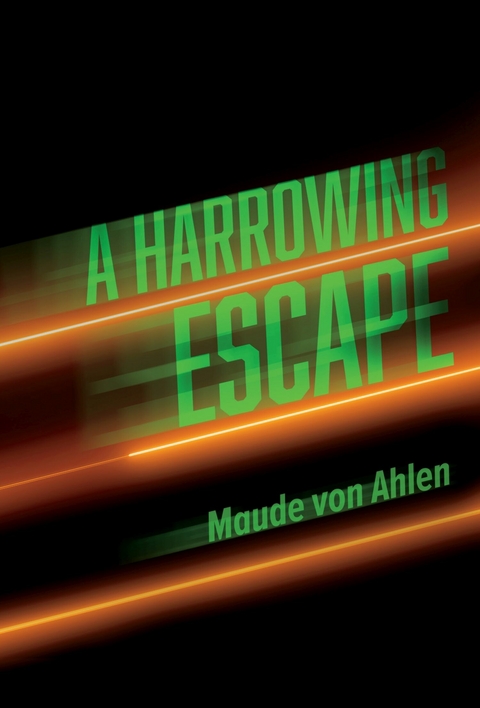
Harrowing Escape (eBook)
242 Seiten
Bookbaby (Verlag)
979-8-3509-8814-7 (ISBN)
Maude von Ahlen has a doctorate in Clinical Psychology. Her experience working with trauma victims inspired this story which is a fictional depiction of the realistic plight of survivors living with post traumatic stress disorder (PTSD). Her interests include writing books that not only entertain and inspire, but also challenge stigma, expand awareness, and elicit compassion.
In "e;A Harrowing Escape"e;, Shiloh, a mother in Croatia, risks everything to abduct her children and escape an abusive husband. Returning to the United States, they confront cultural alienation and the lingering scars of their ordeal. Meanwhile, on the other side of the world, James, a bright young boy in Australia, endures years of cruelty at the hands of an abusive father. The novel initially presents their stories as separate yet equally harrowing accounts of survival. But as the narrative unfolds, Shiloh and James's paths unexpectedly intersect, forging an unlikely bond that helps them confront and overcome the ghosts of their past. This evocative story of survival, resilience, and healing highlights the strength of the human spirit in the face of extraordinary adversity. Readers will be captivated by its raw emotion, nuanced characters, and an enduring message: even in darkness, connection and hope can lead to profound transformation.
Chapter 1
“You have sad eyes again,” I tell her. She is packing a suitcase with clothing for me and my brother. As if blinded by a flash, she freezes mid-motion—a pair of my underwear still in her hand. Her vacant countenance and empty gaze are familiar, yet still frightening. Like someone possessed, she is physically occupying space in front of me, and yet I know she is no longer here. Already her soul has escaped, like a bird through an open window. Dimly staring at nothing, I know she must be reliving an invisible reel of hell. I feel abandoned, even though I am the one who triggered the flight of mind from body. These spells seem to happen more often and last longer than I remember. This one was long enough for me to count: 1 hippopotamus, 2 hippopotamus, 3 . . . all the way up to 23 hippopotami. Then, the phenomenon ends as suddenly as it began. An instantaneous panic of consciousness pushes her to the surface. The suitcase is zipped and slid under the bed as evidence of regained sanity. We do not discuss what just happened. Like a cat who emerges from the fog of dawn, exhausted from the previous night’s foray, she does not disclose where her soul absconds. We pretend it didn’t happen. The escape. It is one of the many secrets we hold between us, mother and daughter. And yet, I feel assaulted by guilt and remorse. I did not intend for my comment to transport her to a place of remembered terror. I just want her to know I notice things about her she may not be aware of herself.
The suitcase is now wedged under the narrow bed Mama shares with me and my brother. The bed is nestled in a mere afterthought of a room, in a poorly designed apartment. The apartment is relegated to a neglected part of the village. The village is a cluster of rundown, stone houses from a time before people cared to keep track of it. Westerners would describe them as “charming.” The houses over-rely on brightly colored paints in terracottas, cobalt blues, pinks, and yellows to distinguish themselves, one from another. There is a postage stamp–sized marina with a chain-gang of aged wooden boats, all with peeling paint. Reluctantly bound by pungent fishing nets, moldy ropes, and neglect, they would make a romantic tableau for a painter if not for the smell. Also peeling, also aging, are the vessels’ owners, some of whom are enjoying their quotidian kafe (espresso) in front of the only local establishment, the kind with indifferent patrons and an aloof barista. When the mood strikes, she might be willing to sell you a carton of cigarettes to complete your breakfast. Considered from a distance, one could easily imagine the ancient fishing village likely hosted Etruscan or Greek voyagers from another age, and yet the island itself boasts no relics from the past. The village occupies the walkable coast of a remote island in the Adriatic Sea. It is surrounded by waters that evoke disinhibition and regression, or so it seems from the nude Brits who hang their colorless legs from the sides of sailboats as they cruise into the harbor. The island is called Mali Iz (“little island”). This is where we live.
It would be important for me to tell you that Mama does not sleep in the same bedroom as Tata. As it were, we share our bed with her and our roof with Tata, who falls asleep on the couch and sometimes wakes up in the other bedroom (if he happens to be home). The door to this bedroom is now closed, so I know he is asleep. We do not know when he will wake up again, so we must be quiet as mice. To do otherwise would be dangerous and foolish. This is how we live.
Placing a finger to her lips, Mama signals shhhhhh. I know this means I am not supposed to say anything to Tata about the suitcase. I won’t, because I don’t want to get her into trouble again. Gesturing for me to follow, we go into the kitchenette. She gently adjusts me so I am posing in front of the white refrigerator. I look toward the camera lens on her phone, but I do not smile—Mama says not to. I’m glad for this because I hate it when people try to force you to smile for pictures. Among my other irritants are when Mama asks me if I’m angry when I am not. No, it is just how my face is, I explain. I like my face the way it is. Except for the shape of my nose and freckles. I wish my nose was more of a long ski-slope like Mama’s. Instead, it is Slavic, like Tata’s. I also have his eye color—“denim blue,” she calls it. She told me once that his eyes were a sign the curse came true, forgetting that as a younger woman, a psychic predicted that a man with blue eyes would ruin her life. Feeling stupid for entertaining such hokum, she instantly regretted letting her cards be read and dismissed the warning. But a part of her knew she would be punished for entertaining the dark arts. And so, ironically, the warning itself became a self-fulfilling prophecy. Or at least, that is how the cautionary tale ends. Stay away from black magic, she tells me, but I never know how serious to take this warning. It might be like all the other things parents say to their children in hopes they won’t repeat their mistakes. I think what she really means is that blue eyes are cursed. I love Tata but I don’t want to be like him. However, every time I see my blue eyes in the mirror, I fear there is too much of him in me and not enough of her.
In the same manner as before, she takes a picture of Stefen. As usual, he is blindly compliant. We do not know why our pictures are being taken in this way. Handing me her phone, she tells me take a picture of her. I don’t remember the last time I saw her smile, so I don’t need to remind her not to.
“Why do we need to take pictures like this?” I ask.
“I’ll tell you later,” she says. I open my mouth in protest, but the answering glare connotes my complicity in this endeavor is mandatory. Having no notion whatsoever of our objective is moot. She banks on the unconditional loyalty of her children. From my perch over her shoulder (already I am nearly taller than she), I can see the three mug-shot like pictures of us on her phone. Then I hear SWOOSH as she presses the button with the paper airplane on it. I imagine the pictures swooshing to some secret person, in some clandestine location. It feels exciting. I imagine us as spies, all three of us. I don’t know yet that I am being kidnapped.
***
It is dark inside save for the light over the stove and the lamp on the antiquated piano. It is missing keys, none of them conveniently obsolete notes. I am practicing my scales—quietly, so that I do not disturb Tata, who is subdued on the couch, hypnotized by the TV. He is donning the same ribbed, white tank top and grey sweats he wears every day, the casual uniform of men on the Adriatic. He also has a matching tracksuit (the European tuxedo) reserved for sorties. There is a bottle of pivo (beer) is in his hand, just as there is usually a buoy tethered to the sea floor at the entrance of the marina.
“Mama should have another baby,” he announces, grinning stupidly. His eyes are trained on the TV as he says it. Mama is sewing a tear in a pair of Stefen’s trousers, pretending not to hear. I can tell by his speech (as if trying to communicate from under water) that he is drunk. He tries to grab her bottom but she scoots away, just out of reach, so his hands are instead swatting at imaginary flies.
“You’re not fun anymore,” he accuses before taking a revenge swig of pivo. To further emphasize his point, he turns up the volume on the TV.
***
Feeling peculiar, I stand in front of an open window the next morning, hoping the fresh air might revive me. The salty ocean breeze wafts in just as always, and yet somehow, everything feels different. Stefen is lazily eating his bread at the table, his eyes half closed with sleepiness. He does not seem to pick up on the strangeness, or at least he doesn’t show it. For me it’s as if the time signature and key of a musical piece has changed without me realizing it. The conductor is making decisions outside of my awareness, and yet I am expected to continue playing the notes. Another movement has developed, and I don’t have the correct sheet music. Attuned to Mama’s mood, I notice it has an obsessive quality to it that I dismiss as garden-variety anxiety. She is wearing her usual, faded black leggings and her best sweater—it has only one hole in it, unlike the others. Expectantly, she stands beside me, peering out the same window. I see only the white ferry, unremarkable in its weekly trip from the mainland toward Mali Iz. She sees a harbinger of hope. Saying nothing, she leaves the apartment and returns moments later, sweating because she has just dragged the concealed suitcase outside and down the steps.
“It’s time to leave,” she tells us. Something indiscernible prevents me from asking where we are going, as if the answer might seal our doom. Mama tips the suitcase onto its wheels and pulls, indicating for us to follow. She tells me to hold her purse. What could possibly be in here, I wonder because of its heaviness. My natural association to feeling unfairly burdened is to resent Stefen, because he never helps with anything. Mama never tells him to help because she knows he won’t. He will grow out of it, she says, but I don’t believe her. He is just like Tata.
We are walking along the main path parallel to the sea, toward the marina. I can hear the flirtatious sound of water lapping on the rocks. Any other day, we would go for a swim in the seductively inviting sea...
| Erscheint lt. Verlag | 2.1.2025 |
|---|---|
| Sprache | englisch |
| Themenwelt | Sachbuch/Ratgeber ► Gesundheit / Leben / Psychologie ► Familie / Erziehung |
| ISBN-13 | 979-8-3509-8814-7 / 9798350988147 |
| Informationen gemäß Produktsicherheitsverordnung (GPSR) | |
| Haben Sie eine Frage zum Produkt? |
 EPUB (Ohne DRM)
Größe: 770 KB
Digital Rights Management: ohne DRM
Dieses eBook enthält kein DRM oder Kopierschutz. Eine Weitergabe an Dritte ist jedoch rechtlich nicht zulässig, weil Sie beim Kauf nur die Rechte an der persönlichen Nutzung erwerben.
Dateiformat: EPUB (Electronic Publication)
EPUB ist ein offener Standard für eBooks und eignet sich besonders zur Darstellung von Belletristik und Sachbüchern. Der Fließtext wird dynamisch an die Display- und Schriftgröße angepasst. Auch für mobile Lesegeräte ist EPUB daher gut geeignet.
Systemvoraussetzungen:
PC/Mac: Mit einem PC oder Mac können Sie dieses eBook lesen. Sie benötigen dafür die kostenlose Software Adobe Digital Editions.
eReader: Dieses eBook kann mit (fast) allen eBook-Readern gelesen werden. Mit dem amazon-Kindle ist es aber nicht kompatibel.
Smartphone/Tablet: Egal ob Apple oder Android, dieses eBook können Sie lesen. Sie benötigen dafür eine kostenlose App.
Geräteliste und zusätzliche Hinweise
Buying eBooks from abroad
For tax law reasons we can sell eBooks just within Germany and Switzerland. Regrettably we cannot fulfill eBook-orders from other countries.
aus dem Bereich