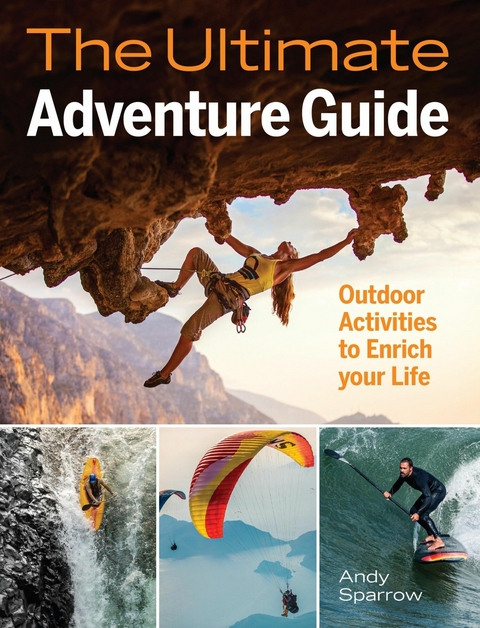
Ultimate Adventure Guide (eBook)
208 Seiten
The Crowood Press (Verlag)
978-0-7198-4476-8 (ISBN)
Andy Sparrow began caving in 1971 and is one of Britain's most experienced cavers and instructors. He has been involved in the exploration of new cave systems in britain and has descended several classic deep caves in Europe. Andy is also an award-winning filmmaker whose work includes 'Sold' and 'A Rock and a Hard Place'. Andy runs a training company, Andy Sparrow Caving Services, and caveclimb.com, an equipment shop for cavers and climbers. Resident - Somerset
INTRODUCTION
Adventure (әd’vεn(t)∫ә) n An unusual and exciting or daring experience.
Adventure is in our DNA and without it our species would still be confined to a small region of Africa. Some irrepressible curiosity led our ancestors north through Africa to Europe, then to Asia and across the land bridge into the Americas. That same adventurous spirit inspired the Polynesians to cross the Pacific in open boats and to their discovery of Australasia and the Pacific Islands. These journeys can’t all have been made through necessity. Even when we are comfortably settled in lands of abundance, some innate, restless part of us is drawn towards far horizons, unknown dangers and uncertain outcomes.
It seems that in our hunter-gatherer past we didn’t just live with danger – we thrived on it. This was recognised in the work of psychologists Yerkes and Dodson in 1908. They observed that we reach our peak level of performance with an intermediate level of stress. Our levels of stress, which often manifest as anxiety, are linked to the hormones noradrenaline and adrenaline. Noradrenaline is ever-present and helps us stay focused and alert – which was essential back in the time when predators stalked us. The bears and wolves are gone but our ancient programming remains and now focuses instead on the pressures of everyday life. For some of us this generates a constant background anxiety. That other well-known flight or fight hormone, adrenaline, designed to kick in when the wolves were circling, now triggers panic attacks when we’re socially embarrassed or have lost our car keys.
This ‘bad’ stress can be relieved by generating ‘good’ stress, and one way to achieve this is through an unusual and exciting or daring experience. For someone living with social anxiety and isolation, this could mean simply stepping out of the front door and walking to the park. Others, in their physical prime but caged behind a desk, may need a much more intense experience when the weekend comes. You can choose what’s right for you, and there is, today, a very varied choice of adventurous activities easily available, as this book seeks to illustrate.
The ordinary working people who embraced outdoor pursuits in the first half of the twentieth century didn’t need psychologists to explain the benefits they derived. Cycling, hill walking, climbing and caving all grew rapidly in popularity in the pre-war period. In the latter half of the twentieth century, the choice expanded dramatically to include innovations like mountain biking, windsurfing and paragliding. At the same time, travel overseas was becoming easier and more affordable, giving UK adventurers access to more dramatic landscapes and the challenges of mountaineering, skiing, ice climbing and via ferrata protected climbing routes. All these activities were restricted to specific regions, but such was the demand that artificial facilities soon began to appear. You can now find indoor climbing walls, snow domes, whitewater centres and high ropes courses across the UK. The opportunities and choices are so great as to be overwhelming. You may not know where to start but this book is here to help.
Get some good stress in your life!
What Defines the Activities in this Book?
Each entry has been chosen to meet the following criteria: a non-competitive adventure activity powered by natural energy that uses portable equipment and interacts with a natural landscape:
Non-competitive Many of the activities listed do have a competitive element but that isn’t usually the reason people get involved. These are activities enjoyed principally for their own sake and the only adversaries you need to overcome are your own fears or lack of self-belief.
Adventure An unusual and exciting or daring experience. A journey or quest with an uncertain outcome. Something that takes you to the edge of your comfort zone.
Activity In some cases the word ‘sport’ could be substituted, but this risks over-emphasising the competitive element.
Natural energy Powered by wind, gravity, water or human muscle (so all animal-related activities have been excluded).
The many benefits of adventure are best when shared.
Portable equipment The necessary equipment can be carried and easily transported. If it doesn’t fit on a roof rack, it’s not included.
Interacting with a natural landscape The activity should get you into the great outdoors, into landscapes and environments that will lift your spirit.
We’re looking for authentic outdoor activities that tick every item on our list of benefits. We want activities that are complementary to the natural world, that do not compromise the enjoyment of others or have a detrimental effect on the landscape.
The activities range from the mild to the extreme, offering something for everyone. Are a few hours of country walking really comparable to wingsuiting from a mountain peak? Yes, because they can both fulfil the definition of being unusual and exciting or daring. For somebody who lives alone, stepping out into the world to make a solitary journey through fields and forests can be a true adventure. And journeys begin with small steps – from local footpaths to moorland trails to, perhaps eventually, mountain summits.
We all have our personal mountains to climb.
The Benefits of Outdoor and Adventurous Activities
• Physical health – exercise and activity are essential for your physical and mental wellbeing.
• Self-confidence – face your fears and discover your true capabilities.
• Challenge – push your boundaries and experiences to new levels.
• Excitement – real thrills, sometimes with real dangers. You’ll never feel more alive.
• Achievement – experience the deep satisfaction of overcoming doubts, fears and hardships.
• Connecting with nature – immerse yourself in natural landscapes.
• Friendship – share experiences so intense they create bonds for life.
• Mental health – take a break and replace your ‘bad’ stress with ‘good’ stress.
• Life enhancement – all the above and much more.
Assessing and Reducing Risk
This book describes activities that vary widely in degrees of danger. They could perhaps be graded in some way to indicate the level of risk that each present – hill walking would be at the lowest level, while something extremely high risk like BASE jumping would be at the top. But this might suggest that hill walking is risk-free when, in reality, it’s probably the most accident- and rescue-prone activity in this book. Dangerous is as dangerous does. The BASE jumper has years of parachuting experience, their equipment is meticulously prepared, and if, on the day, the conditions aren’t perfect, they are fully prepared to say no, and walk back down. Contrast that with the ill-prepared walker heading out without a map, head torch or waterproofs.
For most of the activities, the best and safest way to begin is with professional instruction or guidance. The importance of this cannot be overstated. Most mishaps in the outdoors are caused when enthusiasm and confidence exceed knowledge and experience. You may be young, fit and confident, but you’re not infallible or indestructible.
The following advice applies to most of the activities, whether on mountain, river or sea:
• Training – learn essential skills. Go on a training course. Read the books and watch the videos. Talk to local people with local knowledge
• Practice – practise skills in a safe environment until they are completely fluent. If you’re a climber, tie knots with your eyes closed; if you’re a paddler, find some safe water to practise capsizing procedures
• Clubs and associations – these exist to promote safe practice, to pass on skills and to make social connections with like-minded people
• Start easy – begin with low grades and modest objectives. Build your experience gradually
• Planning – choose your objectives carefully and fully prepare for them. Know what to expect and where the hazards exist
• Research – find out everything you can about your objective. Use online forums and social media to connect with others and get advice
• Equipment – invest in the best equipment and learn how to use it
• Flexibility – be prepared to change or postpone your plans if the weather or conditions aren’t right. Make sure everybody has the skills and fitness required. Set a schedule and abort if you can’t keep to it
• Caution – be alert for hazards at all times. In dynamic environments things can change quickly, and what was safe one day can become deadly the next
• Conditions – it’s not just today’s weather that counts. What are the river levels, or the sea conditions? Is there still snow on the mountain?
• Weather – get the best and most recent forecast and assess what impact it may have. Forecasts are generally accurate, but sometimes things arrive ahead of schedule
• Call out – tell a reliable person your plans and what to do if you are...
| Erscheint lt. Verlag | 25.3.2025 |
|---|---|
| Verlagsort | London |
| Sprache | englisch |
| Themenwelt | Sachbuch/Ratgeber ► Sport |
| Schlagworte | Abseiling • air sports • & Kitesurfing • BASE jumping & Wingsuiting • Bungee jumping • Canoeing & Kayaking • Canyoning • cave diving • caving • Climbing • Coasteering • Cycling • Extreme Sports • Free Diving • Hang-gliding & Paragliding • High ropes • Hiking • ice climbing • long boarding • Longboard skating • Mountain Biking • mountain boarding • Mountainboarding • Mountaineering • mountain running • outdoor pursuits • Outdoors • parachuting • Road cycling • scrambling • Scuba Diving • Skiing • Slacklining • snow kiting • Snowkiting • snow shoeing • Snowshoeing • stand-up paddleboarding • Surfing • trail cycling • Tyrolean traverse • Via Ferrata • Walking • Water sports • whitewater rafting • wild camping • wild swimming • Wild Wookey • Wind & Wheels • Windsurfing • wingfoiling • Zip Lines • Zorbing |
| ISBN-10 | 0-7198-4476-2 / 0719844762 |
| ISBN-13 | 978-0-7198-4476-8 / 9780719844768 |
| Informationen gemäß Produktsicherheitsverordnung (GPSR) | |
| Haben Sie eine Frage zum Produkt? |
 EPUB (Wasserzeichen)
DRM: Digitales Wasserzeichen
Dieses eBook enthält ein digitales Wasserzeichen und ist damit für Sie personalisiert. Bei einer missbräuchlichen Weitergabe des eBooks an Dritte ist eine Rückverfolgung an die Quelle möglich.
Dateiformat: EPUB (Electronic Publication)
EPUB ist ein offener Standard für eBooks und eignet sich besonders zur Darstellung von Belletristik und Sachbüchern. Der Fließtext wird dynamisch an die Display- und Schriftgröße angepasst. Auch für mobile Lesegeräte ist EPUB daher gut geeignet.
Systemvoraussetzungen:
PC/Mac: Mit einem PC oder Mac können Sie dieses eBook lesen. Sie benötigen dafür die kostenlose Software Adobe Digital Editions.
eReader: Dieses eBook kann mit (fast) allen eBook-Readern gelesen werden. Mit dem amazon-Kindle ist es aber nicht kompatibel.
Smartphone/Tablet: Egal ob Apple oder Android, dieses eBook können Sie lesen. Sie benötigen dafür eine kostenlose App.
Geräteliste und zusätzliche Hinweise
Buying eBooks from abroad
For tax law reasons we can sell eBooks just within Germany and Switzerland. Regrettably we cannot fulfill eBook-orders from other countries.
aus dem Bereich