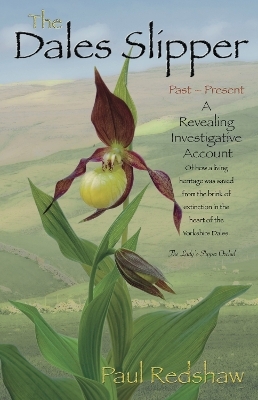
The Dales Slipper
Naturally Red Publications (Verlag)
978-1-0685422-0-6 (ISBN)
- Titel nicht im Sortiment
- Artikel merken
The Dales-slipper is an original, enlightening, investigative account of how an orchid, (The
Lady’s-slipper) having thought to have disappeared from the English countryside forever,
was re-found and protected in the heart of the Yorkshire Dales, before pioneering
conservation efforts, fraught with difficulties, saved it from the brink of extinction.
Up, until my research, this remarkable story had been kept secret for over ninety years; by
per chance, I happened to be living in the township of where this secret was kept and by
another coincidence I had a family connection!
The Dales-slipper relates in detail the full-bodied tale, finally revealing where and by whom
the re-discovery of the Lady’s-slipper was made, and exposing at last the names of all the
plant guardians and the feuds that plagued their dealings as they protected the orchid colony
for almost 40 years.
Illustrated with dozens of previously unseen images, it brings together a vast diversity of
evidence, including previously untapped archives and personal testimony from
contemporary witnesses to events. From its re-finding in 1930 to the conservation efforts of
today you will be fascinated by the ‘behind the scenes’ perseverance and endeavours of
naturalists, scientists and specialists to save what is probably the most unique and most
beautiful member of the British flora we fortunately still have.
With an exceptional amount of primary evidence The Dales-slipper is also fully referenced. It
is the first complete account of this fascinating true story – given the breadth of information
it also will probably be the only one!
In its current form it has been edited by three renowned editors - one a senior editor working
for the Royal Horticultural Society, another a highly educated botanist, nature advisor to
King Charles, fellow of the Linnean Society and editor of various journals and publications.
The third being, the Chief Scientific officer for the Botanical Society of Britain and Ireland.
It has two written forewords, again, by two highly esteemed and relevant individuals, one
based in the UK and the other in Estonia.
The book will appeal to many; plant lovers, historians, gardeners, orchidophiles, scientists,
ecologists, conservationists and naturalists.
As a child I had a fortunate upbringing; windowsills at home were often filled with worldly plants that my father grew. I took interest in his work in plant sciences and was taken on nature forays with Leeds Naturalists Union. I’m indebted to many of my fathers technicians, scientists and professors that I readily questioned at his work place; in particular, Albert Henderson, an incredible Lichenologist, who persistently encouraged me to look at life rather differently, usually through a lens. In consequence, by the age of sixteen I had gained an extensive knowledge and understanding of the differences between ‘higher and lower’ plants and the habitats in which they could be found. Though I was interested in most subjects at school, my mind and desires were always elsewhere, much because I remember staring out of the school window to fields and hedgerows. After undertaking conservation work for the British Trust for Conservation Volunteers and a residential course in forestry skills in Lincolnshire I enrolled on a parks apprenticeship, with Leeds City Council. Passing all exams easily and with much enthusiasm, I became supervisor of plants at Tropical World, Roundhay Park, Leeds, before being offered a horticultural teaching role. Eager to learn more, in 1990 I enrolled at the Royal Botanical Gardens Edinburgh on a three year botanical horticulture diploma course, then recommenced teaching in local colleges. At the age of 33 I decided to retrain as a landscape architect, whereafter I took up various positions with corporate organisations, firstly as an architect, then as an environmental consultant. My depth of knowledge, particularly with plants was greatly appreciated, and it became regular that ecologists would approach me for advice. Despite my extensive knowledge of plants and expertise on botany and ecological matters, probably my greatest achievement at that time was designing many wind farms, particular Burbo-Bank offshore wind farm in Liverpool Bay. Expanding my education further I subsequently became a qualified teacher. Outside of work, my passion is with nature. In my adolescence I learned to love nature by climbing trees, sitting high on a bough, watching, listening, feeling and absorbing. It is, however, on the ground, amongst the herb layer, where I have specific interest. Orchids have always fascinated me, so it is during orchid season I’m always out finding new records or checking in on old ones I know of. In 2019, a month prior to my research for this book, I discovered the first known variegated Bee orchid (Ophrys apifera ‘Variegata’). More recently I discovered a new habitat with six species of orchid - far greater than some SSSI’s – Seeking new habitats is therefore a big thing for me. As a naturalist there are no bounds to enjoying the diversity on our planet; but as an environmentalist I am concerned about the continuous pressures of biodiversity being lost and its long lasting impacts on our health and well being. Many see fields being built on and trees, woods, hedgerows being removed at great pace, for homes. What, often, isn’t noticed, is the cumulative and longer term impacts those losses have, not just locally but across the country. As habitats diminish, the joy of seeing hardy orchids growing in unexpected places is certainly getting to be a more difficult pastime. When the British orchid season tails off, landscape photography is my other chosen serious hobby; the best days are when I can combine both.
CHAPTERHEADINGPAGE
FIGURES & TABLES IX
FOREWORDSXIII
CHAPTER 1INTRODUCTION1
CHAPTER 2THE REMARKABLE LADY’S-SLIPPER 5
Botany7
Biogeography 11
Habitat12
Bedrock & Soils15
Predation & Ailments 18
CHAPTER 3THE SLIPPER OF PAST29
The Queens Reign30
Records Before 193035
Records After 1930 43
Records In Other Settings45
CHAPTER 4MY DISCOVERIES53
A Chance Meeting55
Barbara Smith 57
CHAPTER 5THE RE-FINDING & SUBSEQUENT AFFAIRS63
Barbara Smiths’ Recollection 63
The Ensuing Years 65
The Guardians 67
A Mystery Author69
Protectorship74
CHAPTER 6CHALLENGES & CONCERNS91
The Enigmatic Jack Smith 102
1958: Cutting a Flower 109
Flowering Records116
The Worry of Eric Hardy 117
Rosse Butterfield120
CHAPTER 7SAFEGUARDING129
Cypripedium Committee 131
Government Protection 136
CHAPTER 8CONSERVATION139
Grove House: Trials & Experiments139
Conservation Science149
Conservation In Cultivation160
CHAPTER 9SITE CONSERVATION169
The Wharfedale Site169
Reintroduction Sites174
A Swiss Conservation Initiative184
CHAPTER 10TOWARDS AN IDENTITY CRISIS185
The Hornby & Mistress Tunstall190
Breeding and Variability 196
A Predicament at Gait Barrows NNR198
CHAPTER 11GLEANINGS201
Future Visions 218
CHAPTER 12SUMMARY219
THE PROTAGONISTS225
ADDITIONAL HISTORY231
WORKS CITED 235
THE AUTHOR247
INDEX253
YOUR NOTES267
| Erscheinungsdatum | 28.01.2025 |
|---|---|
| Sprache | englisch |
| Maße | 138 x 216 mm |
| Themenwelt | Sachbuch/Ratgeber ► Natur / Technik ► Garten |
| Naturwissenschaften ► Biologie ► Botanik | |
| Naturwissenschaften ► Biologie ► Ökologie / Naturschutz | |
| ISBN-10 | 1-0685422-0-9 / 1068542209 |
| ISBN-13 | 978-1-0685422-0-6 / 9781068542206 |
| Zustand | Neuware |
| Informationen gemäß Produktsicherheitsverordnung (GPSR) | |
| Haben Sie eine Frage zum Produkt? |
aus dem Bereich