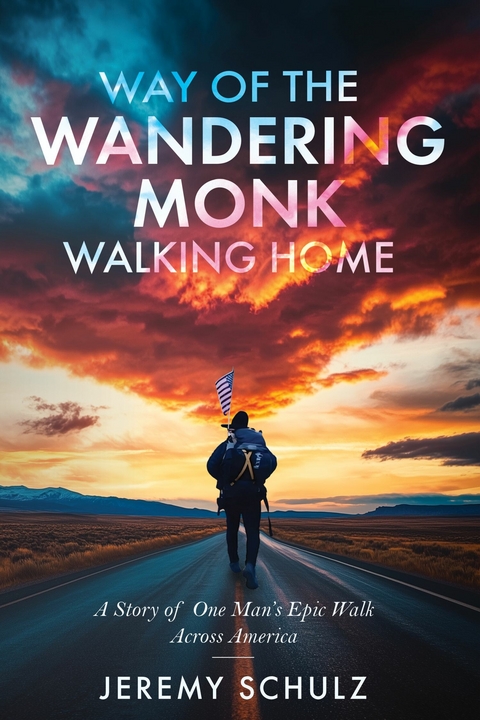
Way Of The Wandering Monk (eBook)
240 Seiten
Bookbaby (Verlag)
9798350983562 (ISBN)
Jeremy Schulz is a professional drummer with over 25 years of experience and a highly sought-after drum teacher for the past 20 years. After years of touring the world, performing, and sharing his love for music, Jeremy made a life-changing decision to walk away from it all in search of deeper meaning and purpose. On April 22, 2019, he stepped off the Brooklyn Bridge in New York City and embarked on a 3,100-mile walk across America, from NYC to the Sundial Bridge in Redding, California-his hometown. This transformative journey forever changed his life. Following his epic walk across America, Jeremy built Beats From The Core Drum School from the ground up, creating a thriving community-based music school with a mission to impact lives and uplift communities through the power of music. Alongside his work as a drummer, Jeremy also transformed his body through bodybuilding at the age of 51. He now channels his passion for fitness and personal growth into coaching, offering online fitness and elite mindset coaching, where he helps adults become the best version of themselves, both physically and mentally. Jeremy's debut book, Way of the Wandering Monk: Walking Home, is a profound tale of loss, discovery, and renewal, chronicling his journey of self-discovery on foot across America. Through the raw isolation of the wilderness and the kindness of strangers, Jeremy-known as The Wandering Monk-finds a deeper sense of purpose, ultimately discovering what it truly means to feel alive. Jeremy's work-whether through drumming, fitness coaching, or writing-aims to inspire others to find their own paths toward transformation and purpose, leading with passion, resilience, and the unwavering belief in the power of self-discovery.
LEARNING TO WALK
On the second day of my walk, I found my mind beginning to wander beyond the steps I was taking. The scenery wasn’t particularly exciting, and the roadside was wet and grimy from the cold morning dew, creating the perfect backdrop for my thoughts to drift.
As I passed through the outskirts of New Jersey’s neighborhoods, it still hadn’t fully sunk in that I’d be walking for the next six months. The reality of the journey felt distant, as if my mind hadn’t quite caught up with the magnitude of what I was undertaking.
I compared the rhythm of my footsteps to the monotonous motion of windshield wipers, working in sync with a car cruising down a rainy highway. Just like driving on autopilot, today’s walk started to feel effortless in a way, though each step was marked by the growing pain of blisters forming on my feet.
Against the advice of others, this walk wasn’t pre-mapped. Every morning, I would decide the day’s route and often find myself rerouting mid-journey. It was a process guided by intuition, something I didn’t fully grasp the significance of in those early days.
My first destination was Niagara Falls, NY, even though it was nearly 450 miles out of my way, in the opposite direction of where I ultimately needed to go. Heading north instead of due west might have seemed impractical, but I didn’t want to leave New York without seeing Niagara Falls. It also served as a test. If I could handle this first leg of the journey, then maybe—just maybe—I could tackle the next 500 miles, and the 500 after that.
Cody and I had heard about the Erie Canalway Trail, a nearly 400-mile path from Buffalo to Albany that would lead us directly to Niagara Falls. The trail was legendary, and we were excited to explore it. The Erie Canal, often referred to as the “internet of its time,” had played a vital role in building much of New York City.
With the Erie Canalway now set as our destination, we knew we needed to head slightly northwest from where we were. With my backpack strapped on and my headphones in, we began walking along the windy, hilly backroads.
The weight of my 50-pound backpack was more of a challenge than I had expected. In the four months of preparation leading up to this walk, I had practiced walking 20-plus miles a day—but without the burden of the pack. Now, only on day two, I could feel blisters forming on my feet and a dull, persistent ache creeping into my knees. Yet, this was when the meditative state of walking began to set in, much like a runner’s high. After an hour or two, my mind started to wander, and the discomfort faded into the background.
After about five hours of walking, we found a spot off the road to take a break and have some lunch. Cody and I sat under the shade of a tree, grateful for the chance to rest and refuel. I eagerly unpacked the food and water, ready for my first real meal on the road.
Cody, being the modern-day Viking that he is, had brought along his “Viking breakfast,” which consisted of various types of herring, kipper snacks, mustard sardines, and crackers. Little did I know that this strange meal would become a staple throughout my journey across the country.
After an hour of resting, we packed up and got back on the road. We had another four hours of walking ahead before we reached our planned destination. I had seen a spot on Google Maps that looked like an abandoned lot near a river, which I thought would make a perfect place for stealth camping that night.
As we walked, I noticed the temperature starting to drop, and dark rain clouds gathered in the distance. It seemed like rain was imminent. I quickened my pace, wanting to reach the campsite and set up before the rain hit. It looked like this might be the first night I would experience sleeping outside in the rain.
Finally, we arrived. Just as I had seen on Google Earth, the lot was tucked away from the road, making it an ideal spot to camp for the night without being noticed. As I started to set up camp, it hit me—I didn’t have a tent! What I did have was a tarp, which I had packed based on advice from a handful of rogue outdoor camping warriors (including Cody) who boasted about the benefits of using a tarp instead of a tent to save weight. It seemed like a practical, lightweight solution at the time.
Fast forward three and a half hours, and the rain was pouring down in buckets. That’s when I learned firsthand how bad of an idea it was to rely on “just a tarp” instead of carrying a proper tent.
My makeshift, MacGyver-style shelter turned out to be a complete disaster. I had tried to rig the tarp into a teepee shape using hemp twine, looping it through the eyelets and tying it to a branch under a tree. In theory, the design would allow rainwater to run off the tarp instead of pooling on it, keeping me dry and cozy underneath. At least, that was the plan.
I couldn’t have been more wrong. Wrapped in my sleeping bag, I quickly realized the ground beneath me was pooling with water, and the rain was dripping from the "secured" tarp above. Water was seeping into my bag, soaking me through to the bone. Exhausted and miserable, I cocooned myself in the damp sleeping bag, hoping for the best and praying for a few hours of sleep. Meanwhile, Cody was already fast asleep, completely oblivious to my unfolding predicament.
When morning finally arrived, I woke up cold and wet. Though the rain had subsided to a drizzle, I was still drenched. I dragged myself out of my soggy sleeping bag and began breaking down camp, shivering from the cold. The only solace I could look forward to was the hot coffee that awaited me once everything was packed up. Drenched and exhausted, even most of my belongings hadn’t escaped the soaking.
As I sipped my first cup of coffee, I turned to Cody and said, "Dude, this tarp sucks as a shelter. I’m getting a tent ASAP!" To my surprise, I noticed he was completely dry. We shared a great laugh, and with a knowing smile, Cody—ever the stoic adventurer—remained perfectly composed, dry as a bone.
The nearest town was about a three-and-a-half-hour walk from where we were, offering the promise of a much-needed break. We could stop for coffee and pastries, charge our devices, and, most importantly, find a tent.
By day three, I was experiencing my first encounter with walking while completely soaked. My feet, pants, shirt, and jacket were all wet or damp. My bones felt stiff from the cold, and my entire body seemed hypersensitive with each step I took that morning.
The thought of the warm, welcoming atmosphere of a coffee shop filled me with anticipation, and I quickened my pace, eager to get there. As I pushed forward, I glanced at Cody, who was lost in the steady rhythm of his stride, seemingly unfazed by the distance I was putting between us. The gap between us didn’t bother me; it felt like a mutual understanding, allowing us both the freedom to walk at our own pace without concern.
We were far enough from the town that there were no sidewalks, just a narrow, muddy road lined with a faded white stripe that blended into broken patches of asphalt. To make matters worse, puddles of water had formed along the road, and every passing car sent a spray of dirty road water all over me. I couldn’t help but think, How many more cars are going to pass by and soak me today? I trudged forward, feeling more miserable with each passing vehicle.
Eventually, my mind settled into the familiar rhythm of walking, and the discomfort began to fade. The sounds around me grew faint, replaced by the steady sound of my own breath. It was keeping me grounded, almost meditative. I had been in this state before—this place where my body was in intense motion, but my mind was calm, detached from my physical discomfort. It reminded me of where I would go whenever I sat behind my drums to practice or play. That rhythm, that focused calm, had become my refuge.
As a child, I often found solace behind my drums, imagining the toms and cymbals as classmates, engaging in conversations. In the beginning, I didn’t just play drums for the sake of music; I used them as a way to communicate, personifying each drum as a different peer. Each strike was a conversation I longed to have but couldn’t, hindered by my stuttering and Tourette’s.
For me, typical forms of communication—simple conversations—were painfully difficult. But behind the drums, I could escape into another world, a place where words weren’t necessary. This became an intentional practice, something I studied and honed as I grew older. My ability to dissociate from my physical body was something I had practiced daily for over 40 years. Until now, I had only ever connected this dissociation with my drumming.
Yet somewhere on the third day of my walk, I tapped into a deeper instinct, something buried in my DNA. It felt like a splintered fragment of the person who once existed—Jeremy—left behind, a ghost from the past.
CRASH!!! In an instant, I snapped back to full awareness as a car hydroplaned on the standing water and violently slammed into the guardrail just five feet in front of me.
Adrenaline surged through my veins, and by pure instinct, I jumped off the side of the road. The car kept moving, disappearing into the wet morning fog without stopping. My knees trembled as I collected myself and continued walking. That had been a close call, and I was grateful I had been walking facing oncoming traffic. I made a mental note to always do so for the rest of the journey.
I found a safe spot on the side of the road and sat down for a break. I texted Cody, estimating we were about 20 to...
| Erscheint lt. Verlag | 18.11.2024 |
|---|---|
| Sprache | englisch |
| Themenwelt | Sachbuch/Ratgeber ► Gesundheit / Leben / Psychologie ► Lebenshilfe / Lebensführung |
| ISBN-13 | 9798350983562 / 9798350983562 |
| Informationen gemäß Produktsicherheitsverordnung (GPSR) | |
| Haben Sie eine Frage zum Produkt? |
 EPUB (Ohne DRM)
Größe: 835 KB
Digital Rights Management: ohne DRM
Dieses eBook enthält kein DRM oder Kopierschutz. Eine Weitergabe an Dritte ist jedoch rechtlich nicht zulässig, weil Sie beim Kauf nur die Rechte an der persönlichen Nutzung erwerben.
Dateiformat: EPUB (Electronic Publication)
EPUB ist ein offener Standard für eBooks und eignet sich besonders zur Darstellung von Belletristik und Sachbüchern. Der Fließtext wird dynamisch an die Display- und Schriftgröße angepasst. Auch für mobile Lesegeräte ist EPUB daher gut geeignet.
Systemvoraussetzungen:
PC/Mac: Mit einem PC oder Mac können Sie dieses eBook lesen. Sie benötigen dafür die kostenlose Software Adobe Digital Editions.
eReader: Dieses eBook kann mit (fast) allen eBook-Readern gelesen werden. Mit dem amazon-Kindle ist es aber nicht kompatibel.
Smartphone/Tablet: Egal ob Apple oder Android, dieses eBook können Sie lesen. Sie benötigen dafür eine kostenlose App.
Geräteliste und zusätzliche Hinweise
Buying eBooks from abroad
For tax law reasons we can sell eBooks just within Germany and Switzerland. Regrettably we cannot fulfill eBook-orders from other countries.
aus dem Bereich