


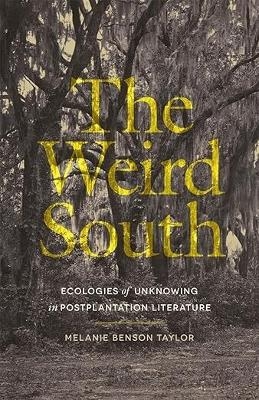
The Weird South
Ecologies of Unknowing in Postplantation Literature
Seiten
2025
University of Georgia Press (Verlag)
978-0-8203-7384-3 (ISBN)
University of Georgia Press (Verlag)
978-0-8203-7384-3 (ISBN)
How do we read southern literature in a postplantation, postregional, and posthuman moment? How do we address the urgent contemporary catastrophes of the Anthropocene in these newly leveled landscapes? Put simply, how do we parse the levels of human responsibility––both for apocalypse and for deliverance––in contexts where settler-colonial and racial capitalist histories dramatically shape our reality?
Reading modern and contemporary southern literary texts from a variety of perspectives, these lectures engage the new materialist, object-oriented ontologies that critique and decenter human agency while uncovering the lasting, determinative, haunting realities of humanity’s detention within what Timothy Morton calls the “weird” web of our entwined social, racial, economic, and natural ecologies.
As a concept in the burgeoning conversation about Anthropocenic disaster and climate emergency, the “weird” is a powerful way to conceptualize not just human hubris but also humility: we are no different from, no more powerful than, any other living or inanimate objects—neither the organisms that take up residence in our bodies nor the myriad things that we imagine we create, fashion, patrol, and control.
Reading modern and contemporary southern literary texts from a variety of perspectives, these lectures engage the new materialist, object-oriented ontologies that critique and decenter human agency while uncovering the lasting, determinative, haunting realities of humanity’s detention within what Timothy Morton calls the “weird” web of our entwined social, racial, economic, and natural ecologies.
As a concept in the burgeoning conversation about Anthropocenic disaster and climate emergency, the “weird” is a powerful way to conceptualize not just human hubris but also humility: we are no different from, no more powerful than, any other living or inanimate objects—neither the organisms that take up residence in our bodies nor the myriad things that we imagine we create, fashion, patrol, and control.
MELANIE BENSON TAYLOR is Professor of English & Creative Writing and of Native American & Indigenous Studies at Dartmouth College. She is the editor of The Cambridge History of Native American Literature and The Norton Critical Edition of Faulkner’s Light in August, and the author of The Indian in American Southern Literature; Reconstructing the Native South: American Indian Literature and the Lost Cause; and Disturbing Calculations: The Economics of Identity in Postcolonial Southern Literature, 1912-2002 (both Georgia).
| Erscheinungsdatum | 07.05.2025 |
|---|---|
| Reihe/Serie | Mercer University Lamar Memorial Lectures |
| Vorwort | Doug Thompson |
| Verlagsort | Georgia |
| Sprache | englisch |
| Maße | 140 x 216 mm |
| Themenwelt | Sachbuch/Ratgeber ► Natur / Technik ► Natur / Ökologie |
| Geisteswissenschaften ► Geschichte ► Regional- / Ländergeschichte | |
| Geisteswissenschaften ► Sprach- / Literaturwissenschaft ► Anglistik / Amerikanistik | |
| Geisteswissenschaften ► Sprach- / Literaturwissenschaft ► Literaturwissenschaft | |
| ISBN-10 | 0-8203-7384-2 / 0820373842 |
| ISBN-13 | 978-0-8203-7384-3 / 9780820373843 |
| Zustand | Neuware |
| Informationen gemäß Produktsicherheitsverordnung (GPSR) | |
| Haben Sie eine Frage zum Produkt? |
Mehr entdecken
aus dem Bereich



aus dem Bereich
die Geschichte einer außergewöhnlichen Begegnung
Buch | Hardcover (2025)
Klett-Cotta (Verlag)
CHF 34,90
eine Geschichte der letzten 500 Jahre
Buch | Hardcover (2025)
C.H.Beck (Verlag)
CHF 47,60
die Corona-Protokolle des Robert-Koch-Instituts
Buch | Softcover (2025)
massel Verlag
CHF 31,95


