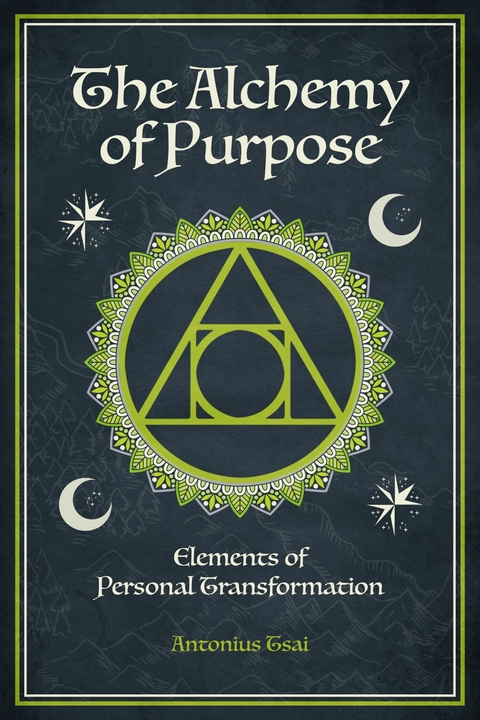
Alchemy of Purpose (eBook)
272 Seiten
Bookbaby (Verlag)
979-8-3509-7853-7 (ISBN)
Antonius (Tony) Tsai is both a teacher and a lifelong student of wisdom. He is dedicated to advancing wisdom, knowledge, and human consciousness through teaching, coaching, and writing. With experience working with thousands of learners, he promotes self-mastery and self-realization. In his leadership roles, Tony has driven transformative changes in higher education, fostering a balance between meaning and purpose and knowledge and skills. Tony holds a degree in business from the Wharton School of Business and an MBA from Columbia Business School. After college, he served as an officer in the U.S. Army with the 3rd Infantry Division. He continues to work in higher education, transforming programs and culture to enhance leadership, growth, and empowerment.
This book delves deep into the quest for discovering your life's purpose, offering a perspective that transcends conventional ideas like simply "e;finding your passion."e; It emphasizes that you are an integral part of a larger, interconnected system-Life itself. Your existence is not random but a vital element in the grand process of Life's continual unfolding. Your journey is one of constant change, growth, and becoming, and this ongoing evolution is at the core of your life's purpose. The book draws upon the ancient concept of alchemy as a powerful metaphor for personal transformation, illustrating how you can transmute your experiences and challenges into profound growth and understanding. By engaging with this book, you will gain deeper insight and clarity about your life's purpose and your intrinsic connection to the larger flow of Life. This journey of self-discovery will guide you toward a more meaningful and aligned existence.
Chapter 1: Beyond Self
… the biggest lever for change is not a change in self-belief but a fundamental change in the way one sees and regards one’s connections with and obligations to others.
~ The Arbinger Institute, The Outward Mindset: Seeing Beyond Ourselves
Let’s begin with a short exercise. In this exercise, which will only take 60 seconds, please take a piece of paper and fold it into three columns so that you have two creases that divide the pager into three columns. Now list your current purposes in the middle column.
You may feel that you don’t know your purpose yet, so we will rephrase the prompt to list the things that your current life is oriented toward. Your purpose and what your life is oriented toward are synonymous. For example, one of the things my life is oriented toward is being a good father to three sons. Another thing my life is oriented toward is traveling the world and enjoying the experience of being in different cultures.
Take a minute to list out your purposes…
Once you have finished listing your purposes, you should have a list of them in the middle column. At the top of the left column, write “For me,” and at the top of the right column, write “For others.” Draw an arrow from each item in the middle column to either the left or right column.
If an item may be categorized as both for you and others, it’s most likely for you, and you are rationalizing how it’s also for others. We’re good at doing that. If you wrote something like “to find a job,” that’s for you, even though you may think it’s for both. It’s mostly about the sentiment that you need a job, or you want a better job. If you wrote something like “to use my career to advance the lives of young adults,” then that’s for others.
This exercise is meant to show that you have some purposes that serve you and some that serve others. Here we come to the first insight into purpose: living things have dual purposes.
The double role of living systems as parts and wholes requires the interplay of two opposite tendencies: an integrative tendency to function as part of a larger whole, and a self-assertive, or self-organizing tendency to preserve individual autonomy.
~ Fritjof Capra, The Systems View of Life: A Unifying Vision
Dual Purpose of Living Things
It can be difficult to think about your purpose, so I will use an example from another living thing: the red blood cell. What is the purpose of red blood cells? The cell delivers oxygen to other cells.
If the red blood cell was doing the purpose exercise that you just did, it would consider delivering oxygen something it does for others since the oxygen isn’t for itself and other cells depend on it. What the cell would do for itself would be to consume energy and to keep itself alive. So, the red blood cell, as a part of a living system, also has an inner (for itself) and an outer (for others) purpose.
Of the two purposes, which one is primary, or are they equal? To understand the answer, consider the two statements below:
- The red blood cell exists to deliver oxygen.
- The red blood cell delivers oxygen to exist.
Of the two statements, only Statement A makes sense. The cell exists (inner purpose for self) to deliver oxygen (outer purpose for others). Therefore, delivering oxygen is the primary purpose, and while the cell must exist and be functional to deliver the oxygen, the inner purpose of consuming energy and keeping itself alive is to enable the outer purpose.
The same dynamic of inner and outer purpose applies in the human context. Let’s use an example of you interviewing for a job and the interviewer asking why you wanted the job. You could say to further the mission of the organization (outer purpose for others) or to make money to buy a nice house (inner purpose for self). Of course, you would not say the latter during the interview because the former is the primary purpose, and the latter is implied.
Although purpose can serve both self and others, the primary purpose is outwardly focused on serving others.
The interviewing example brings up the phenomenon of nested systems in living things. The cell is a living system, the human being is a living system, and even the organization in which you work is a living system. In the case of the organization, the subsystems are human beings, and the organization needs the people to carry out outer functions so that the organization itself can run efficiently (inner purpose) and carry out its mission (outer purpose). Beyond organizations are cities, countries, the Earth, the galaxy, and beyond. All are systems nested in one another. This larger system in its totality (which includes you) is Life.
Over the years, I have seen many people declare that their life mission was a self-serving purpose such as to become rich, gain fame, attain a high rank, or find happiness. This last one, to find happiness, sounds like a worthy purpose, but happiness is mainly a byproduct and not a cause. If you try to find happiness through becoming rich, gaining fame, or other self-serving strategies, then happiness will be temporary and elusive. However, if you pursue happiness as a byproduct of serving others, then that happiness is enduring.
Individualism and Hyper-Focus on Self
Once on a visit to Seattle, I met a former student who was a medical resident at the University of Washington. I asked him what he was thinking and what was on the minds of the other residents in his program. He said that people were thinking about becoming leaders. This isn’t an uncommon sentiment these days, especially among those who have an orientation toward achievement and success. I asked him, “Sure it’s understandable that they want to be leaders, but what does it benefit others to follow?”
In his inaugural address, John F. Kennedy said this iconic line: Ask not what your country could do for you. Ask what you could do for your country. When I hear people talk about their desire for leadership, I often hear behind their words a sentiment of what being a leader would do for them and their self-image. I don’t hear quite as much about how being a leader would allow them to serve others.
Purpose is primarily about what you will do for something beyond yourself and not primarily about how you can get more for yourself.
In contemporary times, there is a hyper-focus on the self. When in a deeper relationship with someone, there is less focus now on one’s duty to the partner and the relationship and more on whether the partner fulfills you or not. If your partner is not fulfilling your needs, then you should find someone else who will. This is also true with careers. It’s all about self-declared passion, fulfillment, and wellness. Does the job fulfill you? If not, then just quit. Purpose has gone from something that is about serving beyond oneself to serving oneself.
No man is an island, entire of itself; every man is a piece of the continent, a part of the main… any man's death diminishes me, because I am involved in mankind, and therefore never send to know for whom the bells tolls; it tolls for thee.
~ John Donne
In contemporary times, we have lost connection with that which is beyond ourselves. We are an individual lost in a sea of other individuals. We want happiness for ourselves, but we don’t realize that we get happiness when we serve others. In Section 1, I have chosen to discuss the topic of purpose from beyond one’s perspective.
I will be using the term Life with the capital “L.” Whereas life with a small “l” means your life, Life refers to the system of all living things. You are a part of Life, and Life has its own purpose of which you are only a small but indispensable part. Your purpose cannot be focused on serving your own life, but on serving Life.
Seeking Happiness, Meaning, and Love
None of us will live forever. At the end of our life, we can reflect and wonder whether this was well-lived. If we have only done things to advance ourselves, we will not be satisfied with our review. However, if we have lived according to higher principles and have served others—affirming our connection to that which is beyond us—we will likely be satisfied with the way that we lived this life.
When you have a career, your career exists in part for your survival. You need to pay the bills and put food on the table. At the same time, your career exists to bring meaning to your life. When you do your job well and that work serves others, it creates meaning. Where does this meaning come from? It comes from your connection to something greater. In serving others, we connect to Life as a whole. Life is enduring whereas one person’s lifetime is fleeting. The primary purpose of your life is to serve the larger system of Life that you are a part of.
What you seek through your purpose are three things: meaning from the connection to something greater, happiness from your service to Life, and love from being cared for unconditionally. Of the three, what you seek most is love. This is not human love...
| Erscheint lt. Verlag | 28.10.2024 |
|---|---|
| Sprache | englisch |
| Themenwelt | Sachbuch/Ratgeber ► Gesundheit / Leben / Psychologie ► Lebenshilfe / Lebensführung |
| ISBN-13 | 979-8-3509-7853-7 / 9798350978537 |
| Informationen gemäß Produktsicherheitsverordnung (GPSR) | |
| Haben Sie eine Frage zum Produkt? |
 EPUB (Ohne DRM)
Größe: 15,3 MB
Digital Rights Management: ohne DRM
Dieses eBook enthält kein DRM oder Kopierschutz. Eine Weitergabe an Dritte ist jedoch rechtlich nicht zulässig, weil Sie beim Kauf nur die Rechte an der persönlichen Nutzung erwerben.
Dateiformat: EPUB (Electronic Publication)
EPUB ist ein offener Standard für eBooks und eignet sich besonders zur Darstellung von Belletristik und Sachbüchern. Der Fließtext wird dynamisch an die Display- und Schriftgröße angepasst. Auch für mobile Lesegeräte ist EPUB daher gut geeignet.
Systemvoraussetzungen:
PC/Mac: Mit einem PC oder Mac können Sie dieses eBook lesen. Sie benötigen dafür die kostenlose Software Adobe Digital Editions.
eReader: Dieses eBook kann mit (fast) allen eBook-Readern gelesen werden. Mit dem amazon-Kindle ist es aber nicht kompatibel.
Smartphone/Tablet: Egal ob Apple oder Android, dieses eBook können Sie lesen. Sie benötigen dafür eine kostenlose App.
Geräteliste und zusätzliche Hinweise
Buying eBooks from abroad
For tax law reasons we can sell eBooks just within Germany and Switzerland. Regrettably we cannot fulfill eBook-orders from other countries.
aus dem Bereich