


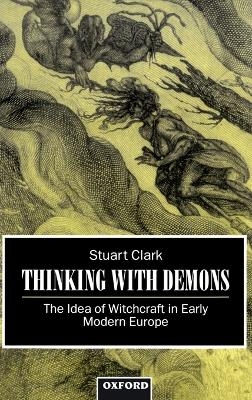
Thinking with Demons
The Idea of Witchcraft in Early Modern Europe
Seiten
1997
Oxford University Press (Verlag)
978-0-19-820001-7 (ISBN)
Oxford University Press (Verlag)
978-0-19-820001-7 (ISBN)
Presents a work of fundamental importance for our understanding of the intellectual and cultural history of early modern Europe. The author offers an interpretation of the witchcraft beliefs of European intellectuals between the fifteenth and eighteenth centuries, based on their publications in the field of demonology.
This is a work of fundamental importance for our understanding of the intellectual and cultural history of early modern Europe. Stuart Clark offers a new interpretation of the witchcraft beliefs of European intellectuals based on their publications in the field of demonology, and shows how these beliefs fitted rationally with many other views current in Europe between the fifteenth and eighteenth centuries.
Professor Clark is the first to explore the appeal of demonology to early modern intellectuals by looking at the books they published on the subject during this period. After examining the linguistic foundations of their writings, the author shows how the writers' ideas about witchcraft (and about magic) complemented their other intellectual commitments--in particular, their conceptions of nature, history, religion, and politics. The result is much more than a history of demonology. It is a survey of wider intellectual and ideological purposes, and underlines just how far the nature of rationality is dependent on its historical context.
This is a work of fundamental importance for our understanding of the intellectual and cultural history of early modern Europe. Stuart Clark offers a new interpretation of the witchcraft beliefs of European intellectuals based on their publications in the field of demonology, and shows how these beliefs fitted rationally with many other views current in Europe between the fifteenth and eighteenth centuries.
Professor Clark is the first to explore the appeal of demonology to early modern intellectuals by looking at the books they published on the subject during this period. After examining the linguistic foundations of their writings, the author shows how the writers' ideas about witchcraft (and about magic) complemented their other intellectual commitments--in particular, their conceptions of nature, history, religion, and politics. The result is much more than a history of demonology. It is a survey of wider intellectual and ideological purposes, and underlines just how far the nature of rationality is dependent on its historical context.
| Erscheint lt. Verlag | 1.3.1997 |
|---|---|
| Zusatzinfo | 2 halftones |
| Verlagsort | Oxford |
| Sprache | englisch |
| Maße | 162 x 243 mm |
| Gewicht | 1318 g |
| Themenwelt | Sachbuch/Ratgeber ► Gesundheit / Leben / Psychologie ► Esoterik / Spiritualität |
| Geschichte ► Allgemeine Geschichte ► Mittelalter | |
| Geschichte ► Allgemeine Geschichte ► Neuzeit (bis 1918) | |
| Geisteswissenschaften ► Geschichte ► Regional- / Ländergeschichte | |
| Geschichte ► Teilgebiete der Geschichte ► Kulturgeschichte | |
| Geisteswissenschaften ► Religion / Theologie ► Weitere Religionen | |
| ISBN-10 | 0-19-820001-3 / 0198200013 |
| ISBN-13 | 978-0-19-820001-7 / 9780198200017 |
| Zustand | Neuware |
| Informationen gemäß Produktsicherheitsverordnung (GPSR) | |
| Haben Sie eine Frage zum Produkt? |
Mehr entdecken
aus dem Bereich

aus dem Bereich
Geschichte einer Augsburger Familie (1367-1650)
Buch | Softcover (2024)
Kohlhammer (Verlag)
CHF 47,60


