


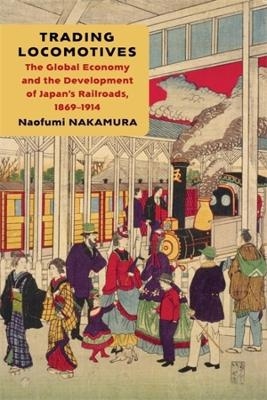
Trading Locomotives
The Global Economy and the Development of Japan’s Railroads, 1869–1914
Seiten
2025
Columbia University Press (Verlag)
978-0-231-21846-7 (ISBN)
Columbia University Press (Verlag)
978-0-231-21846-7 (ISBN)
The proliferation of railroads around the world was integral to the emergence of a global market-based economy at the turn of the twentieth century. This deeply researched and comprehensive book examines the history of rail in Japan from a global perspective, offering new insight into the connections between the world economy and Japan’s industrialization. Naofumi Nakamura traces the international locomotive trade and the growth of the Japanese railway industry, considering its ties to Japan’s domestic economic development and later imperial expansion. He investigates locomotive manufacturing and distribution in the late nineteenth and early twentieth centuries, focusing on how this industry came to Japan and then became a major domestic sector.
Nakamura argues that rail, introduced as an essential tool for nation-state building, was transformed into a tool for empire after the late 1890s. Japan sought to develop its domestic economy in response to globalization, yet had to balance the desire to localize industry with its imperial ventures. This necessitated imports from Western manufacturers until just before the First World War, by which time a domestic rail industry formed through government-led technology transfer and development found new outlets in Japan’s colonies and sphere of influence. Drawing on an extensive array of archival materials, Trading Locomotives sheds new light on the transnational nature of the industrial revolution in Japan and the world.
Nakamura argues that rail, introduced as an essential tool for nation-state building, was transformed into a tool for empire after the late 1890s. Japan sought to develop its domestic economy in response to globalization, yet had to balance the desire to localize industry with its imperial ventures. This necessitated imports from Western manufacturers until just before the First World War, by which time a domestic rail industry formed through government-led technology transfer and development found new outlets in Japan’s colonies and sphere of influence. Drawing on an extensive array of archival materials, Trading Locomotives sheds new light on the transnational nature of the industrial revolution in Japan and the world.
Naofumi Nakamura is a professor at the Institute of Social Science at the University of Tokyo. He has written widely on the business and economic history of modern Japan, including railroad history, local history, and the history of technological transfer.
Introduction
1. International Competition in the Global Locomotive Market
2. Technological Transfer and British Monopolization
3. Japan’s Industrial Revolution and American Locomotives
4. The Rise of Japanese Trading Companies
5. War, Empire Building, and the Locomotive Trade
6. Localizing Locomotive Production in Japan
Conclusion
Notes
Bibliography
Index
| Erscheinungsdatum | 09.05.2025 |
|---|---|
| Zusatzinfo | 7 graphs, 3 maps, 25 photographs, 11 tables |
| Verlagsort | New York |
| Sprache | englisch |
| Maße | 152 x 229 mm |
| Themenwelt | Natur / Technik ► Fahrzeuge / Flugzeuge / Schiffe ► Schienenfahrzeuge |
| Geisteswissenschaften ► Geschichte ► Regional- / Ländergeschichte | |
| Geschichte ► Teilgebiete der Geschichte ► Technikgeschichte | |
| ISBN-10 | 0-231-21846-X / 023121846X |
| ISBN-13 | 978-0-231-21846-7 / 9780231218467 |
| Zustand | Neuware |
| Informationen gemäß Produktsicherheitsverordnung (GPSR) | |
| Haben Sie eine Frage zum Produkt? |
Mehr entdecken
aus dem Bereich



aus dem Bereich
The Definitive Guide
Buch | Softcover (2024)
hidden europe publications (Verlag)
CHF 36,65
Vielfalt verbindet Baden-Württemberg
Buch | Softcover (2025)
VUD Medien (Verlag)
CHF 18,90
Zug für Zug um die Ostsee
Buch | Softcover (2025)
Lehmanns Media (Verlag)
CHF 29,90


