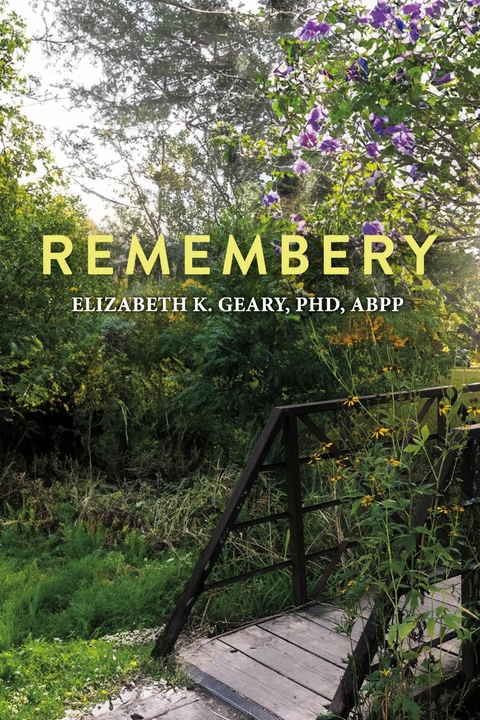
Remembery (eBook)
268 Seiten
Bookbaby (Verlag)
979-8-3509-5697-9 (ISBN)
Elizabeth K Geary, PhD, ABPP is a board-certified clinical neuropsychologist working in the Chicagoland area. Her clinical work focuses on neuropsychological evaluations of patients with a variety of neurologic disorders, including patients with various forms and stages of dementia and their families.
"e;Remembery"e; is part self-help and part memoir. As a clinical neuropsychologist working with patients with various forms of dementia and their families, Elizabeth Geary started "e;Remembery"e; to educate patients and their loved ones about the process of cognitive aging. This book explains the procedures involved in a neuropsychological evaluation to help others understand how the process contributes to the diagnosis and treatment of age-related brain diseases. "e;Remembery"e; aims to serve as a guidebook to help one navigate through some of the issues which may face patients with dementia and their loved ones. Through humor, information gleaned from the author's clinical experience, and science, readers will understand that dementia is not a shameful condition to be whispered about, but a diagnosis that needs to be accepted for the health crisis dementia is becoming. By sharing her own story, Elizabeth hopes that people can understand how even the experts might not have all the answers. Despite all that she know about dementia, she was not prepared for how her mother's dementia would interact with age-old family dynamics. She hopes to humanize the experience by sharing her own emotional journey. Ultimately, "e;Remembery"e; shares the message that accepting that the process of living and managing dementia is far from perfect. Knowing that we do the best we can is what makes "e;living with dementia with dignity"e; attainable.
Introduction
My mother forgot my son’s birthday for the first time when he was three years old. He was her first grandchild, and my mother had wanted nothing but grandchildren, ever since her children reached an age when it was appropriate for her children to have children. When my son was born, you would have thought angels delivered him into her arms from heaven.
When she first laid eyes on him, everything else in the world fell away.
This was only a touch problematic, because her singular focus allowed her to lose sight of the fact that she had come to town to help me, her daughter, who had delivered this mammoth, 10-pound infant, via C-section.
As soon as my mother laid hands on her grandson, she adored every ounce of him. Over those first two years, she was known to send him things through the mail including crab apples, that arrived slightly rotten, because she knew he liked throwing apples when he had come to visit her. She thought about him all of the time. She doted on him. If anything, she sent him or brought him too much stuff.
When his third birthday came and went without even a phone call, I was mad and sad. How could she! And then, seriously…how could she????
As a neuropsychologist, I have been on the other side of the desk countless times delivering the news that, indeed, the patient’s changes in their thinking or memory abilities are greater than what we would attribute to age alone. In delivering the diagnosis and likely etiology of these cognitive changes, I attempt to focus with families on the elements of the prognosis that are most amenable to intervention. Specifically, discussing the appropriateness for palliative medications, addressing the mountain of “what-if worries,” and helping them make decisions regarding future care.
I started working on this book as means of outreach to the countless patients and families out there who are confronting the dementia diagnosis or living with dementia. It evolved over many years, but in the background, dementia began to enter my life on a more personal level. After years of working with patients, my professional life merged with my personal life in 2013. It started slowly. Initially, I was annoyed by the changes in my mother, as I now know that I was in denial. Even when I provided my family with the objective facts, I was met with resistance. I later risked jeopardizing those family relationships in my desire to break through that resistance.
The day before my 42nd birthday, I had one of those “you are not as young as you think you are” moments. I was looking forward to starting a new position at a hospital, and after my routine pre-employment physical I was informed, “Dr. Geary, the blood work on your immunization titers is in. You are not immune to chicken pox.” Now, if family lore is to be believed, I had a vicious case of chicken pox as a babe and the vestiges of a self-conscious teen can still readily point to various scars on my body. In protest, I even cited my last blood test five years ago showing a rigorous immunity.
I was informed that some can lose immunity with age. I toyed with the idea of requesting a retest as this result had to be an error. Instead, I got a shot intended for a toddler without the courtesy of a sticker or lollipop. I decided to take this unpleasant needling in the saggy part of my left arm in stride noting that my lack of immunity was really reflective of a rebirth or being otherwise renewed! I was regenerating, really. In all truth, I wondered if this merely decreased my odds of contracting shingles because, after all, I was getting older.
As life will surprise us, the same day that I spent musing about the chicken pox re-immunization as reflective of my regeneration and renewal, I received a call from my mother’s neurologist in New Hampshire. I did not expect this call, but I had been anticipating it for years. Years before, I begged my mother to consult with a neurologist regarding episodes of confusion and disorientation in familiar surroundings with visual disturbance. We have a family history of stroke and cardiac disease, so I was concerned that she might be experiencing transient ischemic attacks. For much longer, I had been concerned regarding her diminished planning ability and retrieval-based memory difficulties (e.g., “did I tell you…oh yes, you are right…we talked about that last week!”). However, when approached regarding these memory changes, she appeared adamant that she had no memory difficulties. Never mind that I found books titled Improving Your Memory on her bedside table. She assured me that she just needed to drink more water and get more sleep! Possibly, but why so determined to avoid a doctor? Whatever her motivation, she was not ready to address memory changes or cognitive decline. However, with a “medical” concern like a transient ischemic attack, she seemed willing to go see a doctor. Oddly, she went and then…never went again. She assured me that her brain was “perfect.” She forwarded a copy of the MRI report, which read, “greater than age-appropriate mild diffuse atrophy. Small vessel ischemic changes.” That is not perfect! What doctor told her that?
Looking back, I made my first “let the patient evidencing cognitive changes steward their own health care” mistake. Sure, as a clinical neuropsychologist, I was aware that she was demonstrating decline in areas of her cognitive function, but apparently, as a daughter, I was not ready to accept that she probably needed some assistance managing her health care. At the very least, I should have insisted my stepfather accompany her to the doctor appointments for another set of ears. Sadly, I didn’t. I guess I made an assumption that my stepfather was seeing the same changes that I was. I suppose I forgot that for those living with someone experiencing cognitive changes, the changes are so gradual, that the issues can be chalked up to “minor hiccups” or normal lapses in cognitive efficiency on any given day. I guess I also underestimated the possibility of his own denial.
I now realize that no doctor told her she was “perfect.” She just told me, and likely herself, that she was perfect…needed more rest and water. She also needed to scale back at work as when she became anxious, she could not think straight. Despite my knowledge of cognitive decline and brain disease, I trusted her. I wanted to believe what I was seeing was treatable. I really, really wanted to believe that she was fine.
We have a family history of Alzheimer’s disease. At my wedding, my grandmother’s brother was thrilled to see that I was wearing a necklace that his sister had received on her 16th birthday. He had Alzheimer’s disease and oddly, he easily recalled that necklace even though he was not 100 percent certain who I was. On my mother’s father’s side, everyone died pretty young. However, those who did not, developed Alzheimer’s. Now, if your older family members died at age 50 from heart disease, they were not alive long enough to show signs of dementia. If we happen to carry around Alzheimer’s disease’s genes (and worse, two pairs), we are at an increased risk of developing Alzheimer’s disease. Frankly, most 90-year-olds have Alzheimer’s disease brain changes or particular pathology (i.e., beta amyloid plaques) at autopsy. However, in the clinical syndrome of Alzheimer’s disease, the location of where the pathology starts, how the pathology progresses, and how these changes impact brain function is what defines the disease. In my clinic, we consider early onset before age 72.
Alzheimer’s disease involves a loss of semantic knowledge. As the disease progresses, some patients may even lose a sense of where they are in time. This is critical because in the daily accounts of our personal narrative, we can sort of place when and where events occurred, put them into a frame of reference, and even recall features of the environment we were in when the event occurred. We also have a good sense of the “I should have said” internal discussion versus the “I did say.” Imagine if all of those facets of placing these bits of knowledge into context were no longer connecting? You lose your storyline. Things become jumbled and for the dementia patient, they want to make sense of it. The “I should have said” may even become the “I did say.”
In my mother’s case, some of this rewriting of her narrative could even be wishful thinking. Years after the onset of dementia, when my mother came to our new home in the suburbs of Chicago and we drove past the school where her much-loved grandchildren were now attending school, she told us all how she used to teach at that school. She also told us how she used to live in our current home while she was teaching at that school. She was so elaborate in her tale that my kindergartener returned to school and proudly announced to the school principal that her grandmother had worked there as a student teacher. Unfortunately, even the principal realized that the “facts” my daughter was sharing secondhand did not make sense. My daughter came home upset to tell me, “So, Nana never did work at my school, did she?” I told her that Nana had not, but that Nana loved her grandchildren so much she must have wanted to be part of their daily lives. This is how Nana’s brain made that wish possible.
I used to believe that I truly understood my mother. I did not always accept her line of thinking, but I understood the rationale. I understand that my mother equates dementia with a loss of intelligence. My mother is a...
| Erscheint lt. Verlag | 28.10.2024 |
|---|---|
| Sprache | englisch |
| Themenwelt | Sachbuch/Ratgeber ► Gesundheit / Leben / Psychologie ► Lebenshilfe / Lebensführung |
| ISBN-13 | 979-8-3509-5697-9 / 9798350956979 |
| Informationen gemäß Produktsicherheitsverordnung (GPSR) | |
| Haben Sie eine Frage zum Produkt? |
 EPUB (Ohne DRM)
Größe: 1,1 MB
Digital Rights Management: ohne DRM
Dieses eBook enthält kein DRM oder Kopierschutz. Eine Weitergabe an Dritte ist jedoch rechtlich nicht zulässig, weil Sie beim Kauf nur die Rechte an der persönlichen Nutzung erwerben.
Dateiformat: EPUB (Electronic Publication)
EPUB ist ein offener Standard für eBooks und eignet sich besonders zur Darstellung von Belletristik und Sachbüchern. Der Fließtext wird dynamisch an die Display- und Schriftgröße angepasst. Auch für mobile Lesegeräte ist EPUB daher gut geeignet.
Systemvoraussetzungen:
PC/Mac: Mit einem PC oder Mac können Sie dieses eBook lesen. Sie benötigen dafür die kostenlose Software Adobe Digital Editions.
eReader: Dieses eBook kann mit (fast) allen eBook-Readern gelesen werden. Mit dem amazon-Kindle ist es aber nicht kompatibel.
Smartphone/Tablet: Egal ob Apple oder Android, dieses eBook können Sie lesen. Sie benötigen dafür eine kostenlose App.
Geräteliste und zusätzliche Hinweise
Buying eBooks from abroad
For tax law reasons we can sell eBooks just within Germany and Switzerland. Regrettably we cannot fulfill eBook-orders from other countries.
aus dem Bereich