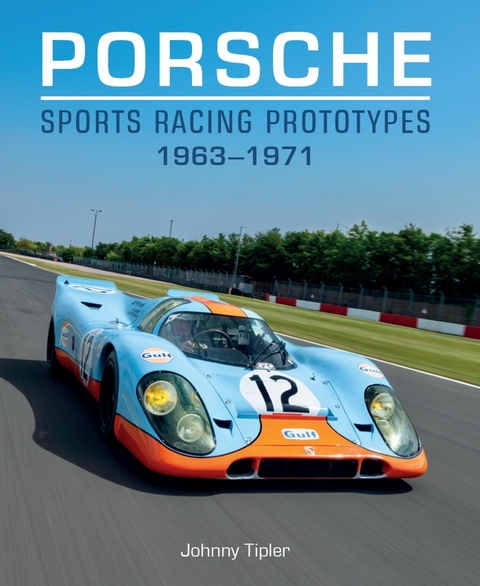
Porsche Sports Racing Prototypes 1963-1971 (eBook)
192 Seiten
The Crowood Press (Verlag)
978-0-7198-4460-7 (ISBN)
Johnny Tipler is a motoring writer and historian, based in north Norfolk. To date, he has written 45 books on a variety of automotive topics, ranging from marque and model histories to Formula 1 racing cars, motorcycles, trucks and heavy equipment, plus driver biographies and legendary race sagas. He writes regularly for a number of specialist car magazines, reviewing products old and new, interviewing famous drivers and industry figures, and reporting on international historic race meetings and long-distance classic rallies.
Between the 1950s and 1971, the halcyon days of long-distance endurance motor racing, Porsche embodied the up-and-coming manufacturer, progressing inexorably from reliable class-winner to outright victor - a platform they consolidated and never rescinded. This book focuses on the six distinct Porsche models that raced from 1963 to 1971. Porsche created a series of racing cars - the 904, 906, 910, 907, 908 and 917 - to run in the FIA-regulated International Sports Car Championship Group 6 Prototype class, the Group 4 World Sportscar Championship, and European Hillclimb Championship events held during that period. These races lasted either 24 hours, 12 hours or 6 hours, or were categorised by distance: 1,000km, 500km or 500 miles. Events took place annually at European tracks including Le Mans, Nurburgring, Monza, Spa-Francorchamps and Brands Hatch, and in the USA at Daytona and Sebring. Chronicling each season, this visually stunning volume records Porsche's multitude of successes. With over 300 outstanding images, many previously unseen, including professional photos and factory archive pictures, and featuring interviews with heroic Porsche racing drivers with the Foreword written by two-times Le Mans winner Gijs van Lennep this book tells the thrilling story of Porsche's rise from consistent class-winner to incontrovertible outright victor.
INTRODUCTION
W hat is so significant about these seemingly random eight years between 1963 and 1971? Almost six decades ago, they represented the era when Porsche methodically worked its way up the endurance racing ladder from class winner to outright victor. We take the company’s success pretty much for granted now, in the showroom as well as on track. The period that the book focuses on reveals the skills, determination, ambition and prowess that consolidated the marque’s already burgeoning reputation.
In many ways, they were the halcyon days of long-distance endurance motor racing, during which Porsche embodied the rise of the up-and-coming manufacturer, progressing inexorably from reliable class-winners throughout the 1950s and 1960s to outright victors – a platform they consolidated and never rescinded. This does not imply that they were in any way also-rans in the lead-up since anyone running a Porsche, whether factory or privateer, was a serious contender at any level of the sport from the word go.
Like Colin Chapman of Lotus Cars, Porsche started off as a car maker in 1948, and the two makes often vied for victory in the sports car classes over the following decade. While Lotus focused mainly on producing and running single-seater racing cars from 1958, Porsche concentrated on sports racing cars, dipping into F1 and F2 with the Types 718/2 and 804 between 1959 and 1962, though majoring on the 718 RSK Spyder, RS61 and Type 695 2000 GS Abarth in sports-GT racing. It is interesting to draw a parallel between the two marques since both manufactured road-going sports and GT cars and, of course, Team Lotus won the F1 World Title four times during this period in which we are exploring Porsche’s rise to the top. Like Enzo Ferrari, Lotus founder Colin Chapman built production cars to subsidise the company’s racing activities, while Porsche raced in order to market its sports car production. It is no disrespect to Lotus to remark that the 75-year-long histories of both companies suggest that Porsche constructed the better business model. Chapman had no time for rules: he comprehended them and found ways to exploit loopholes – the ‘unfair advantage’, as he put it. Porsche, on the other hand, played with a straight bat. So, while Team Lotus was often the trailblazer in the rarefied field of F1 and single-seater racing cars, the sports-racing prototype arena in which Porsche competed was dominated by Ferrari, who was challenged over much of the 1960s – and beaten – by the corporate might of Ford. The eponymous Hollywood movie casts this needle match rather well. And as the titans wore each other down, Porsche capitalised on their rivalry and had eclipsed them by 1970.
The work’s 907s of Gerhard Mitter/Lodovico Scarfiotti, Jo Siffert/Hans Herrmann and Vic Elford/Jochen Neerpasch roar away from the startline to begin 1968’s BOAC 500 enduro.
I have been infatuated with Porsches since I was a child, initiated by an incident in the early 1960s involving my father spinning backwards into a hedge in his friend’s 356, fortunately without incurring injury or significant damage to the car. One could keep track of Porsche’s performances on track and in rallies via the motor racing magazines and a neat annual publication entitled Castrol Achievements. That’s why I have always been fascinated by the epoch that encapsulates the subject matter covered here.
I have interspersed the specification of the cars with their performances in accounts of the World Championship races they participated in, mostly chronologically, dovetailing interviews with some of Porsche’s top drivers who helped define this fabulous epoch. The book focuses on the six distinct Porsche models that raced during this period. Obviously, and inevitably, there were overlaps, for instance as Porsche tried out a new model whilst the existing one was still being campaigned, but, more or less, each car falls conveniently into each year.
Between 1963 and 1971, Porsche created and honed a series of racing cars in its Zuffenhausen factory and Weissach competitions department to run in the International Sports Car Championship Prototype classes. These cars are synonymous with the Le Mans 24-Hours and the rest of the FIA-regulated thirteen-round World Sportscar Championship races held during that period, split between the International Manufacturers’ Championship and the International Sports Car Championship. The category is known today as the World Endurance Championship; these races lasted 24 hours, twelve hours, or six hours, or they were otherwise categorised by distance, usually run over 1,000km or 500km, or indeed 500 miles. According to the FIA calendar, events took place annually at various European tracks, including Le Mans, Nürburgring, Monza, Spa-Francorchamps and Brands Hatch, among others, and in the USA at Daytona and Sebring.
With the 917 KH (#023, pictured at the factory in 1970) Porsche finally achieved its ambition of winning the Le Mans 24-Hours.
Here in the Brands Hatch paddock, the 2.2-litre 907 LH of Hans Herrmann and Jochen Neerpasch came 4th in the 1967 BOAC 500.
THE WORLD SPORTSCAR CHAMPIONSHIP
The World Sportscar Championship that Porsche zealously contested virtually throughout was an endurance race series, running under several different guises from 1953 to 1993. The series’ official name changed from time to time, variously to the Sportscar World Championship, the World Endurance Championship, the World Championship for Makes – or Manufacturers – and the World Sports Prototypes Championship.
The first era dates from 1953 to 1961, with six or so races each season in which sports prototypes and GT cars competed, exemplified by works entries from Ferrari, Maserati, Mercedes-Benz, Aston Martin and Jaguar, though the latter only ran at Le Mans. The 2023 movie Ferrari, starring Adam Driver and Penélope Cruz, encapsulates extremely well the drama of the duel between Ferrari and Maserati in 1957.
From 1962 to 1965, the FIA grouped GT cars into three categories with separate classifications, while hillclimbs and sprints expanded the championship calendar to fifteen races a year. The points system did not paint an accurate overall picture of the most significant results, so from 1966, the FIA reverted to a programme of between six and ten races, with events including the Le Mans and Daytona 24-Hours and the Targa Florio, Monza, and Nürburgring 1,000kms counting towards the Groups 4 and 5 sports-prototype championship. The crucial year of the Homeric contest between Ford and Ferrari was 1966, captured with varying degrees of veracity in the eponymous 2019 movie. The no less significant supporting cast included Porsche, Lola, Chevron, Matra, Alpine, Alfa Romeo, Chaparral and Howmet, not forgetting the AC ‘Daytona’ Cobras, Ford-Cosworth F3L and the odd Maserati. There was also a separate classification for GT cars between 1968 and 1975, though the swingeing rule change for 1972 that outlawed the 5.0-litre sports cars such as the Porsche 917 and Ferrari 512S saw Porsche withdraw officially, with Ferrari dropping out in 1973 and Matra in 1974.
The Type 910 #28 driven by Jo Siffert and Hans Herrmann in the 1967 Nürburgring 1,000Kms failed to finish due to a dropped valve.
Long-distance endurance races such as the Le Mans 24-Hours inevitably include nocturnal running, demonstrated by this 917 at the 2012 Classic event.
KEY EVENTS
Le Mans 24-Hours, 1953–Mille Miglia, 1953–57
Nürburgring 1,000kms, 1953–
RAC Tourist Trophy, Dundrod/Goodwood/Oulton Park, 1953–69
Sebring 12-Hours, 1953–
La Carrera Panamericana, 1953–54 Targa Florio, 1955–73
Monza 1,000kms, 1963–2008
Spa-Francorchamps 1,000kms, 1963–
Reims 12-Hours, 1964–65
Buenos Aires 1,000kms, 1954–72
Zeltweg-Österreichring 1,000kms, 1966–76
BOAC 500 miles/1,000km Brands Hatch, 1967–71
Norisring 200 Miles, 1984–88
Watkins Glen 6 Hours, 1968–71, 1973–80
In 1976, a separate championship for GT and new Group 5 silhouette cars was introduced, ushering in the 911 Carrera RSR Turbo-based Porsche 935 that became almost ubiquitous over the following eight or nine years. Prototypes were readmitted in 1979, followed by the Group C category, which was synonymous with the FIA’s World Endurance Championship from 1982 to 1985, the World Sports-Prototype Championship from 1986 to 1990, and the World Sportscar Championship from 1991 to 1992. Several international manufacturers built Group C cars, including Porsche, Ford, Lancia, Jaguar, Nissan, Mazda, Toyota, Aston Martin and Peugeot. The most successful marque contesting the World Sportscar Championship was Porsche, who gained the most titles, followed by Ferrari.
PORSCHE LINE-UP
Over this halcyon period, the Porsche models involved in the action ranged from the Types 904 GTS (1963–66), the 906 – also known as the Carrera Six – (1966–67), the 907 (1967), the 908 (1968–71), the 909 Bergspyder (1968), the 910 (1967–69) and the 917 (1969–71). I consider it to be the era of the most aesthetically attractive sports racing cars, too – swooping curvaceous shapes unadorned for the most part by aerodynamic extravagances apart from modest split-ters, spoilers and gurney flaps.
Different models of Porsche were demonstrated at the 2012...
| Erscheint lt. Verlag | 28.1.2025 |
|---|---|
| Verlagsort | London |
| Sprache | englisch |
| Themenwelt | Natur / Technik ► Fahrzeuge / Flugzeuge / Schiffe ► Allgemeines / Lexika |
| Natur / Technik ► Fahrzeuge / Flugzeuge / Schiffe ► Auto / Motorrad | |
| Schlagworte | BOAC 500 • Brands Hatch • brian redman • Carrera • Gerard Larrousse • Gijs van Lennep • Guards Trophy • Gulf Racing • Hans Hermann • Le Mans • Le Mans 24 Hours • Monza • Motorsport • Mugello Grand Prix • Nürburgring • Oulton Park • Porsche • Porsche 904 • Porsche 906 • Porsche 907 • Porsche 908 • Porsche 909 • Porsche 910 • Porsche917 • racing drivers • Richard Attwood • SCCA • Sebring 12-Hours • Silverstone • Spa-Francorchamps • Will Kauhsen • Zeltweg 500kms • Zuffenhausen |
| ISBN-10 | 0-7198-4460-6 / 0719844606 |
| ISBN-13 | 978-0-7198-4460-7 / 9780719844607 |
| Informationen gemäß Produktsicherheitsverordnung (GPSR) | |
| Haben Sie eine Frage zum Produkt? |
 EPUB (Wasserzeichen)
DRM: Digitales Wasserzeichen
Dieses eBook enthält ein digitales Wasserzeichen und ist damit für Sie personalisiert. Bei einer missbräuchlichen Weitergabe des eBooks an Dritte ist eine Rückverfolgung an die Quelle möglich.
Dateiformat: EPUB (Electronic Publication)
EPUB ist ein offener Standard für eBooks und eignet sich besonders zur Darstellung von Belletristik und Sachbüchern. Der Fließtext wird dynamisch an die Display- und Schriftgröße angepasst. Auch für mobile Lesegeräte ist EPUB daher gut geeignet.
Systemvoraussetzungen:
PC/Mac: Mit einem PC oder Mac können Sie dieses eBook lesen. Sie benötigen dafür die kostenlose Software Adobe Digital Editions.
eReader: Dieses eBook kann mit (fast) allen eBook-Readern gelesen werden. Mit dem amazon-Kindle ist es aber nicht kompatibel.
Smartphone/Tablet: Egal ob Apple oder Android, dieses eBook können Sie lesen. Sie benötigen dafür eine kostenlose App.
Geräteliste und zusätzliche Hinweise
Buying eBooks from abroad
For tax law reasons we can sell eBooks just within Germany and Switzerland. Regrettably we cannot fulfill eBook-orders from other countries.
aus dem Bereich